


Panic attacks feel like they come from nowhere. In reality, they come from somewhere very specific — and understanding where is the first step toward feeling less afraid of them, and less controlled by them.
📅 August 3, 2026 | ⏱ 11 min read | 🧠 Mental Health
📋 In This Article
- What Is a Panic Attack?
- They Don’t Come From Nowhere
- Trigger 1: Chronic Stress
- Trigger 2: Past and Childhood Experiences
- Trigger 3: Cognitive Patterns and Anxiety Sensitivity
- Trigger 4: Neurochemical Imbalances
- Trigger 5: Familial Predispositions
- Trigger 6: Somatic Interactions
- Trigger 7: Emotional Suppression and Unresolved Conflict
- The Panic Cycle: How It Sustains Itself
- What Actually Helps
- Frequently Asked Questions
One moment you are fine. The next, your heart is pounding, your chest is tight, you can’t quite get enough air, and some part of your brain is screaming that something is catastrophically wrong — even when, by every available measure, nothing is.
This is a panic attack. And one of the cruelest things about it is the apparent randomness: the way it can arrive without warning, in the middle of a meeting, a supermarket, a perfectly ordinary afternoon. The unpredictability, in many ways, becomes its own source of dread. When you don’t understand why something happens, you can’t feel safe anywhere.
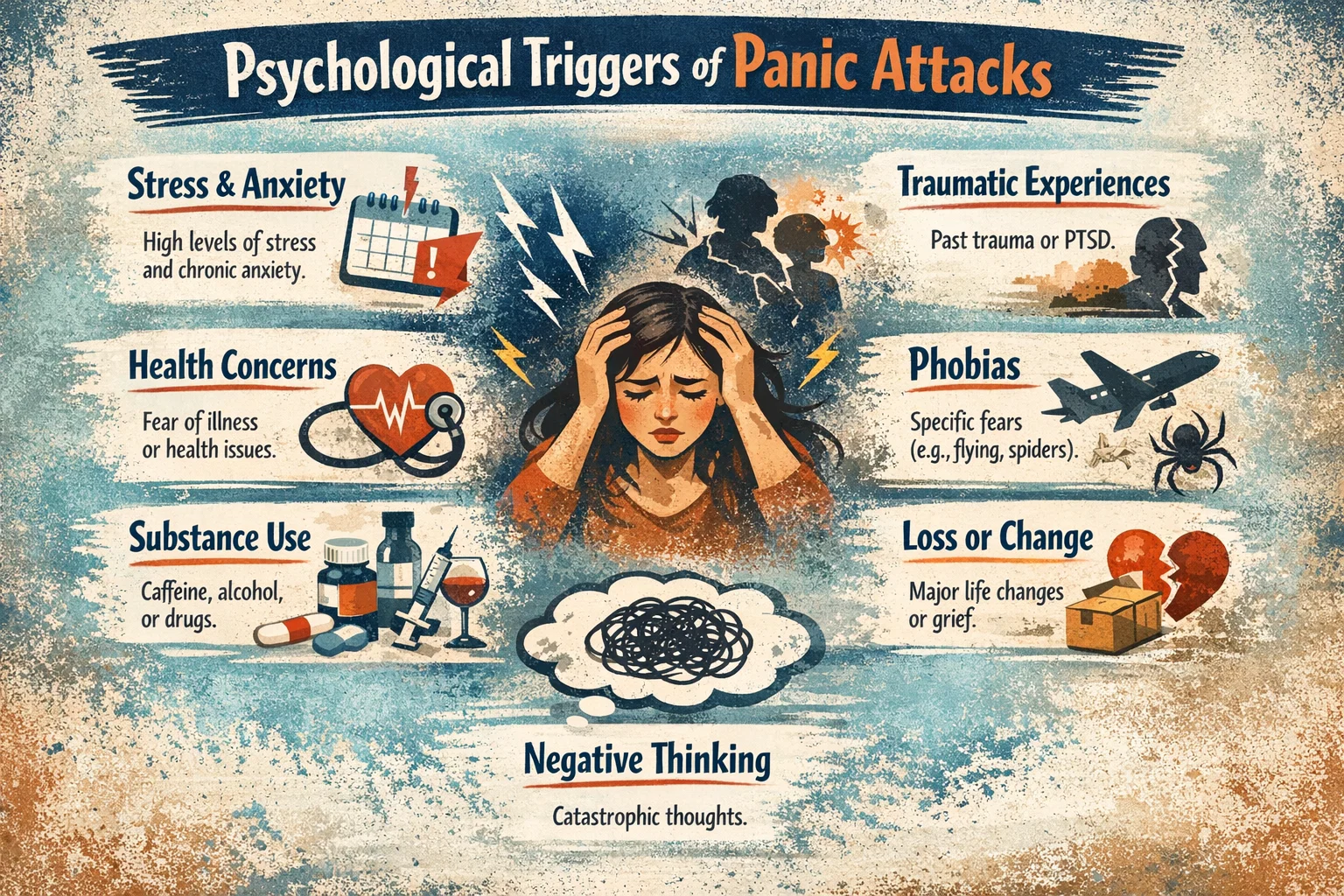
But panic attacks are not random. They arise from a specific and well-documented interplay of psychological, neurobiological, and experiential factors — factors that, when understood, become far less frightening and far more workable. This article maps those factors clearly, using both the neuroscience and the psychological frameworks that offer the most complete picture of what is actually happening when panic arrives.
What Is a Panic Attack?
A panic attack is a sudden episode of intense fear or discomfort that reaches a peak within minutes and is accompanied by a cluster of physical and psychological symptoms. The DSM-5 identifies thirteen characteristic symptoms, and a panic attack requires four or more of them:
These symptoms are real — not imagined, not exaggerated, not a sign of weakness. They are the direct physiological consequences of a nervous system in full threat activation: a body that believes, with complete conviction, that it is in danger and is mobilising every available resource to survive.
The problem is not that the system activated. The problem is that it activated when no real threat was present. A panic attack is the body’s emergency response system running a drill — at full intensity — in a context that didn’t call for it.
🔬 Important Distinction: Panic attacks can be expected (triggered by a known feared situation) or unexpected (arriving without an obvious trigger). The unexpected variety is what most people experience as most frightening — and understanding the psychological triggers below helps explain why “unexpected” attacks are rarely as random as they seem.
They Don’t Come From Nowhere
The experience of a panic attack arriving “out of nowhere” is understandable — but psychologically and neurologically, it is rarely accurate. What feels like a sudden onset is typically the visible peak of a process that has been building beneath the surface: a nervous system that has been under sustained pressure, a threat-detection system sensitised by history or current stress, and a body that has been accumulating activation that finally reaches the threshold for a full panic response.
The triggers are rarely single causes. They are more accurately understood as interacting vulnerabilities — biological, psychological, experiential, and situational — that lower the threshold at which the panic response activates. Understanding them doesn’t make panic attacks impossible. But it makes them comprehensible, less frightening in their apparent randomness, and — crucially — workable.
Trigger 1: Chronic Stress ⚡
Prolonged, sustained stress is one of the most significant contributors to panic attacks — and one of the most consistently underestimated. When stress is chronic rather than acute, the effects on the nervous system are qualitatively different from the short-term stress of a specific stressor.
Chronic stress — from work overload, financial pressure, relationship difficulty, life transitions, or sustained uncertainty — dysregulates the autonomic nervous system. The hypothalamic-pituitary-adrenal (HPA) axis becomes sensitised, producing elevated baseline cortisol. The amygdala — the brain’s threat-detection centre — is primed by this sustained activation to interpret ambiguous signals as threatening. Over time, the threshold for triggering the fight-or-flight response drops: stimuli that would previously have been processed as neutral are now assessed as potentially dangerous.
This means that when chronic stress has been elevated long enough, the body doesn’t need a large trigger to initiate a panic response. It needs only a small one. A racing heart from caffeine. A moment of breathlessness from hurrying. A shift in body temperature. Any internal sensation that gets processed by an already-primed amygdala as evidence of danger can be enough to set the cascade in motion.
| Common Chronic Stress Sources | How They Lower the Panic Threshold |
|---|---|
| Work overload, job insecurity, burnout | Sustained sympathetic activation; elevated cortisol baseline; reduced capacity to recover between stressors |
| Relationship conflict, isolation, loneliness | Loss of co-regulatory social support; chronic low-level threat activation from relational insecurity |
| Financial pressure and uncertainty | Persistent background anxiety priming the nervous system; anticipatory threat processing |
| Bereavement, loss, major life transitions | Grief and adjustment stress elevate physiological baseline; disrupted routine removes stabilising anchors |
Trigger 2: Past and Childhood Experiences 🧒
The nervous system is shaped by experience — and this shaping begins early. Childhood environments that involved trauma, neglect, loss, chronic unpredictability, emotional abuse, bullying, or inconsistent caregiving do not simply affect the child at the time. They calibrate the threat-detection system toward heightened sensitivity — because in those environments, heightened sensitivity was genuinely adaptive.
A child who grew up in a household where danger was unpredictable learns to scan constantly for warning signs. A child who was repeatedly told their feelings were wrong or excessive learns to distrust their own internal signals. A child whose nervous system was repeatedly overwhelmed without adequate comfort and co-regulation develops a threat-response system with a lower activation threshold — one that, in adulthood, fires in contexts that the person’s rational mind knows to be safe, but that the nervous system cannot yet distinguish from the original danger.
Unresolved trauma is particularly significant. Through the mechanism of classical conditioning, traumatic experiences can create associative links between neutral stimuli and the visceral fear response of the original event. A particular sound, smell, physical sensation, or interpersonal dynamic can unconsciously evoke the full physiological response of a past trauma — even decades later, even in objectively safe circumstances. This is one explanation for panic attacks that seem entirely disconnected from the present moment: the trigger is not in the present at all. It is in the past, activated by something the conscious mind didn’t register.
🌿 Worth Knowing: Recognising that past experiences contribute to current panic responses is not about blame — toward others or toward yourself. It is about understanding that your nervous system’s current behaviour made complete sense in its original context. That understanding is the foundation of genuine change — not through sheer willpower, but through the kind of therapeutic work that helps the nervous system update its threat-assessment with new, accurate information.

Trigger 3: Cognitive Patterns and Anxiety Sensitivity 🧠
How we interpret our internal experience — the meanings we assign to bodily sensations, the predictions we make about what symptoms mean — is one of the most powerful and most modifiable triggers of panic attacks.
The key concept here is anxiety sensitivity: a belief that the symptoms of anxiety are themselves dangerous. Not just uncomfortable — dangerous. The person with high anxiety sensitivity experiences a rapid heartbeat and thinks not “I’m anxious” but “something is wrong with my heart.” They experience dizziness and think “I’m going to faint” or “I’m losing my mind.” The sensation triggers a catastrophic interpretation, which triggers more anxiety, which intensifies the sensation, which confirms the catastrophic interpretation — a self-reinforcing spiral that can escalate from mild discomfort to full panic within minutes.
The Fear of Fear Loop
In panic disorder specifically, this process creates what clinicians call the “fear of fear” loop — one of the most clinically significant phenomena in anxiety treatment. The original panic attack, however it was triggered, creates a memory of intense fear associated with specific internal sensations. Going forward, those sensations — even in completely benign contexts — are interpreted as warnings of impending panic. The anticipation of panic becomes the trigger for panic. The person becomes afraid of their own nervous system.
| Cognitive Pattern | How It Triggers Panic |
|---|---|
| Catastrophic misinterpretation of sensations | “My heart is racing → I’m having a heart attack.” Normal physiological variation becomes evidence of catastrophe, triggering the full fear response. |
| Hypervigilance to bodily sensations | Constant internal monitoring means normal fluctuations are detected and flagged that others would never notice. The act of monitoring itself increases sensitivity. |
| Anticipatory anxiety | Worrying about when the next panic attack will arrive creates the physiological conditions (elevated cortisol, increased heart rate) that make it more likely — a self-fulfilling prediction. |
| Safety behaviours | Avoidance of situations previously associated with panic, or of sensations that might trigger panic. While reducing immediate anxiety, safety behaviours maintain the belief that the feared situation is genuinely dangerous — and prevent the learning that it is not. |
Trigger 4: Neurochemical Imbalances 🧪
Panic attacks do not exist only in the mind. They have a clear neurobiological substrate — and disruptions in the brain’s neurotransmitter systems are among the well-documented contributing factors.
Several key neurochemical systems are implicated:
| Neurotransmitter System | Role in Panic |
|---|---|
| GABA (gamma-aminobutyric acid) | The brain’s primary inhibitory neurotransmitter — responsible for calming neural activity. Low GABA function reduces the brain’s capacity to modulate the fear response, leaving the anxiety system with less “braking power.” This is why benzodiazepines (which enhance GABA function) produce rapid anxiety relief. |
| Serotonin | Plays a significant role in mood regulation and threat processing. Low serotonin availability is associated with increased anxiety sensitivity and reduced capacity to down-regulate the fear response — which is why SSRIs are a first-line treatment for panic disorder. |
| Norepinephrine (noradrenaline) | The primary neurotransmitter of the sympathetic nervous system’s arousal response. Elevated norepinephrine activity — as seen in panic disorder — amplifies the physical symptoms of fear and increases vigilance to threat signals. |
| Corticotropin-releasing hormone (CRH) | The brain’s primary stress-initiating hormone, released by the hypothalamus. Elevated CRH sensitivity — common in people with anxiety disorders and trauma histories — lowers the threshold for the full stress activation cascade. |
It is important to note that neurochemical factors and psychological factors do not operate independently. Chronic psychological stress changes neurochemistry. Traumatic experiences alter the functioning of the HPA axis and the amygdala’s threat-processing circuits. The relationship is bidirectional and continuous — which means that psychological interventions genuinely change neurochemistry, just as neurochemical changes affect psychological experience.
Trigger 5: Familial Predispositions 🧬
Panic disorder and anxiety more broadly have a documented genetic component. Research on twins suggests a heritability of approximately 40–48% for panic disorder — meaning that while environment plays a substantial role, biological predisposition is a genuine factor.
What is inherited is not a specific disorder but rather a set of temperamental and neurobiological vulnerabilities: a more reactive amygdala, a nervous system that responds more intensely to threat signals and takes longer to return to baseline, and a greater tendency toward what is called “behavioural inhibition” in childhood — wariness, sensitivity, and withdrawal in novel situations.
Having a parent or sibling with an anxiety disorder significantly increases risk — not through inevitability, but through the combination of shared genetic predisposition and the environmental modelling of anxious responses to threat. Children raised by anxious caregivers may learn, through observation and co-regulation (or its absence), that the world is more dangerous than it is, and that internal sensations warrant alarm rather than curiosity.
Understanding familial predisposition is useful not as a source of fatalism but as a piece of the picture — one that explains vulnerability without determining outcome. Genetic predisposition increases susceptibility; it does not create inevitability. Environment, skill, and therapeutic support are all meaningful modifiers.
Trigger 6: Somatic Interactions 💓
The mind and body are not separate systems. Physical health issues can directly precipitate or amplify panic attacks through two interconnected mechanisms: physiological activation and cognitive misinterpretation.
Several physical conditions produce symptoms that are easily misinterpreted as signs of catastrophe:
| Physical Condition | How It Can Trigger Panic |
|---|---|
| Cardiovascular irregularities | Palpitations, arrhythmias, or benign ectopic beats are interpreted as evidence of cardiac emergency — triggering the fear cascade that intensifies the very sensations being misread |
| Respiratory conditions | Asthma, hyperventilation patterns, or breathing difficulties heighten sensitivity to respiratory sensations — which are among the most common panic triggers |
| Thyroid dysfunction | Hyperthyroidism produces symptoms (racing heart, anxiety, sweating) that directly mimic and can precipitate panic; thyroid screening is recommended when panic attacks present without clear psychological precipitants |
| Hypoglycaemia | Low blood sugar produces trembling, sweating, heart racing, and lightheadedness — sensations that in an anxious or sensitised person can activate the panic response |
| Vestibular disorders | Dizziness, spatial disorientation, or balance difficulties — common in vestibular conditions — closely mimic the depersonalisation and dizziness of panic, and can activate or be activated by the panic cycle |
The concept of interoceptive sensitivity is central here — the degree to which a person is attuned to and affected by internal physical sensations. High interoceptive sensitivity, combined with a tendency toward catastrophic interpretation, creates a system highly susceptible to somatic triggering. A medical examination to rule out physical contributors is always a sensible first step when panic attacks first present.
Trigger 7: Emotional Suppression and Unresolved Conflict 🫙
Perhaps the most underappreciated psychological trigger of panic attacks is the habitual suppression of difficult emotions. When someone consistently pushes down anger, grief, shame, fear, or longing — when the emotional life has no outlet because expressing it feels too dangerous, too inconvenient, or too vulnerable — those emotions do not dissolve. They accumulate.
The body becomes the outlet. Panic, in this framework, functions as an “overflow valve” — the point at which suppressed emotional activation can no longer be contained and erupts through the body in the only form it has been given access to: physiological alarm.
This is one reason why panic attacks are so common in people who present as outwardly calm, highly functional, and apparently in control. The appearance of control is sometimes precisely the condition that makes panic necessary — the body expressing what the mind will not allow to be felt directly.
Research supports this connection. Emotional suppression — particularly the suppression of anger — is associated with elevated physiological arousal and increased sympathetic nervous system activation. Paradoxically, the effort of not feeling something requires significant physiological resources. The body pays the cost of suppression whether or not the mind acknowledges the emotion.

The Panic Cycle: How It Sustains Itself
Understanding individual triggers is important — but so is understanding how panic sustains itself once it has begun. The panic cycle is a self-reinforcing feedback loop in which each component amplifies the others:
The cycle has multiple intervention points — and effective treatment targets several of them simultaneously: the cognitive interpretation, the physiological response, the avoidance, and the underlying vulnerabilities that set the threshold low in the first place.
What Actually Helps
Panic attacks are among the most treatable presentations in mental health. With the right approach, the frequency and intensity of panic attacks can reduce dramatically — and many people move to a place where attacks are rare, brief, or no longer feared even when they do occur.
Cognitive Behavioural Therapy (CBT)
The most extensively evidenced treatment for panic disorder. CBT for panic directly targets catastrophic interpretation of sensations, anticipatory anxiety, and avoidance behaviours. A central component is interoceptive exposure — deliberately inducing the physical sensations associated with panic (through exercise, spinning, breathing exercises) in a controlled context, to build the evidence that the sensations are uncomfortable but not dangerous. Over time, this desensitises the fear response to the sensations themselves — breaking the cycle at its most fundamental link.
Breathing and physiological regulation
Slow, diaphragmatic breathing — particularly extending the exhale — directly activates the parasympathetic nervous system and provides a rapid intervention during an active panic attack. This is not simply calming advice: the extended exhale engages the vagal brake, signalling the body that it is safe and initiating the physiological down-regulation of the threat response. Practised regularly, paced breathing also reduces baseline sympathetic activation — lowering the threshold for future attacks.
Trauma-informed therapy
For panic attacks with roots in unresolved trauma or early childhood experiences, approaches including EMDR, somatic therapy, and attachment-focused therapy address the underlying nervous system calibration that standard CBT may not reach. Processing the original experiences that sensitised the threat system — rather than only managing the current symptoms — can produce deeper and more lasting change.
Emotional processing
For those whose panic is linked to emotional suppression, creating regular, supported space for difficult emotions — through therapy, journalling, creative expression, or trusted relationships — reduces the accumulation that eventually overflows into panic. The goal is not catharsis but a more permeable, flexible relationship with emotional experience: one in which feelings can be felt, acknowledged, and allowed to move through rather than being held and stored.
Addressing underlying vulnerabilities
Reducing chronic stress, improving sleep, moderating stimulant intake (caffeine, alcohol, which can both trigger and lower the threshold for panic), and building a consistent biological foundation are all meaningful contributors to reducing panic frequency — because they raise the activation threshold that previously sat so low.
✦ Key Takeaways
- Panic attacks are not random. They arise from an interplay of psychological, neurobiological, and experiential factors that lower the threshold for the body’s threat-activation response.
- The seven key psychological triggers are: chronic stress, past and childhood experiences, cognitive patterns and anxiety sensitivity, neurochemical imbalances, familial predispositions, somatic interactions, and emotional suppression.
- The “fear of fear” loop — in which the anticipation of panic becomes the trigger for panic — is one of the most important mechanisms in panic disorder and one of the most directly addressable through treatment.
- Emotional suppression is an underappreciated contributor: when difficult emotions have no outlet, the body becomes the outlet. Panic can be the physiological expression of feelings the mind will not allow.
- CBT, breathing techniques, trauma-informed therapy, and emotional processing all have strong evidence for reducing panic frequency and intensity. Panic disorder is among the most treatable presentations in mental health.
- Understanding your panic — its triggers, its cycle, its origins — does not make it disappear immediately, but it does make it less frightening. And less frightening is the beginning of less frequent.
Frequently Asked Questions
Can a panic attack actually harm me physically?
This is one of the most important questions to answer clearly, because the fear of physical harm is itself one of the most potent drivers of the panic cycle. Panic attacks are not physically dangerous. Despite the intensity of symptoms — the racing heart, chest tightness, breathing difficulties — a panic attack does not cause heart attacks, strokes, fainting (blood pressure actually rises during panic, making fainting unlikely), or any lasting physical damage. The symptoms are the physiological expression of fear, not signs of organ damage. This is why medical evaluation to rule out physical causes is valuable: once physical causes are excluded, the knowledge that the symptoms — however frightening — are not dangerous is a genuinely therapeutic piece of information.
Why do I get panic attacks in my sleep?
Nocturnal panic attacks — waking suddenly from sleep in a state of full panic — affect approximately 40–70% of people with panic disorder. They occur predominantly during the transition from stage 2 to stage 3 sleep (deep sleep) and are not triggered by nightmares or dreams. The current understanding is that they arise from the same physiological sensitisation as daytime panic — the nervous system activating the threat response in response to internal signals, even during sleep. They are distressing partly because of the disorientation of waking suddenly in panic, and partly because they remove sleep as a place of safety. They respond to the same treatments as daytime panic attacks.
Is panic disorder the same as having panic attacks?
Not exactly. A panic attack is a single episode — which can occur in a range of conditions (generalised anxiety, PTSD, phobias, stress) or as an isolated experience. Panic disorder is diagnosed when: the attacks are recurrent and unexpected; at least one attack has been followed by a month or more of persistent concern about future attacks or significant change in behaviour to avoid them; and the pattern is not better explained by another condition. Not everyone who has panic attacks has panic disorder — but the psychological treatment approaches are similar, and the triggers and cycle described in this article are relevant to both.
Will I always have panic attacks?
No — and this is worth saying firmly. Panic disorder has one of the highest treatment response rates of any anxiety condition. Research suggests that 70–90% of people with panic disorder who engage in appropriate treatment (particularly CBT) experience significant and lasting reduction in panic attack frequency and severity. Many people achieve full remission. Even for those who continue to experience occasional panic attacks, treatment typically transforms the relationship with panic — from something terrifying and unmanageable to something uncomfortable but not catastrophic, brief, and no longer capable of organising the avoidance of an entire life around it.
When should I see a doctor about panic attacks?
Any first-time panic attack — or panic attacks with new or unusual physical symptoms — warrants a medical evaluation to rule out physical causes including cardiac arrhythmias, thyroid dysfunction, hypoglycaemia, and respiratory conditions. Once physical causes have been excluded, a GP can provide a referral to psychological services, and a psychologist or therapist with experience in anxiety disorders is the recommended next step. If panic attacks are occurring frequently, significantly disrupting daily functioning, or leading to increasing avoidance of situations or activities, seeking professional support promptly — rather than waiting to see if things improve — is strongly recommended.
If you are experiencing panic attacks and would like to speak with someone, please reach out to your GP or a mental health professional. Effective support is available — and you don’t have to manage this alone.
Evidence-based wellness content to help you feel your best — body and mind. | The Whole You Wellness




Leave a Comment