


You haven’t done anything yet. The event hasn’t happened. And yet your heart is racing, your stomach is tight, and your mind is running worst-case scenarios on a loop. This is anticipatory anxiety — and understanding it is the first step to breaking free from it.
📅 May 18, 2026 | ⏱ 10 min read | 🧠 Mental Health
- What Is Anticipatory Anxiety?
- Why Your Brain Does This (The Neuroscience)
- Signs You’re Experiencing Anticipatory Anxiety
- The Most Common Triggers
- How It Affects Your Life Without You Realising
- 10 Evidence-Based Strategies to Manage It
- Why Avoidance Makes It Worse — and What to Do Instead
- When to Seek Professional Support
- Frequently Asked Questions
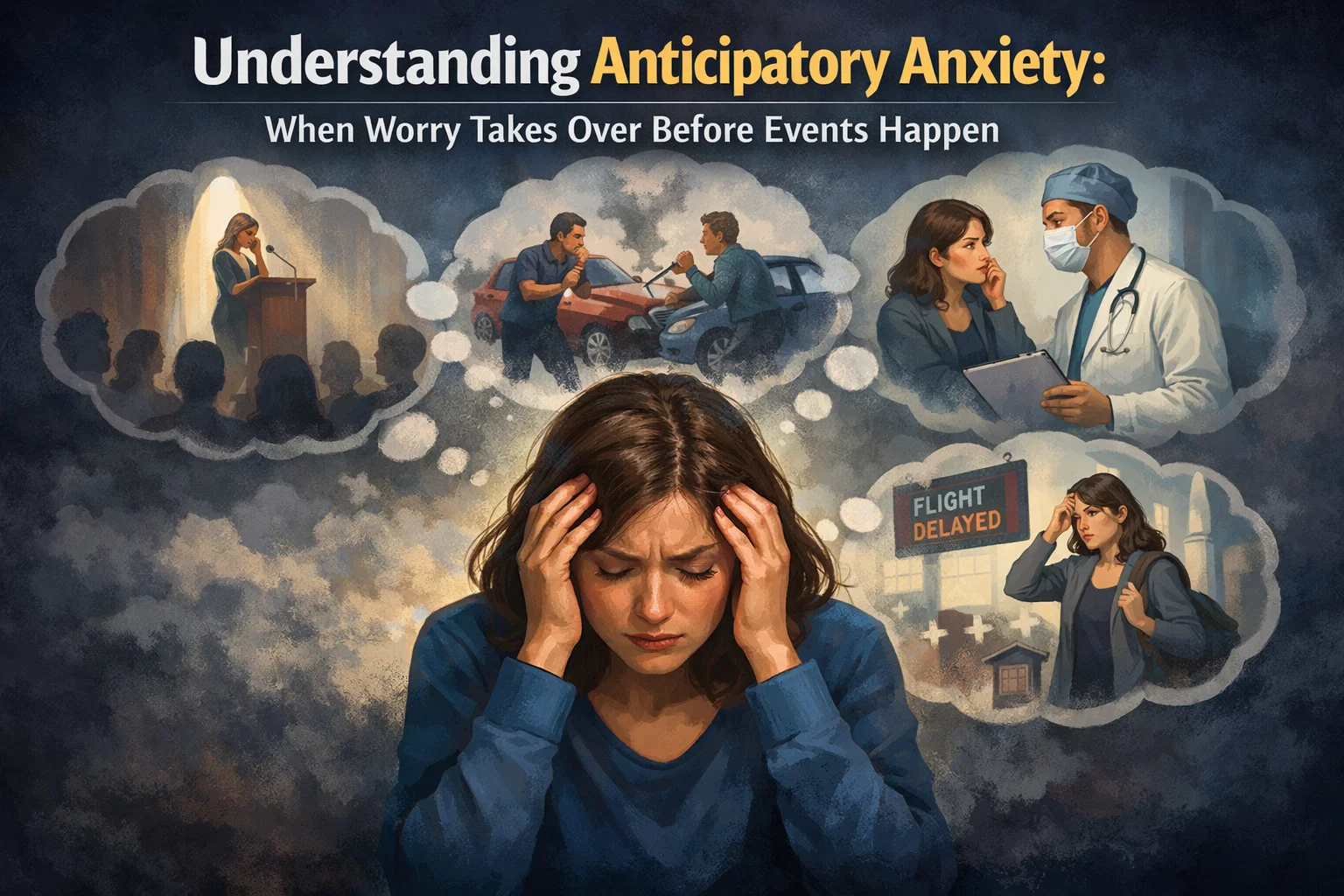
The job interview is two weeks away. The medical appointment is on Thursday. The difficult conversation you’ve been putting off is happening on Saturday. And from the moment each of these was scheduled, a low hum of dread has been running in the background of everything you do — colouring your mood, disturbing your sleep, making it hard to be present in your actual life.
This is anticipatory anxiety: anxiety not about what is happening, but about what might happen. It is, for many people, one of the most exhausting and debilitating forms of anxiety — not because the feared events are so terrible, but because the suffering begins so far in advance and persists so relentlessly.
The frustrating irony is that the thing you’re dreading often turns out to be far less awful than your brain predicted. You get through the interview. The medical result is manageable. The difficult conversation goes better than expected. And yet the next anticipated event arrives, and the cycle begins again.
Understanding why your brain does this — and what you can do to work with it rather than against it — is what this article is about.

What Is Anticipatory Anxiety?
Anticipatory anxiety is the experience of significant anxiety, dread, or fear in response to an upcoming event or situation — often well before that event occurs, and often disproportionate to the actual likelihood or severity of a negative outcome.
It is not a formal clinical diagnosis in itself, but rather a feature of several anxiety-related conditions — including generalised anxiety disorder (GAD), social anxiety disorder, panic disorder, health anxiety, specific phobias, and PTSD. It can also occur in people who don’t meet criteria for any clinical diagnosis but who have naturally anxious temperaments or have experienced traumatic or highly stressful events in the past.
What distinguishes anticipatory anxiety from ordinary pre-event nerves is its intensity, duration, and impact on daily functioning. Most people feel some nervousness before important events — a job interview, a first date, a medical procedure. Anticipatory anxiety is different in that it:
- Begins days, weeks, or even months before the event
- Occupies a disproportionate amount of mental bandwidth
- Often persists even when intellectual reassurance (“it will probably be fine”) is available
- Triggers physical symptoms — disturbed sleep, digestive upset, muscle tension, fatigue
- Can lead to avoidance of the feared situation entirely — often at significant personal cost
- Rarely resolves cleanly even after the event passes, because another anticipated event soon takes its place
🔬 Important Distinction: Anticipatory anxiety is future-focused — it’s about what might happen. This distinguishes it from general anxiety (which can attach to almost anything) and from rumination (which is past-focused, replaying what did happen). Many people experience all three, but each responds to different interventions. Knowing which pattern you’re in helps you choose the right tool.
Why Your Brain Does This: The Neuroscience
Anticipatory anxiety isn’t a personality flaw or a sign of weakness. It’s an output of a nervous system doing exactly what it evolved to do — just in a modern context it wasn’t designed for.
The Threat-Detection System
Your brain has a threat-detection and response system centred on the amygdala — a small, almond-shaped structure in your limbic system that acts as your personal alarm system. The amygdala’s job is to detect potential threats and trigger the appropriate physiological response (fight, flight, or freeze) before they materialise.
This system evolved to protect you from immediate physical threats — predators, hostile strangers, environmental dangers. In this context, anticipating a threat before it arrives is genuinely adaptive. The animal that noticed a predator’s movement in the bushes before the attack had a survival advantage over one that only responded when the predator struck.
The problem is that this same system now operates in a world full of social, psychological, and hypothetical threats — job loss, relationship conflict, social rejection, health concerns, financial insecurity — that are not resolved by fight or flight. The amygdala cannot distinguish between a lion and a looming presentation at work. It responds to both with the same cascade of stress hormones. And unlike the lion encounter, the presentation threat can be anticipated weeks in advance — giving the amygdala weeks of activation time.
The Prefrontal-Amygdala Imbalance
In people with elevated anticipatory anxiety, neuroimaging research consistently shows heightened amygdala reactivity paired with reduced effectiveness of the prefrontal cortex (PFC) — the rational, regulating part of your brain — in dampening amygdala output.
The PFC is supposed to evaluate the amygdala’s threat alarm, apply context and probability, and modulate the response. It’s the part of you that says: “Yes, the presentation is nerve-wracking, but I’m well-prepared, and even if it goes poorly, the consequences are survivable.” In highly anxious individuals, this PFC regulation is less efficient — the amygdala alarm sounds louder and longer, and the rational override is slower to engage.
Predictive Processing and Threat Simulation
Your brain is fundamentally a prediction machine. It is constantly building models of what will happen next based on past experience — and running simulations of potential futures to prepare appropriate responses. This is called predictive processing. For people with anxiety, the threat-prediction models are calibrated too sensitively — they weight negative outcomes too heavily, assign too much probability to worst-case scenarios, and generate simulations that feel more like previews of reality than speculative possibilities.
This is why anticipatory anxiety so often involves vivid, detailed mental rehearsals of things going wrong. Your brain isn’t tormenting you on purpose — it believes it’s preparing you. The tragedy is that these simulations generate real physiological stress responses, as if the feared events were actually occurring.
Signs You’re Experiencing Anticipatory Anxiety
Anticipatory anxiety manifests across four domains — cognitive, emotional, physical, and behavioural. Most people experience it in all four, though the balance varies between individuals:
| Domain | Common Signs |
|---|---|
| 🧠 Cognitive | Intrusive “what if” thoughts; worst-case scenario thinking; mental rehearsal of things going wrong; difficulty concentrating on anything other than the feared event; overestimating the probability of negative outcomes; underestimating your ability to cope if they occur |
| 💛 Emotional | Dread, foreboding, or doom; inability to feel joy about good things in the present because of looming worry; irritability; feeling “on edge” or unable to relax; a sense that something bad is inevitable |
| 🫀 Physical | Disturbed sleep (difficulty falling asleep or waking at 3–4am with worry); muscle tension (jaw, neck, shoulders); digestive upset; elevated heart rate; fatigue despite rest; headaches; loss of appetite or stress eating |
| 🚶 Behavioural | Seeking excessive reassurance from others; repeatedly checking plans, calendars, or information about the feared event; procrastinating on tasks related to it; avoiding making plans that feel risky; in severe cases, cancelling or avoiding the feared event entirely |
The Most Common Triggers
Anticipatory anxiety can attach to almost any future event — but certain categories trigger it more reliably and more intensely for most people:
| Trigger Category | Examples | What the Anxiety Is Usually About |
|---|---|---|
| Social situations | Presentations, parties, dates, meetings, job interviews, difficult conversations | Fear of embarrassment, rejection, judgement, or being perceived negatively |
| Health and medical | Test results, doctor appointments, procedures, symptoms that haven’t been explained yet | Fear of serious illness, pain, loss of control, or mortality |
| Performance and evaluation | Exams, performance reviews, competitions, creative submissions, auditions | Fear of failure, inadequacy, or consequences of not meeting expectations |
| Travel and transition | Flying, new places, life changes (moving, starting a job, ending a relationship) | Fear of the unknown, loss of control, or something going catastrophically wrong |
| Relationship and conflict | Difficult conversations, confrontations, relationship milestones, potential loss | Fear of rejection, abandonment, conflict escalation, or relationship damage |
How It Affects Your Life Without You Realising
One of the most insidious aspects of anticipatory anxiety is that its costs extend well beyond the immediate suffering. Over time, it quietly reshapes how you live — often in ways you don’t consciously attribute to anxiety:
- You stop making plans. If booking a flight generates a month of dread, you stop booking flights. If making social plans creates anxiety about cancelling, you stop making social plans. Your world gradually shrinks — not through dramatic decisions, but through incremental avoidance.
- You can’t enjoy the present. A holiday that should be joyful is shadowed by anxiety about the flight home. A good day is contaminated by awareness of the difficult week approaching. The capacity to experience genuine present-moment pleasure is steadily eroded.
- Your relationships suffer. Anticipatory anxiety makes you irritable, distracted, and emotionally unavailable in the days or weeks before feared events. The people around you bear the cost of a fear they may not even know you’re carrying.
- It compounds over time. Avoidance provides short-term relief but long-term amplification. Each time you avoid a feared situation, your brain receives confirmation that the situation was genuinely dangerous enough to avoid — making the anxiety more intense next time.
- It interferes with performance. The cognitive resources consumed by anticipatory worry are resources unavailable for actual preparation and performance. You may be so consumed by imagining failure that you underinvest in the preparation that would reduce it.

10 Evidence-Based Strategies to Manage Anticipatory Anxiety
These strategies are drawn from cognitive-behavioural therapy (CBT), acceptance and commitment therapy (ACT), mindfulness-based approaches, and neuroscience research on anxiety regulation. They are not quick fixes — they are skills that improve with practice.
1. Name It to Tame It
Research by neuroscientist Dr. Matthew Lieberman at UCLA found that simply labelling an emotion — putting it into words — measurably reduces amygdala activation. When you notice anticipatory anxiety, name it explicitly: “I am feeling anticipatory anxiety about Thursday’s appointment.” This activates the prefrontal cortex and reduces the emotional intensity of the experience. It sounds almost too simple — and yet the evidence for affect labelling is robust and replicable.
2. Externalise Your Worry — Write It Down
Anxious thoughts gain power from cycling repeatedly through your working memory. Writing them down removes them from the loop. Spend 10–15 minutes writing freely about exactly what you’re afraid will happen — the specific feared outcome, the emotions attached to it, and what it would mean to you. Research shows this process reduces the cognitive load of worry and often reveals that the fear is more manageable in written form than it felt in your head.
Then, separately, write your answers to these three questions: What’s the realistic probability this feared outcome actually occurs? If it does occur, what will I do? What evidence suggests I can handle this?
3. Distinguish Productive from Unproductive Worry
Not all worry is created equal. Productive worry leads to concrete action — identifying a problem, making a plan, taking a step. Unproductive worry runs in circles: imagining bad outcomes without moving toward any resolution. When you notice yourself worrying, ask: Is there an action I can take right now? If yes, take it. If no, the worry is unproductive — and continuing to engage with it generates suffering without benefit. This distinction is the foundation of most CBT approaches to generalised anxiety.
4. Schedule Your Worry
This CBT technique sounds counterintuitive — but it works. Designate a specific 15–20 minute “worry window” each day — same time, same place, outside the bedroom. When anxious thoughts arise outside this window, acknowledge them (don’t suppress them) and consciously redirect: “I’ll think about this during my worry time.” During the worry window, engage fully with the concern. Outside it, practise redirecting.
This technique works because it gives anxiety a legitimate outlet while preventing it from colonising your entire day. Over time, it also reduces the urgency of anxious thoughts — they become something you’ll attend to, rather than something demanding immediate attention.
5. Challenge Catastrophic Thinking
Anticipatory anxiety almost always involves cognitive distortions — automatic, inaccurate thought patterns that amplify the perceived threat. The most common in anticipatory anxiety:
- Catastrophising: Assuming the worst possible outcome is the most likely outcome
- Fortune telling: Treating an imagined future as a certainty
- Probability overestimation: Dramatically overestimating the likelihood of negative events
- Emotional reasoning: “I feel like something terrible will happen, therefore something terrible will happen”
- Minimising coping ability: “Even if it goes wrong, I won’t be able to handle it”
For each distortion, ask: What is the evidence for and against this thought? What would I say to a close friend who was thinking this? What’s the most realistic (not most optimistic) outcome?
6. Physiological Calming — Breathe First
When the anticipatory anxiety response is active, your physiological state amplifies every anxious thought. Trying to reason your way out of anxiety while your nervous system is in threat mode is fighting biology. Regulate the body first, then engage the mind.
The 4-7-8 breathing technique: inhale for 4 counts, hold for 7, exhale slowly for 8. The extended exhale activates the vagus nerve and parasympathetic nervous system — counteracting the fight-or-flight response within minutes. Do 4–6 cycles before attempting to engage with any anxiety-management technique. This is not optional preparation — it’s the physiological prerequisite for effective cognitive work.
7. Reduce Uncertainty by Preparing — Strategically
Anticipatory anxiety is strongly driven by uncertainty. Where uncertainty is reducible, reducing it is adaptive and healthy — not avoidance. Identify specifically what you can control or prepare and do that preparation thoroughly. Research the medical procedure. Practise the presentation. Plan your route. Prepare what you’ll say in the difficult conversation.
The critical qualification: preparation should be purposeful and finite. Research the flight safety statistics once — not seventeen times. Practise your presentation three times — not until 2am the night before. Beyond a certain point, more preparation does not reduce anxiety; it feeds it. Set a deliberate limit on preparation activities and stop when you’ve reached it.
8. Practise Present-Moment Grounding
Anticipatory anxiety is, by definition, a time-travel problem. Your body is in the present, but your mind is in a feared future. Grounding techniques interrupt this and return you to now.
The 5-4-3-2-1 technique: Name 5 things you can see, 4 you can physically feel (your feet on the floor, the texture of your clothing), 3 you can hear, 2 you can smell, 1 you can taste. This deliberately redirects sensory attention to the present moment and interrupts the mental simulation of future catastrophe. It sounds simple. It works because sensory attention and future-oriented worry genuinely cannot occupy the same cognitive space simultaneously.
9. Practise Acceptance — Not Resignation
Acceptance and Commitment Therapy (ACT) offers a particularly powerful reframe for anticipatory anxiety: the problem is not the presence of anxious thoughts — it’s your relationship to them. The more you fight, suppress, or try to eliminate anxious thoughts, the more psychological energy they consume and the more power they accumulate. The attempt to not think about something requires constant cognitive monitoring of the very thing you’re trying not to think about.
Acceptance means allowing anxious thoughts to exist without treating them as facts, dangers, or commands. You notice them: “I’m having the thought that the appointment will bring bad news.” You observe them with distance rather than immersion. You do not have to believe them, obey them, or eliminate them — you simply allow them to pass through, like weather, while you continue doing what matters to you.
This is not passive resignation. It is an active, practiced skill — and it has strong evidence for reducing the suffering associated with anxiety without requiring the impossible task of eliminating the thoughts themselves.
10. Gradually Expand Your Comfort Zone
This is the long game — and the most important one. The only way to sustainably reduce anticipatory anxiety is to accumulate evidence, through lived experience, that the feared situations are survivable and often far less catastrophic than predicted. This is called exposure — and it is the most effective psychological intervention for anxiety disorders ever studied.
You don’t need a formal exposure programme. You simply need to gently, persistently resist avoidance. Book the appointment. Have the conversation. Attend the event — even feeling anxious, even imperfectly, even if it goes badly. Each time you face a feared situation and survive it — which you almost certainly will — your amygdala’s threat model is updated. Over time, the alarm sounds less loudly, the anticipatory period shortens, and the feared event becomes less formidable.
💡 The Prediction Log: Keep a simple record of feared events and their actual outcomes. Before each feared event, write down your worst-case prediction and your estimate of how you’ll feel afterward. After the event, record what actually happened. Over time, this log becomes powerful empirical evidence against your brain’s catastrophic predictions — evidence from your own life, which is far more persuasive than generic reassurance.
Why Avoidance Makes It Worse — and What to Do Instead
Avoidance is the most natural response to anticipatory anxiety — and the most counterproductive one. When you avoid a feared situation, several things happen:
- Immediate relief, which powerfully reinforces the avoidance behaviour (making it more likely next time)
- Confirmation of the threat — your brain interprets avoidance as evidence that the situation was genuinely dangerous enough to escape
- Maintenance of the anxiety — the feared situation is never tested against reality, so the catastrophic prediction is never disconfirmed
- Narrowing of your life — opportunities, relationships, and experiences are sacrificed to the management of a threat that may never materialise
The alternative to avoidance is not fearlessness — it’s willingness. The goal is not to eliminate anxiety before facing feared situations. It’s to act despite anxiety, consistently enough that the anxiety eventually diminishes through accumulated experience. Courage, in this context, is not the absence of fear. It’s taking the action your values require while fear is present.
⚠️ Safety Behaviours: Subtle forms of avoidance — called safety behaviours — can be just as maintaining as outright avoidance. Bringing a “support person” everywhere, always sitting near the exit, obsessively over-preparing, speaking very quietly to avoid attention, saying yes to avoid conflict — these reduce immediate discomfort but prevent the full exposure that would extinguish the anxiety. Over time, they become part of the anxiety maintenance cycle.

When to Seek Professional Support
The strategies in this article are powerful tools for managing anticipatory anxiety — but they are not substitutes for professional support when anxiety has become severe, persistent, or significantly impairing. Seek help from a therapist or doctor if:
- Your anticipatory anxiety is significantly interfering with work, relationships, or quality of life
- You’re avoiding important situations, opportunities, or relationships because of anxiety
- Physical symptoms (sleep disruption, digestive problems, chronic tension) are persistent and distressing
- The anxiety is accompanied by depression, hopelessness, or thoughts of self-harm
- Self-help strategies have been consistently applied for several weeks without meaningful improvement
- The anxiety is escalating over time rather than remaining stable or improving
Cognitive Behavioural Therapy (CBT) is the most extensively researched and most effective psychological treatment for anxiety disorders — with a strong evidence base for the specific patterns (catastrophising, avoidance, safety behaviours) that drive anticipatory anxiety. A course of CBT typically runs 8–16 sessions and produces lasting results in the majority of people who engage with it.
Acceptance and Commitment Therapy (ACT) is particularly well-suited to anticipatory anxiety because it directly addresses the relationship between thoughts and behaviour — teaching you to act on your values rather than your fears, even in the presence of anxious thoughts.
Medication (particularly SSRIs) can also be appropriate for moderate to severe anxiety — most effectively in combination with therapy rather than as a standalone treatment.
✦ Key Takeaways
- Anticipatory anxiety is anxiety about a future event — driven by an overactive threat-detection system that cannot distinguish between real and imagined danger.
- It is not a character flaw. It is a nervous system pattern that can be understood, worked with, and significantly reduced.
- Avoidance is the single biggest maintaining factor. Every avoided situation strengthens the anxiety. Every faced situation — however imperfectly — weakens it.
- Regulate your body first (breathing), then your thoughts (cognitive reframing, worry scheduling, acceptance). Trying to reason your way out of anxiety without first calming the physiology is fighting against biology.
- Keep a prediction log. Your brain’s worst-case forecasts are almost always wrong — but you need your own evidence to believe it.
- The goal is not to eliminate anxiety before acting — it’s to act while anxious, consistently, until the anxiety diminishes through accumulated experience.
- Seek professional support (CBT or ACT with a therapist) if anticipatory anxiety is significantly impairing your life. It is highly treatable.
Frequently Asked Questions
Is anticipatory anxiety the same as generalised anxiety disorder?
Anticipatory anxiety is a feature of GAD but not identical to it. GAD involves persistent, excessive worry about a wide range of life domains that is difficult to control and associated with physical symptoms and functional impairment — and anticipatory anxiety about future events is a core component. However, anticipatory anxiety also occurs in social anxiety disorder, specific phobias, health anxiety, panic disorder, and in people who don’t meet criteria for any clinical diagnosis. Think of anticipatory anxiety as a pattern that can exist within or independently of clinical anxiety disorders.
Why does anticipatory anxiety often feel worse than the actual event?
Because your brain’s predictive models are calibrated toward worst-case scenarios — and the simulations feel real. When the actual event occurs, several things happen: you’re no longer predicting, you’re doing; your attention narrows to the immediate task rather than running catastrophic scenarios; and your coping resources, which anxiety systematically underestimates, become active. Research consistently confirms that people overestimate how bad they’ll feel during feared events and underestimate their ability to cope — a phenomenon called the “impact bias” and “durability bias” in affective forecasting research.
Can anticipatory anxiety cause physical symptoms?
Yes — and these are among the most distressing aspects of the condition. The anticipatory anxiety response activates the same physiological stress cascade as immediate fear — elevated cortisol and adrenaline, increased heart rate, muscle tension, altered digestion, disrupted sleep. When sustained over days or weeks, these effects accumulate meaningfully: chronic muscle pain (particularly in the neck, jaw, and shoulders), IBS-like digestive symptoms, fatigue, headaches, and immune suppression. These are not “just psychological” — they are real physiological effects of a chronically activated stress response.
Does anticipatory anxiety ever go away on its own?
In some cases — particularly when triggered by a specific, time-limited stressor — anticipatory anxiety resolves naturally once the event passes. But for many people, especially those with a more chronic anxious temperament or underlying anxiety disorder, new anticipated events quickly take the place of the resolved one, and the pattern continues indefinitely without active intervention. The good news is that with the right tools — particularly graduated exposure to feared situations — the anxiety pattern becomes less intense and less persistent over time. It rarely requires zero effort to maintain.
What’s the difference between anticipatory anxiety and intuition?
This is one of the most common and most important questions people with anxiety ask. The distinction is not always clean, but some useful markers: intuition tends to arise quickly and quietly, without the cognitive elaboration and “what if” chaining of anxiety; it tends to be specific rather than generalised; and it’s usually accompanied by calm certainty rather than fearful urgency. Anticipatory anxiety, by contrast, tends to attach to multiple possible outcomes, generates vivid worst-case scenarios, persists despite evidence to the contrary, and is accompanied by physiological arousal. If a thought feels urgent, catastrophic, and repetitive — it’s almost certainly anxiety, not intuition.
Can mindfulness make anticipatory anxiety worse?
For most people, mindfulness — particularly when practised consistently — significantly reduces anticipatory anxiety by training the capacity to observe thoughts without fusing with them. However, a small proportion of people, particularly those with trauma histories, experience increased distress when directed to focus inward during formal meditation. If this resonates for you, open-monitoring mindfulness (observing the external environment rather than internal experience), walking meditation, or mindful movement may be better entry points than breath-focused sitting practice. Always go at a pace that feels manageable, and seek guidance from a trauma-informed therapist if needed.
Will my child grow out of anticipatory anxiety?
Anxiety is common in children and adolescents, and many children do show reduced anxiety as their nervous system matures and their coping skills develop. However, untreated anxiety in childhood tends to persist and escalate rather than resolve spontaneously — and avoidance behaviours, if reinforced by well-meaning parental accommodation, can become deeply entrenched. Early intervention (play therapy and CBT adapted for children, school-based support) produces far better outcomes than watchful waiting. If your child’s anxiety is causing significant distress or avoidance of normal activities, consultation with a child psychologist is appropriate.
If you are experiencing significant anxiety and would like support, please reach out to a mental health professional or contact a crisis line in your country. You don’t have to manage this alone.
Evidence-based wellness content to help you feel your best — body and mind. | The Whole You Wellness

Leave a Comment