


Your first thought is rarely your most helpful one. Here’s how to get to the one that actually helps.
📅 March 20, 2026 | ⏱ 7 min read | 🧠 Mental Health
Your First Thought Isn’t Always the Truth
You’re upset. Something happened. And immediately, before you’ve even had time to breathe, a thought arrives:
“She did that on purpose.”
“No one cares about me.”
“I always mess everything up.”
These thoughts feel very true in the moment. They feel like facts. But they’re not facts — they’re reactions. They’re your emotional brain firing at full speed, doing what it does: protecting you, warning you, trying to make sense of something that hurt.
The problem is, when we live inside those first reactions — when we write them down, repeat them, and build a whole story out of them — they don’t help us feel better. They just keep us in the pain.
That’s where emotional reframing comes in.
So What Is Emotional Reframing? 🔄
Emotional reframing is simply this: choosing better words for what you feel.
Not fake words. Not pretending you’re fine when you’re not. Not toxic positivity dressed up as self-help.
Just a small, honest shift — from the harsh, reactive version of the thought to a clearer, more accurate one.
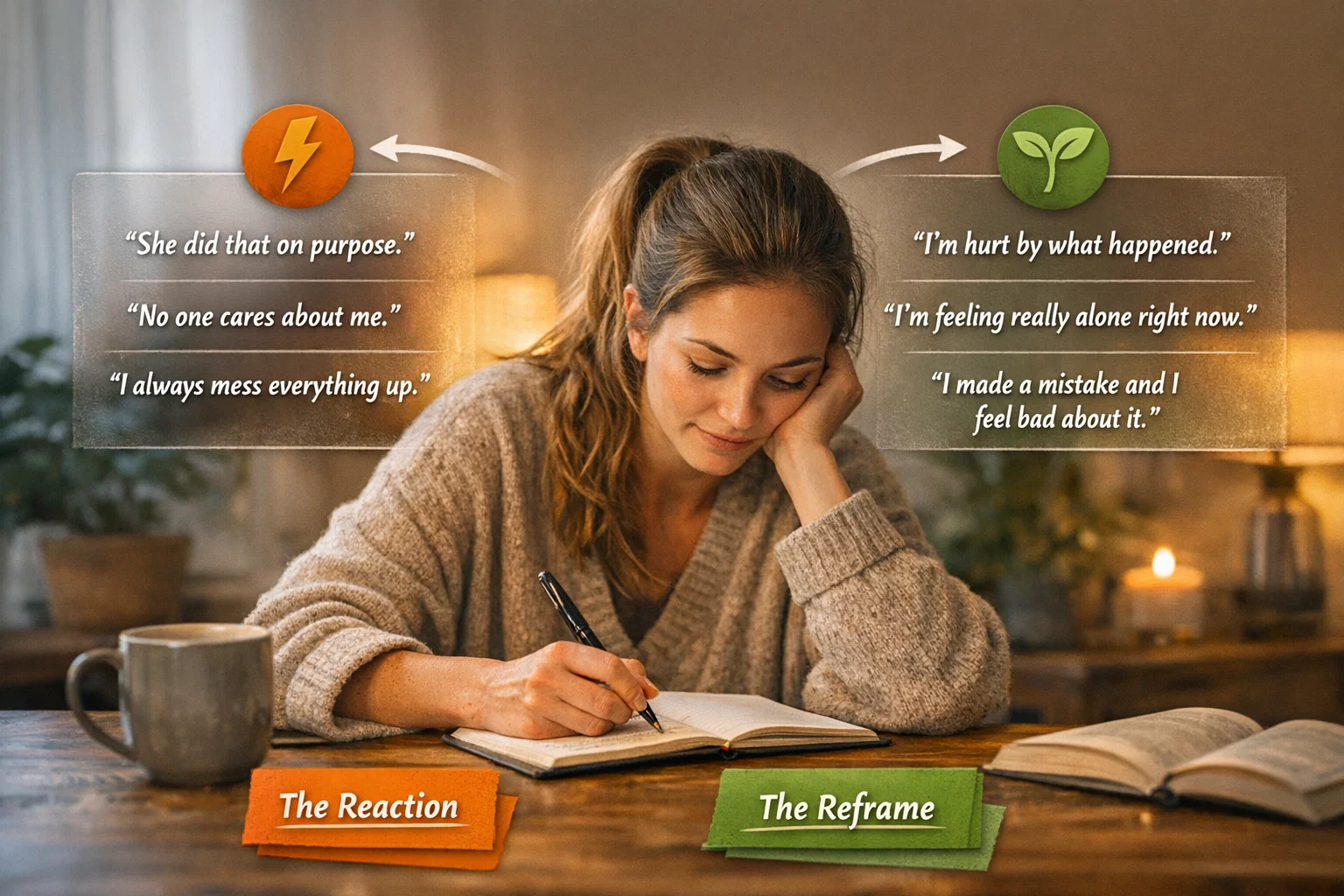
⚡ The Reaction
“She did that on purpose.”
“No one cares about me.”
“I always ruin everything.”
🌱 The Reframe
“I’m hurt by what happened.”
“I’m feeling really alone right now.”
“I made a mistake and I feel bad about it.”
See the difference? The reframed version is still honest. It doesn’t deny the pain. But it’s more specific, more grounded — and it leaves space for something to actually change, instead of just spiralling.
Why Are Our First Thoughts So Harsh?
This is worth understanding — because it helps you stop taking your reactive thoughts so seriously.
When something painful happens, your brain doesn’t stop to gather evidence. It reacts. Its job in that moment is to protect you — to identify the threat, assign blame, and generate a response fast. So it reaches for the broadest, most extreme interpretation it can find:
Everyone. No one. Always. Never. They did it on purpose. It’s all my fault.
These sweeping statements feel certain because the brain delivers them with certainty. But they’re not careful observations. They’re alarm bells. And alarm bells are not designed to be accurate — they’re designed to be loud.
Once you understand that, you can start to hear the alarm without obeying it.
A useful question to ask yourself: “Is this what I actually think — or is this what I feel in this moment?” Both matter. But they’re not the same thing.
Your Journal Isn’t Just a Place to Vent 📓
When people say “write your feelings down,” they usually mean it in a general way. And writing is genuinely helpful — getting things out of your head and onto a page creates distance between you and the thought. That distance alone can bring relief.
But there’s a more powerful version of journalling — and it only takes one small step further.
Instead of just recording the reaction, you slow down and ask: what am I actually feeling here? What actually happened? What do I actually need?
This is writing for clarity, not just reaction.
| Writing for reaction | Writing for clarity |
|---|---|
| Dumps every thought as it arrives | Slows down to examine the thought |
| Uses extreme language: always, never, everyone | Gets specific: this person, this moment, this feeling |
| Assigns blame outward or inward | Names the feeling without a verdict |
| Keeps you in the feeling | Helps you move through it |
| Leaves you feeling more overwhelmed | Leaves you feeling more understood — by yourself |
Both are valid starting points. But the second one takes you somewhere. The first one often just circles back to where you started.
How to Actually Do It — Simply
You don’t need a special journal. You don’t need a therapy session. You just need a few honest questions and the willingness to slow down for two minutes.
Here’s a simple three-step reframing process you can use anytime:
Write the raw thought — but label it
Write exactly what came up. Don’t edit it. But add three words before it: “I notice I’m thinking…” — “I notice I’m thinking no one cares about me.” That small label reminds your brain that this is a thought, not a fact.
Ask: what am I actually feeling?
Under every harsh thought is a real feeling. Hurt. Fear. Loneliness. Shame. Disappointment. Get specific about the emotion — because naming it accurately is the beginning of being able to do something about it.
Ask: what do I need?
This is the most useful question you can ask yourself — and the one most people skip. What would help right now? To talk to someone? To have space? To be heard? To understand what actually happened? Knowing your need gives you somewhere to go.
Real Examples — Before and After 💬
Let’s see what reframing actually looks like in everyday moments:
Notice what changes in every reframe: the statement becomes more honest, less absolute, and it opens a door. It moves you from “this is the verdict” to “here is what’s actually happening — and here’s what I might do next.”
What Reframing Is NOT ✋
This is important — because emotional reframing is sometimes confused with things it isn’t.

Journal Prompts to Try 📝
Next time something upsets you, try working through one of these instead of just venting:
- What actually happened? (Just the facts — no interpretation yet.)
- What was my first reaction — and what emotion is underneath it?
- What am I actually feeling right now? (Choose one word: hurt, scared, embarrassed, lonely, angry, sad.)
- Is there another way to see this situation that I haven’t considered?
- What do I need right now? (Not what you want to happen to the other person — what do you need?)
- What would I tell a friend who came to me with this exact feeling?
You don’t have to answer all of them. Even one honest answer is enough to shift the direction of the thought.
✦ What to Remember
- Your first thought is a reaction — not a verdict. It is loud, not accurate.
- Emotional reframing is simply choosing more honest, more specific words for what you feel.
- It doesn’t mean pretending you’re fine. It means getting clear on what you’re actually feeling — and what you actually need.
- Your journal is not just a place to vent. It is a place to make sense of things — to move through feelings rather than around them.
- Write for clarity, not just reaction. One honest reframe can change the entire direction of your day.
- You are not your first thought. You are the person who gets to choose what comes next. 🌱
💛
Write for clarity, not just reaction.
Your feelings deserve to be understood — by you, first. Give them the right words, and they’ll show you the way through.
Evidence-based wellness content to help you feel your best — body and mind. | The Whole You Wellness



Leave a Comment