

Anger is the emotion we’re most taught to suppress — and the one we understand least. Yet it’s one of the most neurologically complex, evolutionarily ancient, and psychologically informative experiences a human being can have. Here’s what anger actually is, what it’s trying to tell you, and how to work with it rather than against it.
📅 June 1, 2026 | ⏱ 11 min read | 🧠 Mental Health
- What Is Anger? A More Complete Definition
- The Neuroscience: What Happens in the Brain
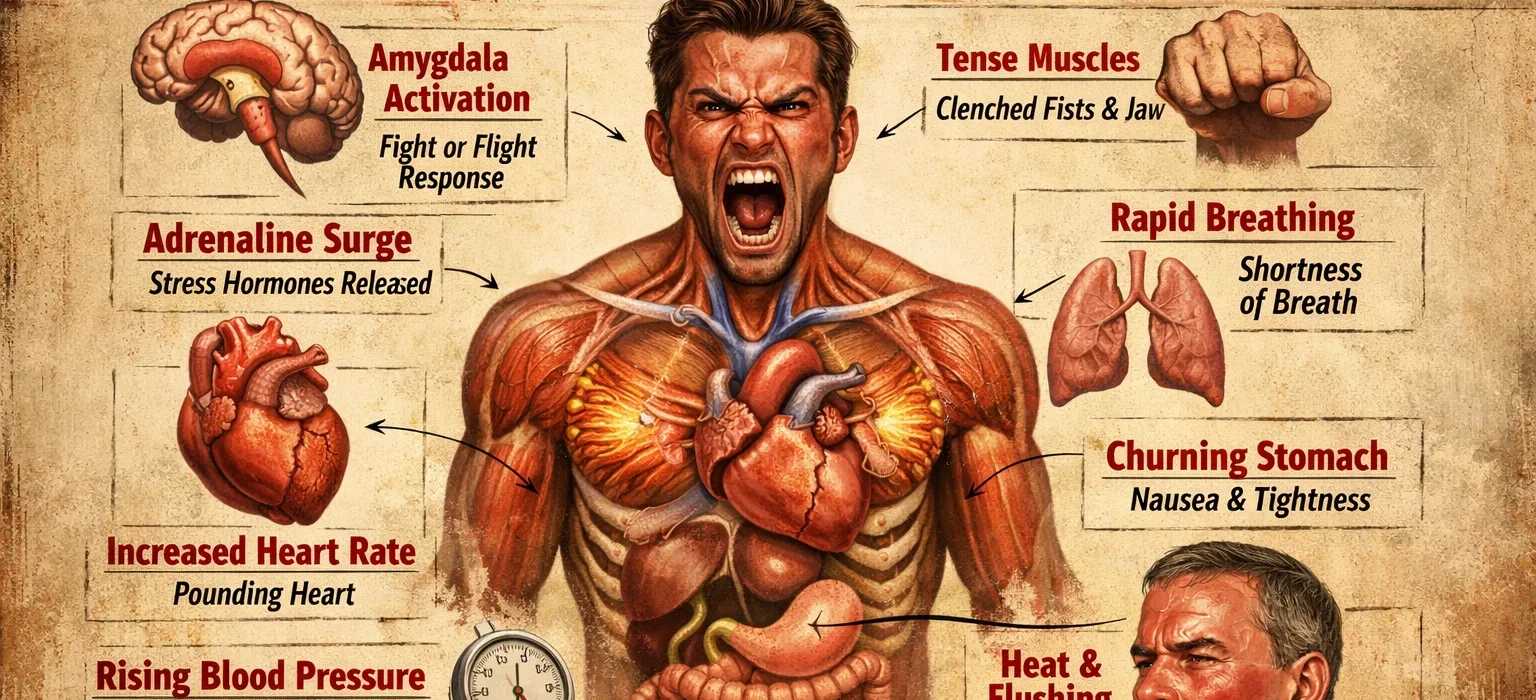
- The Body in Anger: A Head-to-Toe Physiological Cascade
- The Spectrum of Anger: Not All Anger Is the Same
- What Your Anger Is Actually Telling You
- The Four Great Myths About Anger
- What Chronic Anger Does to Your Health
- How to Process Anger Effectively
- Communicating Anger Without Destroying Relationships
- Frequently Asked Questions
We are taught, from remarkably early in life, that anger is a problem to be managed, suppressed, or eliminated. “Don’t be so angry.” “Calm down.” “You’re overreacting.” The message arrives through parents, schools, workplaces, and cultural norms — and it is almost always the same: anger is dangerous, unbecoming, or a sign of weakness.
The neuroscience, evolutionary biology, and psychology of anger tell a radically different story. Anger is not a character flaw. It is one of the most ancient, universal, and informationally rich signals in the human emotional repertoire. It evolved because it was useful — profoundly useful, in fact — and it continues to carry important messages about boundaries, values, threats, and injustice that are worth hearing rather than silencing.
The problem is not anger itself. The problem is that most of us were never taught what anger actually is, what it’s for, or how to engage with it skillfully. We were taught either to suppress it (swallow it down, keep it professional, don’t make a scene) or to express it impulsively (say what we feel, in the moment, at full volume). Neither approach serves us — or the people around us.
This article gives you the complete picture: the neuroscience, the physiology, the evolutionary function, the varieties of anger, the myths that surround it, and a practical framework for processing and communicating it in ways that actually work.

What Is Anger? A More Complete Definition
Anger is a discrete negative emotion characterised by a perceived threat, frustration, or injustice — accompanied by a motivational drive toward approach rather than avoidance. This last element is crucial and often overlooked: unlike fear, which motivates withdrawal, anger motivates engagement. It is approach-oriented — it moves you toward the source of the threat or injustice, with energy and intention.
Psychologist Paul Ekman’s landmark cross-cultural research identified anger as one of six universal basic emotions — present in every human culture ever studied, with consistent facial expressions that are recognised across cultures with no prior exposure to each other. This universality is a powerful indicator of evolutionary significance. Anger is not a social construction or a cultural artefact. It is a deeply conserved biological signal.
At its functional core, anger serves as:
- A boundary signal — communicating that a limit has been crossed, a value has been violated, or a need has gone unmet
- A threat response — mobilising energy and resources to confront, challenge, or resist a perceived source of harm
- A justice signal — alerting you (and sometimes others) to perceived unfairness, wrongdoing, or moral violation
- A motivational force — providing the energy and drive to change situations that are genuinely unacceptable
- A communication tool — in social contexts, signalling to others that a line has been crossed and that continuation has consequences
None of these functions are pathological. All of them can become problematic when anger is expressed without skill, escalates beyond proportion, or is directed toward the wrong target — but the anger itself is not the pathology. The emotion is information. What you do with that information is the skill.
🔬 Evolutionary Note: Anger predates language, complex social organisation, and conscious deliberation by hundreds of millions of years. The neural circuitry that produces anger is found in all vertebrates — fish, reptiles, birds, and mammals all exhibit anger-like responses to threat and frustration. In humans, this ancient circuitry is layered beneath, and often in tension with, the more recently evolved prefrontal cortex that regulates it. This tension is the source of much of what humans experience as emotional struggle.
The Neuroscience: What Happens in the Brain
Anger is produced by a complex, distributed neural network — not a single “anger centre” — that involves multiple brain regions operating in rapid, often unconscious sequence.
The Amygdala: First Responder
The process almost always begins in the amygdala — your brain’s threat-detection hub, located deep in the temporal lobe. The amygdala receives sensory and social information (a cutting remark, an aggressive gesture, an unjust outcome) and evaluates it for threat relevance in milliseconds — before you are consciously aware of it.
When the amygdala detects a threat, frustration, or perceived injustice, it initiates a cascade of neural and hormonal signals — the beginning of the anger response. Crucially, this evaluation occurs before the prefrontal cortex (your rational, deliberating brain) has received and processed the same information. The amygdala is faster — which means your body can be in the early stages of an anger response before you’ve consciously decided to be angry.
The Hypothalamus: Mobilising the Body
Amygdala activation rapidly recruits the hypothalamus, which acts as the brain’s command centre for physiological regulation. The hypothalamus triggers the sympathetic nervous system and the HPA (hypothalamic-pituitary-adrenal) axis — initiating the hormonal cascade that produces the characteristic physiology of anger (adrenaline, noradrenaline, cortisol, increased heart rate, elevated blood pressure, muscle activation).
The Prefrontal Cortex: The Regulator
The prefrontal cortex (PFC) — particularly the ventromedial and dorsolateral PFC — is the brain region responsible for emotion regulation, impulse control, context evaluation, and the modulation of amygdala output. Under normal conditions, the PFC evaluates the amygdala’s initial alarm, applies context (“this person probably didn’t mean it that way”), and adjusts the intensity of the emotional response accordingly.
The fundamental challenge of anger is that amygdala activation reduces PFC function. The more intense the anger response, the more the PFC is effectively taken offline — reducing the capacity for rational evaluation, impulse control, and perspective-taking precisely when those capacities are most needed. This is the neurological basis of “seeing red” — the subjective experience of losing access to your own reasoning ability during intense anger.
The Anterior Cingulate Cortex: Error Detection
The anterior cingulate cortex (ACC) plays a particularly interesting role in anger — it is involved in detecting mismatches between expected and actual outcomes, and between intention and result. When things don’t go as expected — when fairness norms are violated, when effort isn’t rewarded, when others don’t behave as anticipated — the ACC activates strongly and contributes to the subjective sense of frustration and injustice that fuels anger.
The Insula: Embodied Anger
The insula — a region buried within the lateral sulcus — processes interoceptive signals (internal bodily sensations) and integrates them with emotional processing. It is why anger feels like something in the body: the heat in the chest, the tension in the jaw, the pressure behind the eyes. The insula translates the physiological cascade of anger into subjective emotional experience — making you aware that you are angry, often through bodily sensation before cognitive recognition.
The Body in Anger: A Head-to-Toe Physiological Cascade
The physiological changes that accompany anger are among the most dramatic of any emotional state. They represent the body’s preparation for confrontation — mobilising maximum energy and resources with urgent efficiency:
| Body System | What Happens | Evolutionary Purpose |
|---|---|---|
| Hormonal | Surge of adrenaline and noradrenaline; elevated cortisol; testosterone rises in dominant anger | Immediate energy mobilisation; heightened alertness; dominant signalling |
| Cardiovascular | Heart rate increases (average 20–30+ bpm); blood pressure rises; blood vessels dilate in major muscle groups | Delivering oxygenated blood rapidly to muscles needed for confrontation |
| Muscular | Muscle tension increases, particularly in jaw, neck, shoulders, and hands; body posture changes toward larger, more expansive positioning | Physical preparation for confrontation; threat display signalling |
| Respiratory | Breathing rate increases; breaths become shallower and more rapid; nostrils may flare | Increasing oxygen supply for physical exertion |
| Thermal | Skin temperature rises, particularly in the face and extremities — producing the characteristic flushing of anger; sweating increases | Metabolic heat dissipation from activated muscle tissue; threat display |
| Digestive | Digestive processes slow or halt; blood diverted away from digestive organs to muscles; stomach may feel tight or nauseous | Resources diverted from non-essential processes to immediate physical priorities |
| Cognitive | Attention narrows dramatically — tunnel vision on the threat source; access to nuanced, multi-perspective thinking reduces; pain tolerance increases; time perception may alter | Focusing all cognitive resources on the immediate threat; reducing distraction |
This entire cascade can be initiated in under 200 milliseconds — before conscious awareness of the triggering event has fully registered. You are physiologically angry before you know you are angry. This delay between emotional activation and conscious recognition is one of the most important facts about anger — and one of the most useful to remember when you’re trying to respond to it skillfully.
The Spectrum of Anger: Not All Anger Is the Same
Anger is not a single, uniform experience. It exists on a spectrum of intensity and takes qualitatively different forms depending on its source, expression, and underlying drivers. Understanding these varieties helps you identify what you’re actually experiencing — and respond appropriately:
| Type | Characteristics | What It Often Signals |
|---|---|---|
| Frustration anger | Arises when goals are blocked or progress impeded — traffic, technology failures, bureaucracy, uncooperative situations | A goal or expectation that needs adjustment, or a situation that requires different approach or acceptance |
| Moral anger / outrage | Triggered by injustice, cruelty, dishonesty, or moral violations — often toward others not directly involved in the situation | Deeply held values and a motivation to correct injustice; the foundation of social reform and moral progress |
| Hurt anger | Anger that masks or accompanies emotional pain — betrayal, rejection, disappointment, or grief expressed as anger rather than vulnerability | Unprocessed hurt or loss; often the anger most likely to damage relationships if expressed impulsively |
| Boundary anger | Arises when personal limits, needs, or values are violated or ignored — by others or by circumstances | A clear signal about where a limit lies; highly informative and often motivating when expressed constructively |
| Fear-based anger | Anger that is primarily driven by threat or vulnerability — aggression as a defensive response to perceived danger (the “scared into aggression” pattern) | An underlying fear or insecurity that is being expressed as aggression rather than vulnerability |
| Chronic / diffuse anger | A persistent background irritability or low-level hostility that is not tied to specific events; the world feels consistently adversarial | Often points to accumulated stress, unprocessed grief, depression, chronic pain, burnout, or an unmet fundamental need — warrants professional attention |
What Your Anger Is Actually Telling You
If you treat anger as information rather than as a problem, a different question emerges: not “how do I get rid of this feeling?” but “what is this feeling telling me?” This reframe is one of the most psychologically useful shifts available to anyone who struggles with anger.
Emotions researcher Dr. Lisa Feldman Barrett — author of How Emotions Are Made — argues that emotions are the brain’s best prediction of what is happening and what is needed in the current moment. They are not random noise or pathological intrusions. They are constructed meaning — your nervous system’s rapid summary of a situation and its implications for you.
Anger, specifically, tends to signal one or more of the following:
- A value has been violated. Something you care about — fairness, honesty, respect, safety, autonomy — has been transgressed. The anger is pointing at what matters to you.
- A need has gone unmet. For connection, recognition, support, autonomy, or respect. Anger often arises when needs go unmet and unacknowledged — by yourself or others.
- A boundary has been crossed. Something has happened that you’re not okay with. The anger is telling you where your limit is — often before you have consciously articulated it.
- Something feels unjust. The situation, relationship, or outcome doesn’t match your internal model of how things should work. The anger is a moral signal.
- You’re depleted. Sleep deprivation, hunger, chronic stress, pain, and illness all lower the threshold for anger by reducing PFC regulatory capacity. Sometimes the signal is not primarily about the triggering event at all — it’s about the state of the body.
- Something else is underneath it. Hurt, fear, shame, or grief are often the deeper experience — with anger as the more accessible, less vulnerable surface layer.
💡 The Anger Decoder: When you notice anger, before responding, ask: What value of mine was just violated? What need am I expressing? What’s the actual unmet expectation here? Is there something hurt or scared underneath this? These four questions almost always produce more useful information than the immediate anger content — and they create the cognitive space needed for a skilled response.
The Four Great Myths About Anger
Popular culture has produced a set of profoundly unhelpful myths about anger that interfere with healthy processing. Dismantling them is essential:
Myth 1: “Venting” Releases Anger and Makes You Feel Better
This is possibly the most damaging myth in the popular psychology of anger — and the research evidence against it is unambiguous. The catharsis hypothesis — the idea that expressing anger aggressively (punching pillows, shouting, venting) releases it and reduces anger — was once popular in psychology but has been thoroughly discredited.
Brad Bushman’s landmark studies at Iowa State University found that venting anger through physical aggression (hitting a punching bag) actually increased anger and aggression compared to sitting quietly. The reason: aggressive expression activates the same neural circuitry as the anger itself, creating a feedback loop rather than a release. Every punch or shout rehearses and reinforces the angry state — it does not discharge it.
What actually reduces anger: physical exercise that is not framed as aggression (going for a run, not “beating up a punching bag”), slow deep breathing, cognitive reappraisal, and addressing the underlying grievance through communication or problem-solving.
Myth 2: Anger Is Always a Sign of Weakness or Lack of Control
This myth — particularly prevalent in professional environments and stoic cultural traditions — conflates the emotion with its expression. Anger, the feeling, is neither strong nor weak. It is information. The capacity to feel anger is a sign of a functioning value system and a working nervous system. People who genuinely never feel anger in the face of injustice, mistreatment, or violation are not emotionally superior — they are often emotionally suppressed, dissociated, or deeply habituated to having their needs disregarded.
Emotional strength is not the absence of anger. It is the capacity to feel anger fully, understand what it is signalling, and express it appropriately. That requires more skill — not less — than either suppression or impulsive expression.
Myth 3: Suppressing Anger Makes It Go Away
Research on emotional suppression consistently shows that unexpressed anger does not dissolve — it is displaced, somatised (expressed in the body as physical symptoms), or stored as chronic low-grade hostility. People who habitually suppress anger show elevated blood pressure, increased risk of cardiovascular disease, impaired immune function, and higher rates of depression.
The relationship between anger suppression and health is well-established enough that anger suppressors show a measurably different physiological profile from both anger expressors and people who process anger effectively through constructive communication or cognitive reappraisal. Suppression is not a healthy long-term strategy. It is a short-term coping mechanism with significant long-term costs.
Myth 4: Anger Is Selfish or Narcissistic
The conflation of anger with selfishness — particularly in women, who face cultural pressure to avoid anger that men do not — ignores the most socially important expression of anger: moral outrage. The history of human moral progress is inseparable from righteous anger. The abolition of slavery, the suffragette movement, civil rights, labour rights — every major expansion of human dignity was driven partly by people who were angry enough about injustice to refuse to accept it.
Anger in service of values and justice is not narcissistic. It is moral. The question is not whether anger is selfish, but what it is in service of — and how it is expressed.

What Chronic Anger Does to Your Health
Occasional, appropriately expressed anger is a healthy part of human experience. Chronic, poorly regulated anger — the kind that simmers as persistent hostility, erupts disproportionately, or is habitually suppressed — carries serious, well-documented health consequences:
| Health Domain | Impact of Chronic Anger | Mechanism |
|---|---|---|
| Cardiovascular | Significantly elevated risk of heart attack and stroke; chronic hypertension; accelerated atherosclerosis | Sustained adrenaline and cortisol damage arterial walls; chronic elevated blood pressure strains the heart |
| Immune system | Impaired immune response; increased susceptibility to infection; elevated inflammatory markers (CRP, IL-6) | Chronic cortisol suppresses immune function; sustained inflammation damages tissue over time |
| Mental health | Strong association with depression, anxiety disorders, and substance use; significant predictor of relationship dissolution | Chronic stress hormones disrupt neurotransmitter systems; relationship damage removes protective social support |
| Musculoskeletal | Chronic tension headaches; jaw pain and TMJ disorders; neck, shoulder, and back pain | Sustained muscle tension without adequate release; somatisation of suppressed anger |
| Longevity | Chronic hostility is among the strongest psychosocial predictors of early mortality identified in longitudinal research | Cumulative cardiovascular, inflammatory, and immune damage; social isolation from relationship damage |
The good news: these risks are primarily associated with hostile, poorly-regulated, or chronically suppressed anger — not with anger per se. People who experience anger but process and express it constructively do not show these health profiles. The goal is not less anger. It is better anger management.
How to Process Anger Effectively
Effective anger processing has three stages: physiological regulation first, then cognitive processing, then behavioural response. Most people skip directly to stage three — and that’s where things go wrong.
Stage 1: Physiological Regulation — Body First
When anger is activated, attempting rational processing without first reducing physiological arousal is neurologically futile. The elevated heart rate, adrenaline surge, and reduced PFC function of acute anger make clear, balanced thinking genuinely difficult. You must bring the body down before the mind can engage effectively.
- Extended exhale breathing. A slow, extended exhale (longer than the inhale) activates the vagus nerve and parasympathetic nervous system — the physiological antidote to the sympathetic activation of anger. Try a 4-count inhale and 6–8 count exhale, repeated for 4–6 cycles. This is not optional preparation — it is the prerequisite for stage two.
- Temporal delay. The classic “count to ten” advice has genuine neurological support. Introducing a delay between anger trigger and response gives the slower, more deliberate PFC time to engage. Research shows that just a few minutes of delay substantially improves the quality of anger responses.
- Physical movement. Non-aggressive physical activity — a brisk walk, running, cycling — dissipates the adrenaline and cortisol load of anger through the physiological channel it was designed for, without reinforcing the aggressive state. This is the most effective physiological regulation strategy for intense anger.
- Grounding. Cold water on the wrists or face, slow sensory attention to the immediate environment — these activate the parasympathetic system and interrupt the neural loop of angry rumination.
Stage 2: Cognitive Processing — What Is This Actually About?
Once physiological arousal has reduced (heart rate below 100bpm is a useful marker), cognitive processing becomes possible. The questions that matter most at this stage:
- What specifically triggered this anger? (The event, not the person)
- What value, need, or boundary was involved?
- Is there something hurt, scared, or grieving beneath the anger?
- What do I actually want to happen — what’s the desired outcome?
- Am I responding to this situation, or to an accumulated pattern?
- Is my interpretation of events the only plausible one? What might I be missing?
Writing is particularly useful at this stage — externalising the angry thoughts reduces their cognitive grip and often reveals that the real issue is something different from, or deeper than, the triggering event.
Stage 3: Behavioural Response — What Action Is Needed?
Once the emotion is regulated and understood, the question becomes: what, if anything, needs to be done? Some anger calls for direct communication. Some calls for problem-solving. Some reveals a need to set a boundary. Some, on reflection, dissolves when the underlying misunderstanding or assumption is corrected. And some calls for advocacy — using the moral energy of anger to pursue change in the world.
Not all anger requires a response directed at another person. The most important question is not “should I express this?” but “what does this anger need in order to be honoured and resolved?”
Communicating Anger Without Destroying Relationships
When anger does need to be communicated to another person, the manner of that communication determines whether it resolves the underlying issue or escalates it. Research on relationship communication — particularly Dr. John Gottman’s decades of work on couples — identifies several patterns that reliably escalate conflict versus patterns that lead to resolution.
What Escalates Conflict
- Criticism of character — “You are selfish/inconsiderate/impossible” (attacks the person, not the behaviour)
- Contempt — sarcasm, eye-rolling, dismissiveness (the strongest predictor of relationship dissolution in Gottman’s research)
- Defensiveness — countering with grievances rather than acknowledging the other person’s experience
- Stonewalling — withdrawing entirely from the interaction during conflict
- Mind-reading — stating the other person’s intentions as fact (“You did that to hurt me”)
- Flooding — expressing anger when physiological arousal is still very high, before regulation has occurred
What Leads to Resolution
- Wait for regulation. Don’t have important anger-related conversations while flooded. A break of at least 20–30 minutes (without angry rumination) allows physiological arousal to reduce sufficiently for productive dialogue.
- Use “I” statements about experience, not “you” statements about character. “I felt dismissed when the meeting went ahead without my input” rather than “You always ignore me.”
- Be specific about the behaviour, not global about the person. “When you interrupted me in front of everyone, I felt humiliated” rather than “You’re so rude.”
- Name the value or need. “I need to feel like my perspective matters in these decisions” gives the other person something constructive to respond to.
- State what you want — not just what upset you. A complaint without a desired outcome is difficult for the other person to address constructively.
- Acknowledge their perspective. Even in anger, the capacity to acknowledge that the other person has a valid perspective — even if you disagree with it — is a powerful de-escalation tool.
✦ Key Takeaways
- Anger is not a character flaw. It is one of the most ancient, universal, and informationally rich signals in the human emotional repertoire — evolved to protect boundaries, confront threats, and signal injustice.
- The anger response begins in the amygdala — faster than conscious awareness — triggering a whole-body physiological cascade before your prefrontal cortex has a chance to evaluate the situation. You are physically angry before you know you are angry.
- Anger carries messages: a value has been violated, a boundary has been crossed, a need is unmet, something feels unjust, or something hurt or scared is underneath it. Treat it as information before acting on it.
- The four great myths — venting releases anger, suppression makes it go away, anger is weakness, anger is selfish — are all contradicted by solid research. Discard them.
- Process anger in sequence: regulate the body first (extended exhale breathing, movement), then process cognitively (what value, need, or boundary is involved?), then decide on action.
- Chronic anger — whether expressed impulsively or suppressed — carries serious health consequences including cardiovascular disease, immune impairment, and elevated mortality risk. Constructively processed anger does not.
- When communicating anger, wait until regulated, use “I” statements about experience rather than “you” statements about character, and name the need or value, not just the grievance.
Frequently Asked Questions
Is it healthy to feel angry?
Yes — absolutely and unequivocally. Anger is a normal, healthy emotion that serves important psychological, social, and moral functions. The capacity to feel anger in response to injustice, boundary violation, or mistreatment is a sign of a functioning value system. People who claim never to feel anger are typically either suppressing it (with associated health costs), are emotionally dissociated, or have become so habituated to having their needs ignored that the anger response has atrophied from disuse. The goal is not less anger — it is more skillful anger.
Why do I feel ashamed after getting angry?
Shame after anger is extremely common — and usually a product of two things: cultural conditioning (particularly if you were raised in an environment where anger expression was punished or modelled badly) and the gap between how you wanted to respond and how you actually did. If your anger led to behaviour you’re not proud of, the shame contains useful information — about what you’d like to do differently. But shame about the emotion itself — about having felt angry at all — is worth examining critically. Anger is not shameful. Aggressive or harmful expression of anger may warrant repair and reflection — but the emotion itself is simply information.
What is the difference between anger and aggression?
Anger is an emotional state — a subjective experience with a specific physiological profile and motivational quality. Aggression is a behaviour — action intended to cause harm, dominate, or coerce. The two are strongly associated but not identical. Anger does not require aggression, and aggression can occur without anger (calculated, cold aggression in the absence of emotional activation). Healthy anger management does not aim to eliminate anger — it aims to decouple anger from aggressive behaviour, so the emotional information can be heard and acted on constructively.
Why does anger sometimes feel good?
Anger involves a surge of adrenaline, elevated energy, and a clear sense of purpose — all of which can feel invigorating, particularly in contrast to states of helplessness, depression, or passivity. Anger can also feel affirming: “I matter enough to be angry about this.” For people who habitually suppress emotions, the experience of anger can feel like aliveness. This is part of why anger can become habitual or addictive — particularly if it consistently produces feelings of energy, clarity, or righteousness. The neurological reward of righteous anger — moral outrage, in particular — involves dopamine activation, which can create a genuine pull toward the angry state.
Can anger be a symptom of something else?
Yes — frequently. Chronic irritability and low-threshold anger are common presentations of clinical depression, particularly in men, who are more likely to express depression as irritability and anger than as sadness. Anger is also a feature of PTSD (hypervigilance and exaggerated threat response), traumatic brain injury, some personality disorders, ADHD, thyroid dysfunction, chronic pain, sleep deprivation, and alcohol or substance use. If you or someone you know experiences anger that feels disproportionate, persistent, and difficult to control, a comprehensive evaluation by a doctor or mental health professional is appropriate — the anger may be a symptom requiring treatment beyond emotional skills training.
How do I deal with someone else’s anger?
The most important principle when facing another person’s anger: do not escalate. Your own physiological stress response to their anger (particularly if it’s directed at you) will activate — and the temptation to defend yourself, counter-attack, or withdraw is powerful. Instead: stay physically grounded, breathe slowly, lower your voice (which neurologically signals calm rather than threat), and resist the urge to argue with the content of the anger until the person has felt heard. Validation — “I can hear that you’re really upset about this” — is not agreement; it is acknowledgement of their experience, which is the necessary prerequisite for productive dialogue. Only attempt to problem-solve after the emotional temperature has reduced.
Is anger ever useful?
Not just useful — sometimes essential. Anger provides the motivational energy to confront injustice, defend oneself and others, enforce boundaries, and drive meaningful change. Studies show that anger (unlike sadness or fear) improves performance on approach-oriented tasks — those requiring assertiveness, persistence in the face of obstacles, and advocacy. Research also shows that negotiators who express anger achieve better outcomes than those who express sadness, because anger communicates the seriousness of the issue and the resolve behind the position. Channelled into advocacy, social change, creative work, or clear boundary-setting, anger is one of the most powerful forces available to a human being.
Evidence-based wellness content to help you feel your best — body and mind. | The Whole You Wellness


Leave a Comment