


You know something needs to change. You’ve known for a while. And yet you’re still here, in the same place, doing the same things — not because you’re weak or lazy, but because change is genuinely hard and ambivalence is genuinely human. This article is for you.
📅 August 10, 2026 | ⏱ 10 min read | 🧠 Mental Health
There is a particular kind of suffering that doesn’t look like suffering from the outside. It looks like someone who has their life reasonably together, who knows what they should probably do differently, and who somehow — despite the knowing, despite the wanting — cannot seem to make it happen.
They’ve tried. They’ve made the decision more than once. Maybe many times. They’ve read the books, made the lists, had the conversations, started the process. And then, somewhere between the intention and the follow-through, something stalls. Old patterns reassert themselves. The momentum dissipates. And the whole cycle repeats — now with the additional weight of having tried and not sustained it.
This is not a character flaw. It is not a failure of intelligence or willpower. It is ambivalence — one of the most universal and least understood experiences in human psychology. And it is exactly what motivational therapy was designed to address.
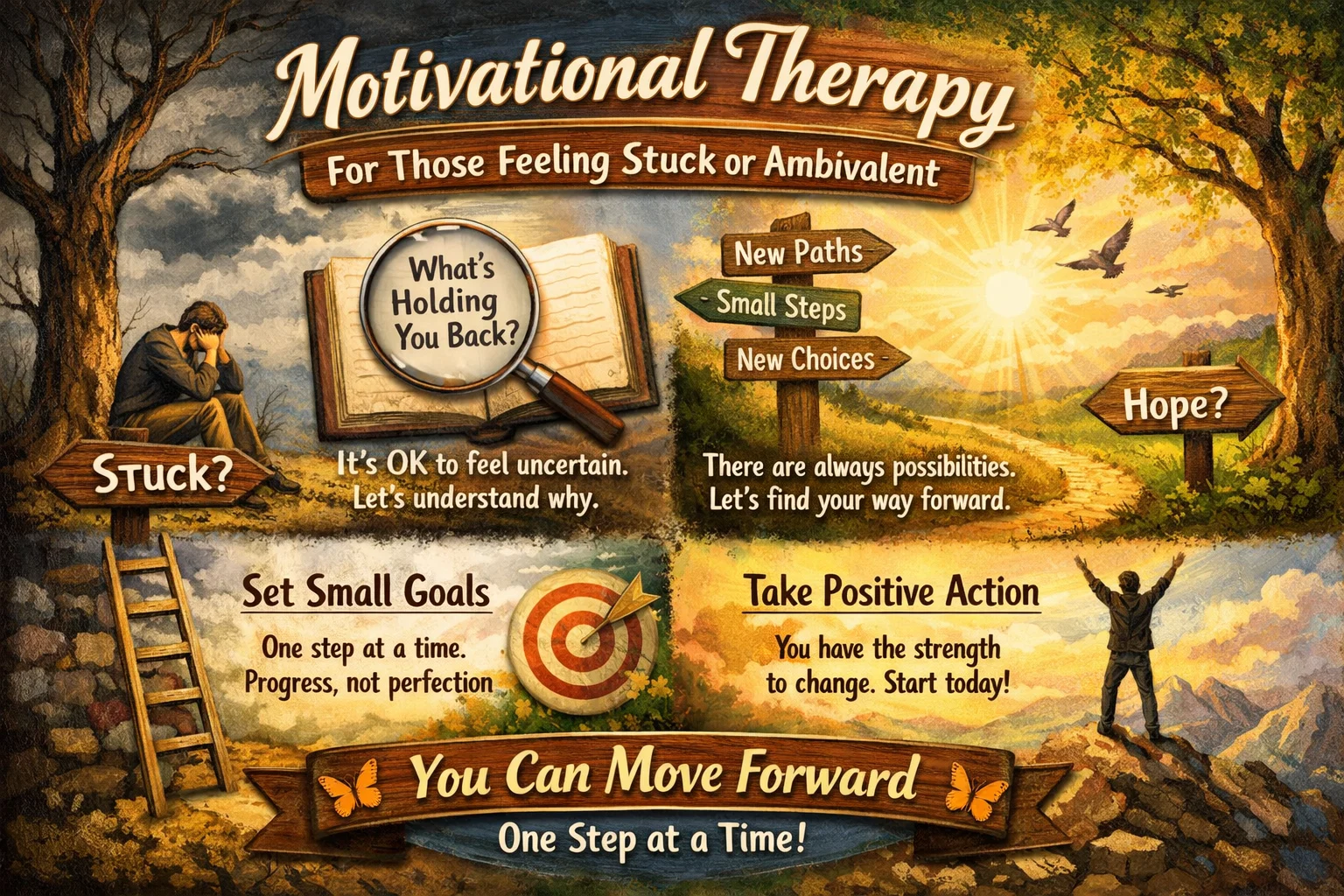
The Experience of Being Stuck
Being stuck is not the same as not wanting to change. Most people who are stuck want to change very much. They want to feel better, be healthier, relate differently, drink less, work differently, leave the relationship that isn’t working, start the thing they keep putting off. The want is real.
What is also real — and what coexists with the want in ways that feel contradictory and confusing — is something pulling in the other direction. The comfort of the familiar. The fear of what change might actually mean. The uncertainty about whether you can do it. The way the current situation, for all its costs, at least has the advantage of being known.
This is ambivalence — and it is not a sign of weakness. It is the entirely rational psychological response to change. Change involves risk. It involves loss as well as gain. It disrupts identity, relationships, and the structures of daily life. Of course part of you resists it, even when another part of you wants it desperately.
The problem is not that you feel ambivalent. The problem is what most people — and most well-meaning helpers — do with ambivalence: they try to override it. They argue with it, shame it, reason it away, or simply push harder. And the ambivalence pushes back. The harder the external pressure for change, the more the internal resistance digs in. This is not stubbornness. It is a well-documented psychological phenomenon called reactance — the motivational state that arises when we feel our freedom or autonomy is being threatened.
Motivational therapy works differently. Instead of fighting the ambivalence, it works with it.
What Is Motivational Therapy?
Motivational Interviewing (MI) — the evidence-based therapeutic approach most commonly referred to as motivational therapy — was developed in the early 1980s by clinical psychologists William Miller and Stephen Rollnick. Originally developed for the treatment of alcohol problems, it has since become one of the most widely researched and applied therapeutic methods in the world, used across healthcare, mental health, addiction, behaviour change, and beyond.
Its central premise is deceptively simple: people are more likely to change when the reasons for change come from within them, rather than being imposed from outside. The role of the therapist is not to tell, persuade, confront, or motivate — it is to create the conditions in which the person’s own motivation can emerge, strengthen, and become the foundation for action.
The four core principles of Motivational Interviewing (PACE):
- Partnership — the therapist and client work together as equals; the therapist is not the expert on the client’s life
- Acceptance — the client is accepted unconditionally as they are now, including their ambivalence; there is no pressure to be further along than they are
- Compassion — the therapist actively promotes the client’s wellbeing and interests, not an external agenda
- Evocation — the therapist draws out the client’s own motivations, values, and reasons for change rather than providing them from outside
This is not a soft approach. MI is rigorously evidence-based — a meta-analysis of over 200 randomised controlled trials found MI to be consistently effective in producing behaviour change across diverse populations and presenting problems. Its gentleness is not weakness: it is a strategic recognition that confrontation produces resistance, and that lasting change requires internal ownership.
Understanding Ambivalence
Ambivalence — the simultaneous pull toward and away from change — is not an obstacle to therapy. In motivational therapy, it is the starting point. Understanding the specific structure of your ambivalence is one of the most useful things you can do, because ambivalence is rarely simply “I want to change” vs “I don’t.” It has a more complex internal architecture.
A useful way to understand it is through what Miller and Rollnick called the “decisional balance” — the person’s internal weighing of the costs and benefits on both sides:
| Benefits | Costs | |
|---|---|---|
| Staying the same | Familiar, safe, certain, known. No risk of failure. Social continuity. Comfort of existing patterns. | The ongoing cost of the problem. Continued suffering. Lost opportunities. Increasing discrepancy with values. |
| Changing | Better health, relationships, self-respect, alignment with values. Relief from the problem. New possibilities. | Risk of failure. Loss of familiar coping. Disruption to relationships and identity. Uncertainty. Effort required. |
When people are ambivalent, all four quadrants of this table are real and present simultaneously. The person arguing against change is not wrong — those costs are real. The person arguing for change is also not wrong. The internal conflict is not irrational. It is the genuinely accurate recognition that change involves real trade-offs.
Motivational therapy does not dismiss the costs of change. It helps the person examine the full picture — and particularly to explore whether the discrepancy between their current behaviour and their deeply held values is one they want to continue living with.
The Stages of Change Model
The Transtheoretical Model of Change — commonly known as the Stages of Change model — was developed by James Prochaska, Carlo DiClemente, and John Norcross in the early 1980s through research into how people successfully change addictive behaviours, both with and without professional help. It has since become one of the most influential and widely applied frameworks in health behaviour, counselling, and therapeutic practice.
The model proposes that change is not a single event but a process — one that moves through identifiable stages, with different psychological tasks and different therapeutic needs at each stage. The critical insight is that “not being ready to change” is not a personality problem. It is a stage — one with its own internal logic, its own challenges, and its own path forward.
The model also introduced the concept of the upward spiral: rather than a linear progression from problem to resolution, most people cycle through the stages multiple times before sustaining change. Each cycle, including the apparent setback of relapse, is an opportunity to learn — and each revolution of the spiral typically carries the person a little higher than before.
Precontemplation
No intention of changing behaviour
The person is not currently considering change — either because they don’t see the behaviour as a problem, because previous attempts have left them demoralised, or because the costs of acknowledging the problem feel too high. Others (family, professionals) are more concerned about the behaviour than the person themselves.
Contemplation
Aware a problem exists — no commitment to action
The person acknowledges the problem and is beginning to think about change — but has made no commitment to act. This stage is characterised by ambivalence: weighing the pros and cons, recognising the need for change while remaining uncertain about it. The classic “I know I should, but…” stage. Can last months or years.
Preparation
Intent upon taking action
The person has made the decision to change and is beginning to plan for it. They may be gathering information, telling others about their intentions, setting a start date, or making small preparatory changes. The balance has shifted — now toward change — but the actual behaviour shift has not yet been made.
Action
Active modification of behaviour
The person is actively changing their behaviour. This is the most visible stage — and the one most people mean when they think of “change.” It requires significant commitment, energy, and effort. The risk of relapse is highest in the early action stage, when new behaviours are not yet habitual and old cues still exert strong pull.
Maintenance
Sustained change — new behaviour replaces old
The new behaviour has been sustained over time (typically defined as six months or more) and is becoming the new normal. The effort required reduces as the behaviour becomes habitual. The person consolidates their new identity and develops strategies for managing ongoing challenges and temptations.
Relapse
Return to old patterns of behaviour
A return to the previous behaviour — from action or maintenance back to an earlier stage. Not a failure, but a normal part of the change process for most people. In the Stages of Change model, relapse is understood as an opportunity to learn, refine, and re-enter the cycle with more information than before. The upward spiral continues.
Each Stage, Explained — With What Actually Helps
One of the most practically valuable insights of the Stages of Change model is this: the right intervention at the wrong stage doesn’t work. Action-stage strategies (making plans, setting goals, building habits) are useless — and can actually increase resistance — when someone is still in contemplation. Contemplation-stage support (exploring ambivalence, weighing pros and cons) is redundant when someone is already in preparation and ready to act. Matching the approach to the stage is what makes support effective rather than frustrating for both parties.
| Stage | The Person’s Internal Experience | What Actually Helps |
|---|---|---|
| Precontemplation | “I don’t have a problem” / “I’ve tried, it doesn’t work” / “The cost of seeing this clearly is too high” | Non-judgmental information; compassionate reflection of discrepancies between behaviour and values; building trust and safety; no pressure to move faster than the person is ready |
| Contemplation | “I know I should… but.” Both sides of ambivalence are real and present simultaneously. Not comfortable with staying the same; not ready to change. | Exploring ambivalence without resolution pressure; decisional balance work; strengthening “change talk” (the person’s own stated reasons for change); building discrepancy between current behaviour and important values |
| Preparation | The decision has been made. Planning energy is present. Some anxiety about the actual change step. | Concrete planning support; identifying barriers and preparing responses; building confidence and self-efficacy; clarifying the first specific steps |
| Action | High effort; change is new and requires deliberate attention; old cues still pull; identity is in flux | Skills and coping strategy support; managing triggers and high-risk situations; recognition and reinforcement of progress; building new identity and social supports |
| Maintenance | New behaviour is becoming normal; vigilance still required; identity is settling into the new pattern; long-term sustainability is the focus | Relapse prevention planning; building lifestyle supports; consolidating new identity; preparing for challenges and high-risk periods |
On Relapse: The Upward Spiral
Of all the insights in the Stages of Change model, the reframing of relapse may be the most important — and the most healing — for people who have tried to change and not sustained it.
In the traditional understanding of behaviour change, relapse means failure. It confirms the belief that change is not possible, that the person doesn’t have what it takes, that they will always return to this. The shame that follows relapse is often more damaging than the relapse itself — because shame drives avoidance, and avoidance makes re-entry into the change cycle far harder.
In the Stages of Change model, relapse is not failure. It is a stage — a normal, statistically expected part of the change process for most people attempting most significant changes. Research on smoking cessation, for example, found that the average successful quitter had made three to four serious attempts before sustaining change. The attempts that didn’t succeed were not wasted. They were part of the process that eventually succeeded.
The model describes the overall trajectory not as a circle — endlessly repeating — but as an upward spiral. Each time a person cycles through the stages, including through relapse, they carry forward information: what triggered the return to old behaviour, what supports were missing, what strategies didn’t hold up under pressure. This information, if compassionately examined rather than buried under shame, makes the next cycle more informed and more likely to result in sustained change.
Questions worth asking after a relapse — with curiosity, not judgment:
- What was happening in my life or emotional state before I slipped back?
- What was the specific trigger? A situation, a feeling, a person, a time of day?
- What need was the old behaviour meeting that my new strategies weren’t?
- What could I put in place differently next time for that specific situation?
- What was I telling myself that made it easier to go back? Is that story accurate?
- What support was I missing? Who could I tell, so I’m less alone with this next time?

How Motivational Therapy Works in Practice
A motivational therapy session looks quite different from other therapeutic approaches. There is no agenda to push, no confrontation of denial, no expert telling you what you should do. Instead, the therapist creates a specific kind of conversational space — one in which your own thoughts, values, and reasons can surface and be heard.
The Key Skills of MI
| Skill | What It Involves | Why It Matters |
|---|---|---|
| Open questions | Questions that invite exploration rather than yes/no answers — “What concerns you most about how things are going?” rather than “Are you worried about your drinking?” | Creates space for the person’s own perspective to emerge, rather than responding to a predefined framework |
| Reflective listening | Reflecting back what the person has said — sometimes the explicit content, sometimes the deeper meaning or feeling beneath it — to show understanding and invite deeper exploration | People move forward in their thinking not primarily by receiving new information but by hearing their own thoughts reflected back clearly |
| Affirmation | Genuinely recognising the person’s strengths, efforts, and values — not false praise, but honest acknowledgement of what is real and positive | Builds self-efficacy — the confidence that change is possible — which research identifies as one of the strongest predictors of successful behaviour change |
| Summaries | Periodic gathering together of what has been said — the ambivalence, the values, the reasons for change, the concerns — in a way that helps the person see the full picture of their own thinking | Organises and consolidates the person’s own material; creates a sense of being genuinely heard and understood |
| Evoking change talk | Selectively attending to and drawing out the person’s own statements about desire, ability, reasons, and need for change — without arguing for change from outside | Research shows that the amount of “change talk” a person produces in MI sessions is directly predictive of behaviour change outcomes — the more you hear yourself articulate reasons for change, the more they become real |
What Motivational Therapy Deliberately Does NOT Do
Understanding what MI avoids is as important as understanding what it does. The MI approach explicitly counters a set of therapeutic reflexes that feel helpful but reliably produce resistance:
- The “righting reflex” — the instinct to correct the person’s thinking, point out what they’re doing wrong, or argue for the position the therapist believes is right. This instinct, however well-intentioned, consistently produces pushback.
- Confrontation and labelling — telling someone they “are an addict” or that they “must” change. These approaches activate reactance and typically entrench the person further in the pre-change position.
- Unsolicited advice — providing solutions before the person has clearly asked for them, or before they are in a stage where solutions are what they need
- Premature focusing on action — jumping to planning and problem-solving before the person’s ambivalence has been sufficiently explored and resolved
Who Benefits Most
Motivational therapy was developed for addiction and substance use, but its application is now far broader. It is particularly well-suited to any situation involving ambivalence — where the person knows on some level that change would be beneficial but has not yet found the internal drive to pursue it:
| Presenting Situation | How MI Helps |
|---|---|
| Substance use and addiction | The original application — exploring the ambivalence around substance use without confrontation; building the internal motivation that makes treatment engagement more likely and more sustained |
| Eating and health behaviours | Exploring ambivalence around eating patterns, exercise, weight, or health management — particularly for people who feel lectured at rather than listened to |
| Self-destructive patterns | Behaviours that the person recognises as harmful but that serve important psychological functions — avoidance, numbing, self-soothing — and that require understanding before they can shift |
| Resistant or sceptical clients | People who have felt judged, pushed, or told what to do by previous helpers — and who need an approach that meets them where they are before asking them to move |
| Life transitions and stuckness | People feeling trapped in situations — careers, relationships, locations — where they know something needs to shift but can’t find the clarity or confidence to move |
| As preparation for other therapy | MI is often used at the beginning of a therapeutic journey to build motivation and readiness before moving into a more change-focused approach — ensuring the person is genuinely on board before the deeper work begins |
Finding Your Own Why
At the heart of motivational therapy is a question that sounds simple and is actually profound: Why does this matter to you?
Not why it should matter — not why it matters to your doctor, your family, society, or the version of yourself you think you’re supposed to be. Why does it matter to you — to your actual values, your real relationships, the life you actually want to be living?
The answer to this question — your answer, in your words, connected to your specific values and your particular life — is far more powerful than any external motivation. Research consistently shows that intrinsic motivation (change driven by personal values) produces more durable behaviour change than extrinsic motivation (change driven by external pressure or reward). The goal of motivational therapy is not to give you the motivation to change. It is to help you find the motivation that was already yours.
A few questions worth sitting with — not to answer quickly, but to genuinely explore:
- If nothing changes, where will I be in five years — and how do I feel about that?
- What would I be able to do or be or have if this changed that I can’t now?
- What are the most important things in my life? How does this behaviour fit — or not fit — with those things?
- What have I already noticed about the cost of staying where I am?
- What is the part of me that wants to change trying to move toward? What does it want for me?
- What has kept me from changing so far — and is that reason still valid, or has it outlived its usefulness?
✦ Key Takeaways
- Motivational therapy works with ambivalence rather than against it — recognising that the pull toward and away from change is not a character flaw but a genuinely human response to the real costs and risks of change.
- The Stages of Change model (Prochaska, DiClemente & Norcross, 1992) describes change as a process with distinct stages — precontemplation, contemplation, preparation, action, maintenance — each with its own psychological tasks and its own most helpful support.
- The right intervention at the wrong stage doesn’t work. Matching support to stage is what makes the difference between feeling pushed and feeling genuinely helped.
- Relapse is a normal part of the change process — not failure. The upward spiral means that each cycle, including the apparent setbacks, carries forward self-knowledge that makes the next attempt more informed.
- Motivational therapy does not provide motivation from outside. It creates the conditions for your own motivation — already present, rooted in your actual values — to become clearer, stronger, and yours to act on.
- The most durable change comes not from external pressure but from intrinsic motivation: change driven by your own values, in your own words, toward a life that is genuinely yours.
Frequently Asked Questions
How is motivational therapy different from regular talk therapy?
Most therapy approaches are broadly change-oriented — they assume the person is ready to change and focus on helping them do so. Motivational therapy specifically addresses the stage before change readiness: the ambivalence, the stuckness, the “I want to but I can’t” experience. It is more directive than person-centred therapy (it has a specific goal: resolving ambivalence in the direction of change) but less prescriptive than CBT (it does not provide a specific model of the problem or a set technique for addressing it). Its closest neighbours in the therapeutic landscape are motivational interviewing, solution-focused therapy, and acceptance-based approaches — and many therapists integrate it with other methods as a preparatory or complementary element.
How many sessions does motivational therapy take?
One of the notable features of motivational interviewing research is that even brief interventions — sometimes as few as one or two sessions — can produce meaningful movement through the stages. This is partly because the approach is targeted: it works on a specific psychological leverage point (resolving ambivalence) rather than attempting comprehensive change across multiple domains. For more complex or entrenched ambivalence, or for situations involving deeper psychological material, a longer-term integration with other therapeutic approaches is typically more effective. The number of sessions is always a conversation between client and therapist based on what is needed.
Can I use motivational therapy principles on myself?
To an extent, yes. The Stages of Change model provides a useful framework for self-assessment — understanding which stage you’re in helps you identify what kind of support is most useful and avoid the frustration of applying action-stage strategies when you’re still in contemplation. The decisional balance exercise (explicitly mapping the costs and benefits of change vs staying the same, for yourself) is a powerful self-directed tool. And the questions in the “Finding Your Own Why” section of this article are legitimate self-reflection tools. However, the interpersonal dimension of motivational therapy — the experience of being heard without judgment, of hearing your own ambivalence reflected back, of having a skilled conversation partner draw out your change talk — is difficult to replicate alone. Working with a therapist, even for a short engagement, provides something qualitatively different from self-directed work.
What if I’ve tried to change many times and failed?
This is precisely the person motivational therapy was designed for. Multiple previous attempts that haven’t held are not evidence that change is impossible for you — they are evidence that the approach, the timing, the support, or the understanding of what was driving the behaviour was incomplete. Each attempt carries information. A motivational therapist working with someone who has tried many times will spend time exploring those previous attempts — not to catalogue failure, but to extract the learning: what worked, even partially? What was missing? What was different about the times when change lasted longer? This information, treated with compassion rather than shame, is some of the most useful material in building a more successful next attempt.
Is motivational therapy only for addiction?
No — though that is its historical origin. The principles of motivational interviewing apply wherever ambivalence is present: health behaviour change, mental health treatment engagement, relationship decisions, career transitions, parenting challenges, financial behaviour, and any situation where a person knows on some level that something needs to shift but hasn’t yet found the internal drive to pursue it. The approach has been validated across a remarkably broad range of contexts in the research literature, and its core principles — meeting people where they are, evoking rather than imposing motivation, working with rather than against resistance — are transferable across virtually any domain of human change.

If you feel stuck or uncertain about where to begin, speaking with a therapist trained in motivational interviewing can be a genuinely helpful first step — not because they will tell you what to do, but because they will help you discover what you already know.
Evidence-based wellness content to help you feel your best — body and mind. | The Whole You Wellness



Leave a Comment