
Dialectical Behaviour Therapy is one of the most rigorously researched and practically powerful approaches in modern mental health treatment. If you’ve ever felt controlled by your emotions, struggled in crisis without knowing how to cope, or found relationships consistently painful and difficult — this article is for you.
📅 July 27, 2026 | ⏱ 12 min read | 🧠 Mental Health
- What Is DBT?
- The Origins and Philosophy of DBT
- The Four Core Modules
- Module 1: Mindfulness
- Module 2: Emotion Regulation
- Module 3: Distress Tolerance
- Module 4: Interpersonal Effectiveness
- DBT, Survival Patterns, and Cultural Context
- Who Benefits From DBT?
- What to Expect in DBT Treatment
- Frequently Asked Questions
Most of us were never taught how to handle our emotions. We were taught to suppress them, push through them, or feel ashamed of their intensity. We were taught to cope — but rarely given the tools to actually do so safely. And for many people, the gap between the emotional life they have and the emotional life they want is one of the most painful places they inhabit.
Dialectical Behaviour Therapy — DBT — was developed specifically to close that gap. Not by making difficult emotions disappear, but by building the skills to navigate them: to feel without being overwhelmed, to cope without causing harm, to communicate without destroying connection, and to stay present in a life that sometimes feels unmanageable.
DBT is not a passive experience. It is a skills-based, practice-intensive approach — one of the most practically oriented therapies available. It gives you real tools that work in real situations. And it does so from a foundation that holds two truths at once: you are doing the best you can — and you can do better.

What Is DBT?
Dialectical Behaviour Therapy (DBT) is a trauma-informed, evidence-based psychological treatment developed in the late 1980s by Dr Marsha Linehan at the University of Washington. It was originally created for people with borderline personality disorder — particularly those experiencing chronic suicidal ideation — but its scope has since expanded dramatically. DBT is now one of the most widely used and extensively researched therapeutic approaches in the world, applied across a broad range of presentations and populations.
The word “dialectical” is important — and often overlooked. A dialectic is the reconciliation of two opposing truths. In DBT, the central dialectic is:
You are doing the best you can
— and —
You need to change.
Both are true simultaneously. This is the foundation on which everything in DBT is built — a synthesis of radical acceptance and active change. You are not broken, you are not bad, you are not beyond help. And there are skills that, when practised consistently, will meaningfully change your relationship with your emotions, your crises, and your relationships.
DBT also integrates elements from cognitive behavioural therapy, Zen Buddhist philosophy (particularly mindfulness and acceptance), and behavioural science. This blend makes it uniquely suited to people who have found purely cognitive approaches insufficient — those for whom emotions are so intense that changing thoughts first is not possible until the emotional flooding is addressed.
The Origins and Philosophy of DBT
Dr Marsha Linehan developed DBT partly from her own lived experience. She has spoken publicly about her own history of severe emotional dysregulation, psychiatric hospitalisation, and suicidality — and the profound inadequacy of the treatments available to her at the time. The standard cognitive-behavioural approaches of the era told her to change. What she also needed — and what she embedded at the core of DBT — was to feel genuinely accepted, exactly as she was, before change was possible.
This dual commitment — to both validation and change — shapes everything about how DBT is delivered. A DBT therapist does not pathologise emotional intensity. They recognise it as a valid, understandable response, often to genuinely difficult life circumstances. The goal is not to make you feel less. It is to give you the skills to manage what you feel in ways that support your life rather than undermine it.
Central to DBT’s philosophy is the concept of the “biosocial theory” of emotional dysregulation — Linehan’s explanation of how severe emotional sensitivity develops. According to this theory, emotional dysregulation arises from the interaction of two factors: a biological predisposition toward emotional sensitivity (a nervous system that responds more intensely and takes longer to return to baseline), and an “invalidating environment” — one in which the person’s emotional experiences were consistently dismissed, minimised, punished, or met with the message that what they felt was wrong, inappropriate, or too much.
The result of this interaction is a person who feels intensely and has never been given the skills to manage that intensity — because their environment consistently denied there was anything to manage. DBT provides those skills. And it does so within a framework of complete validation of the original experience.
The Four Core Modules
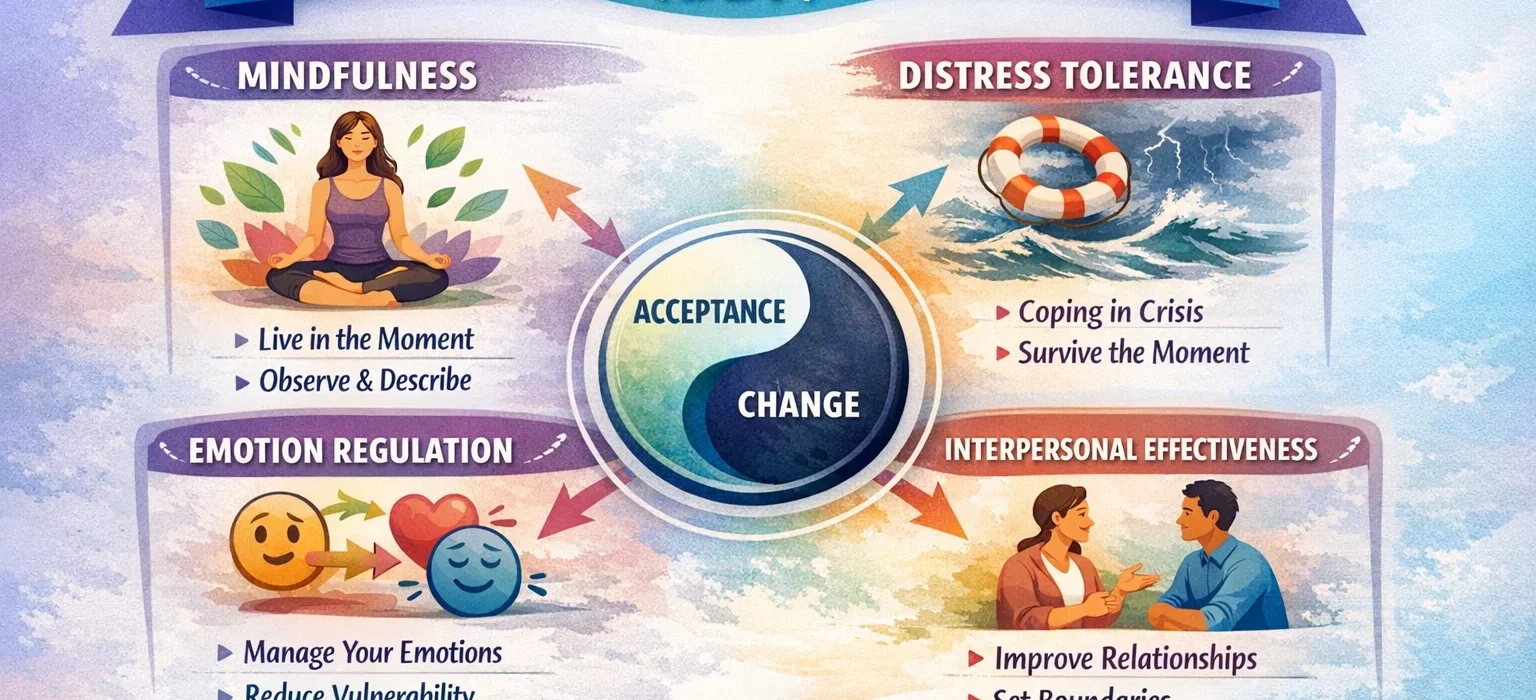
DBT is organised around four skill modules — each addressing a different domain of emotional, psychological, and relational functioning. Together, they form a comprehensive framework for building what Linehan called “a life worth living.”
🧘
Mindfulness
The foundation of all other DBT skills — understanding what you feel, directing your attention, and being present without judgment
🌊
Emotion Regulation
Understanding and reducing the intensity of difficult emotions — so that you direct your emotions rather than being directed by them
🛟
Distress Tolerance
Surviving crisis moments without making things worse — tools for getting through pain when it cannot immediately be changed
🤝
Interpersonal Effectiveness
Communicating clearly, maintaining relationships, and holding your self-respect — even in difficult interactions
Module 1: Mindfulness 🧘
Mindfulness is not just one skill in DBT — it is the foundation of all the others. Every other module draws on the capacity that mindfulness develops: the ability to observe your experience without being consumed by it, to notice what is happening without immediately reacting, and to direct your attention intentionally rather than being pulled wherever your emotions and thoughts take you.
DBT mindfulness is drawn from Zen Buddhist contemplative practice but stripped of religious context and made practically accessible. It is less about sitting still and meditating and more about developing a particular quality of awareness that can be applied in any moment — in a conversation, in a crisis, in the middle of an intense emotional experience.
The Three “What” Skills
| Skill | What It Involves | In Practice |
|---|---|---|
| Observe | Noticing your experience — thoughts, feelings, sensations — without immediately trying to change, escape, or act on it | “I notice I’m feeling tightness in my chest.” “I notice a thought that says I’m going to fail.” |
| Describe | Putting words to what you observe — labelling experience without interpretation or judgment. Facts, not stories. | “I am feeling angry” rather than “I am an angry person.” “He said X” rather than “He was trying to hurt me.” |
| Participate | Throwing yourself fully into what you’re doing — fully present, not half-engaged while the mind is elsewhere. The antidote to emotional avoidance and dissociation. | Being fully in a conversation, a meal, a task — not mentally rehearsing, reviewing, or escaping |
The Three “How” Skills
| Skill | What It Means |
|---|---|
| Non-judgmentally | Observing and describing without evaluating — not “this feeling is bad,” but “this feeling is here.” Releasing the second layer of suffering that judgment adds to pain. |
| One-mindfully | One thing at a time, with full attention. The opposite of the fragmented, distracted presence that is the norm for most people under stress. |
| Effectively | Doing what works — not what is “right,” “fair,” or satisfying to your emotional state, but what actually moves you toward your goals. Wisdom over reaction. |
Linehan described mindfulness as moving toward what she called the “Wise Mind” — the integration of “Emotion Mind” (where only feelings drive decisions) and “Rational Mind” (where only logic does). Wise Mind is the place where both inform the decision — where you are neither ruled by emotion nor dismissive of it.
Module 2: Emotion Regulation 🌊
Emotion regulation is the heart of what many people come to DBT seeking. If you have ever felt that your emotions arrive at a volume others don’t experience, stay longer than they should, or make choices on your behalf that you later regret — this module is specifically for you.
DBT’s approach to emotion regulation begins with something that most people have never been offered: a genuine understanding of what emotions actually are and what they are for. Emotions in DBT are not problems to be eliminated. They are information — adaptive signals with evolutionary purpose, each one carrying a message about what is happening and what might be needed.
Understanding the Emotion
Every emotion in DBT is understood through a model that includes: the prompting event (what triggered it), the interpretation (what meaning was assigned), the physical sensation in the body, the action urge (what the emotion wants to do), and the consequences of acting on that urge. Understanding this full sequence — rather than simply experiencing the emotion as an undifferentiated flood — creates points of intervention at each stage.
Key Emotion Regulation Skills
| Skill | What It Does |
|---|---|
| Check the facts | Examining whether your emotional response fits the actual facts of the situation — or whether it fits an interpretation. Many intense emotional reactions are responses to a feared story, not the current reality. |
| Opposite action | Deliberately acting opposite to the emotional action urge when that urge is not effective — approaching what fear urges you to avoid; being gentle when anger urges aggression. Research shows this directly changes the emotional experience, not just the behaviour. |
| PLEASE skills | Treating PhysicaL illness; Eating balanced meals; Avoiding mood-altering substances; Sleeping adequately; Exercising. The biological foundations of emotional regulation — because a dysregulated body makes emotional regulation almost impossible. |
| Build positive experiences | Deliberately building positive emotional experiences into daily life — not waiting for them to arrive, but actively creating the conditions for them. Short-term (doing something pleasant today) and long-term (building a life aligned with values). |
| Ride the wave | Observing an emotion without acting on it — sitting with the experience, noticing it as a wave that will peak and fall, without either suppressing it or being swept away. Radical in its simplicity and genuinely difficult in practice. |

Module 3: Distress Tolerance 🛟
There are moments when the pain is too big to problem-solve, and when all you need to do is survive it without making things worse. This is what distress tolerance skills are for.
Distress tolerance does not try to fix the crisis or change how you feel. It works with a different goal: getting through the moment safely, without adding harm on top of pain. For people who have historically coped with intense distress through self-harm, substance use, impulsive decisions, or other behaviours that provided short-term relief and long-term damage — distress tolerance offers an alternative path.
Crisis Survival Skills
The most well-known DBT distress tolerance skill set is TIPP — a set of body-based interventions that rapidly shift the nervous system’s level of activation:
| TIPP Skill | What It Is | How It Works |
|---|---|---|
| T — Temperature | Cold water on the face or holding ice | Activates the dive reflex, rapidly slowing heart rate and shifting the nervous system toward calm. One of the fastest physiological regulation interventions available. |
| I — Intense exercise | Brief, vigorous physical activity | Burns off the stress hormones and physiological activation of the threat response; provides an effective outlet for fight-or-flight energy |
| P — Paced breathing | Slowing the breath, extending the exhale | Activates the parasympathetic nervous system; the extended exhale specifically engages the vagal brake, signalling safety to the body |
| P — Paired muscle relaxation | Progressive tension and release of muscle groups | Releases physically held stress from the body; the deliberate contrast of tension and release produces a deeper state of physical relaxation |
ACCEPTS and Self-Soothe
Beyond TIPP, DBT offers two further crisis toolkits. ACCEPTS (Activities, Contributing, Comparisons, opposite Emotions, Pushing away, Thoughts, Sensations) provides a menu of distraction strategies — not as permanent avoidance, but as a temporary bridge to get through the acute peak of distress without acting destructively. Self-soothe uses the five senses to activate the parasympathetic nervous system through comfort and pleasure: something beautiful to look at, something soothing to hear, something pleasant to smell, something gentle to touch, something nourishing to taste.
Radical Acceptance
Perhaps the most philosophically significant distress tolerance skill is radical acceptance: the complete acknowledgement of reality as it is, without fighting it. This is not approval — it is the recognition that resisting what cannot be changed adds suffering without changing anything. Pain is inevitable. Suffering is pain plus resistance. Radical acceptance doesn’t remove the pain. It removes the additional layer of anguish that comes from refusing to accept that the painful thing is real.
Module 4: Interpersonal Effectiveness 🤝
Relationships are where the work of therapy most often has to be applied — and where emotional dysregulation most often creates damage. Interpersonal effectiveness skills address the full complexity of relating: how to ask for what you need, how to say no, how to navigate conflict, and how to do all of this while maintaining both the relationship and your self-respect.
DBT organises interpersonal effectiveness around three goals that are often in tension with each other:
🎯 Getting what is needed (Objective)
Achieving your practical goal in an interaction — asking for something, declining something, resolving a problem. The DEAR MAN skill framework supports this.
🔗 Keeping relationships steady (Relationship)
Maintaining the quality of the relationship even when asking for something difficult or declining a request. The GIVE skill framework supports this.
🛡️ Maintaining self-respect (Self-respect)
Acting in ways that you can feel good about — regardless of the outcome. Not compromising your values or self-worth to achieve the other goals. The FAST skill framework supports this.
DEAR MAN — Getting What You Need
| Letter | Skill | What It Means |
|---|---|---|
| D | Describe | State the facts of the situation without judgment or interpretation |
| E | Express | Share how you feel about the situation — using “I” statements |
| A | Assert | Ask clearly for what you need or say no clearly to what you don’t |
| R | Reinforce | Explain why fulfilling the request benefits the other person or the relationship |
| M | Mindfully | Stay focused on your goal — don’t get pulled into side arguments or distractions |
| A | Appear confident | Use body language, tone, and eye contact that communicate certainty, even when you don’t feel it |
| N | Negotiate | Be willing to give to get — offer alternatives, find middle ground, remain solution-focused |
DBT, Survival Patterns, and Cultural Context
DBT’s evidence base is strong — but like much of mainstream psychology, it was developed primarily within Western, white, academic contexts. For BIPOC (Black, Indigenous, and People of Colour) clients, engaging with any therapeutic approach requires attention to cultural context — and DBT is no exception.
Several aspects of DBT are particularly relevant to this context:
Survival-based emotional patterns
Many of the emotional and behavioural patterns that DBT addresses — hypervigilance, emotional reactivity, difficulty with trust, shutdown responses — are not simply symptoms of individual pathology. For many BIPOC individuals, they are adaptive responses to real, ongoing, systemic experiences of racism, discrimination, and racial trauma. A trauma-informed DBT clinician working with BIPOC clients understands that these patterns often developed as genuine survival strategies in hostile environments — not as deficits to be corrected, but as intelligent adaptations to be honoured, understood, and, where possible, supported toward greater flexibility.
Radical acceptance and systemic injustice
The DBT concept of radical acceptance — accepting reality as it is — requires careful handling in cultural context. Accepting racism, discrimination, or injustice is not the goal. The goal is accepting the reality of what has happened and what currently exists, as a starting point for effective action — not as a reason to stop advocating for change. A culturally competent DBT clinician will make this distinction clearly and ensure that acceptance skills are never used to invalidate the reality of systemic harm.
Collective and community dimensions of wellbeing
DBT’s interpersonal effectiveness module was designed with largely individualistic Western relational frameworks in mind. For many BIPOC clients, from cultures where wellbeing is understood collectively rather than individually, the skills may need to be adapted — honouring the importance of family, community, and collective obligation as genuine values, not merely as competing demands on individual self-care.
DBT is most effective when delivered by clinicians who understand these nuances — who can hold the evidence-based framework and the cultural context simultaneously, and who create a therapeutic environment where the full complexity of a person’s experience, including the racial and cultural dimensions, is genuinely welcomed.
Who Benefits From DBT?
DBT was originally designed for borderline personality disorder and chronic suicidality, but its application has expanded significantly. Strong evidence now exists for DBT’s effectiveness across a range of presentations:
| Presentation | How DBT Helps |
|---|---|
| Borderline personality disorder | The original and most extensively evidenced application — reducing self-harm, suicidality, and hospitalisation rates, and improving emotional regulation and relationship stability |
| Eating disorders | Particularly binge eating and bulimia — addressing the emotional dysregulation that drives binge-purge cycles |
| PTSD and complex trauma | DBT’s stabilisation and skills-building phase is often used before trauma processing in CPTSD treatment — building the emotional regulation capacity that makes deeper trauma work safe |
| Depression and anxiety | Particularly for people whose depression or anxiety is characterised by intense emotional experiences and whose previous CBT approaches were insufficient |
| Substance use | DBT-SUD (Substance Use Disorders) adapts the standard programme to address the emotional dysregulation that drives addictive behaviours |
| Anyone who wants better emotional and relational skills | The skills taught in DBT are not exclusively for clinical presentations — they are human skills that support anyone navigating difficult emotions, relationships, and life challenges |
What to Expect in DBT Treatment
Standard DBT is structured differently from most other therapy approaches — and understanding its structure helps set realistic expectations.
Full, standard DBT involves four components:
- Individual therapy — weekly one-to-one sessions focused on applying skills to your specific life situations, addressing the behaviours on your personal “treatment targets” hierarchy, and building the therapeutic relationship
- DBT skills group — a structured, group-based class (not group therapy in the traditional sense) in which all four skill modules are taught over approximately 24 weeks, with homework assignments and practice exercises
- Phone coaching — between-session access to your therapist for brief skills coaching calls when you’re in distress and struggling to apply skills
- Therapist consultation team — a support system for DBT therapists themselves, ensuring fidelity to the model and preventing burnout
Many people receive DBT-informed or adapted DBT — individual therapy that incorporates DBT skills and principles without the full four-component structure. This is less comprehensive than standard DBT but still significantly effective. If you are seeking DBT, it is worth asking a potential therapist whether they offer full-model DBT or a DBT-informed approach, as the two are meaningfully different.
✦ Key Takeaways
- DBT is a trauma-informed, evidence-based therapy built on the central dialectic: you are doing the best you can — and you can do better. Radical acceptance and active change are held simultaneously.
- The four modules — Mindfulness, Emotion Regulation, Distress Tolerance, and Interpersonal Effectiveness — provide a comprehensive framework of practical skills for navigating emotional intensity, crisis, and relationships.
- Mindfulness is the foundation of all other DBT skills: the capacity to observe your experience without being consumed by it, and to direct your attention intentionally.
- Distress tolerance skills help you survive crisis moments without making things worse — they work when the pain cannot immediately be changed, offering a safe bridge through the hardest moments.
- For BIPOC clients, culturally competent DBT acknowledges that many emotional and behavioural patterns are survival adaptations — not deficits — and holds the evidence-based framework alongside cultural context, collective wellbeing, and the reality of racial trauma.
- DBT skills are not exclusively clinical — they are human skills. Anyone who wants to feel less controlled by their emotions and more capable in their relationships can benefit from learning them.
Frequently Asked Questions
How is DBT different from CBT?
Both DBT and CBT address the relationship between thoughts, feelings, and behaviour — but they differ in significant ways. CBT primarily targets cognitive patterns (changing unhelpful thoughts) and tends to be more structured and shorter-term. DBT places much greater emphasis on emotional validation and acceptance before change, includes specific skills for managing intense emotional experiences that CBT does not, and explicitly addresses interpersonal functioning and distress tolerance. DBT was also developed specifically for people with significant emotional dysregulation — people for whom the purely cognitive approach of CBT was insufficient because the emotional flooding needed to be addressed first. DBT is generally longer-term and more comprehensive in its scope.
Do I need a diagnosis to benefit from DBT?
No. While DBT was developed for specific clinical presentations and has the strongest evidence base for those populations, the skills it teaches are not diagnosis-dependent. Anyone who experiences emotional intensity, relationship difficulties, difficulty in crisis, or wants to develop greater psychological flexibility can benefit from DBT skills. Many people access DBT skills through self-help books, online programmes, and group courses without a formal diagnosis or individual therapy component.
How long does DBT take?
Standard full-model DBT is typically delivered over 12 months, with the skills group cycling through all four modules over approximately 24 weeks (and sometimes repeated for another cycle). Individual therapy runs concurrently for the same period. Many people continue beyond the formal programme as needed. DBT-informed therapy has a more variable timeline depending on individual needs and goals. The skills, once learned, are designed to be lifelong tools — the goal is not to complete a course and stop using them, but to internalise them to the point where they become the default response.
What is the difference between radical acceptance and giving up?
This is one of the most commonly misunderstood aspects of DBT. Radical acceptance is not resignation, passivity, or giving up. It is the clear-eyed acknowledgement of what is currently true — as the starting point for effective action, not as a reason to stop acting. You can fully accept the reality of an unjust situation while simultaneously working with every resource available to change it. What radical acceptance releases is the additional suffering that comes from fighting the reality of what has already happened — the “it shouldn’t be this way” that changes nothing but costs enormous energy. Acceptance and action are not opposites in DBT. They work together.
Can I learn DBT skills without a therapist?
Yes — to an extent. DBT skills are well-documented and accessible through several high-quality resources, including Marsha Linehan’s own skills training manual and workbook. Many people find significant benefit from self-directed DBT skills learning, particularly the mindfulness and distress tolerance modules. However, for more complex presentations — particularly trauma, severe emotional dysregulation, or active self-harm — professional support is strongly recommended. The individual therapy component of full DBT exists specifically to help you apply skills to your particular life situation, including the moments when skills feel impossible to access. A therapist who knows you, your history, and your patterns can support that application in ways that self-directed learning cannot replicate.

If you are interested in finding a DBT-trained therapist, ask prospective therapists specifically about their DBT training and whether they offer full-model DBT or a DBT-informed approach. You deserve support that is evidence-based, culturally informed, and genuinely suited to your needs.
Evidence-based wellness content to help you feel your best — body and mind. | The Whole You Wellness



Leave a Comment