
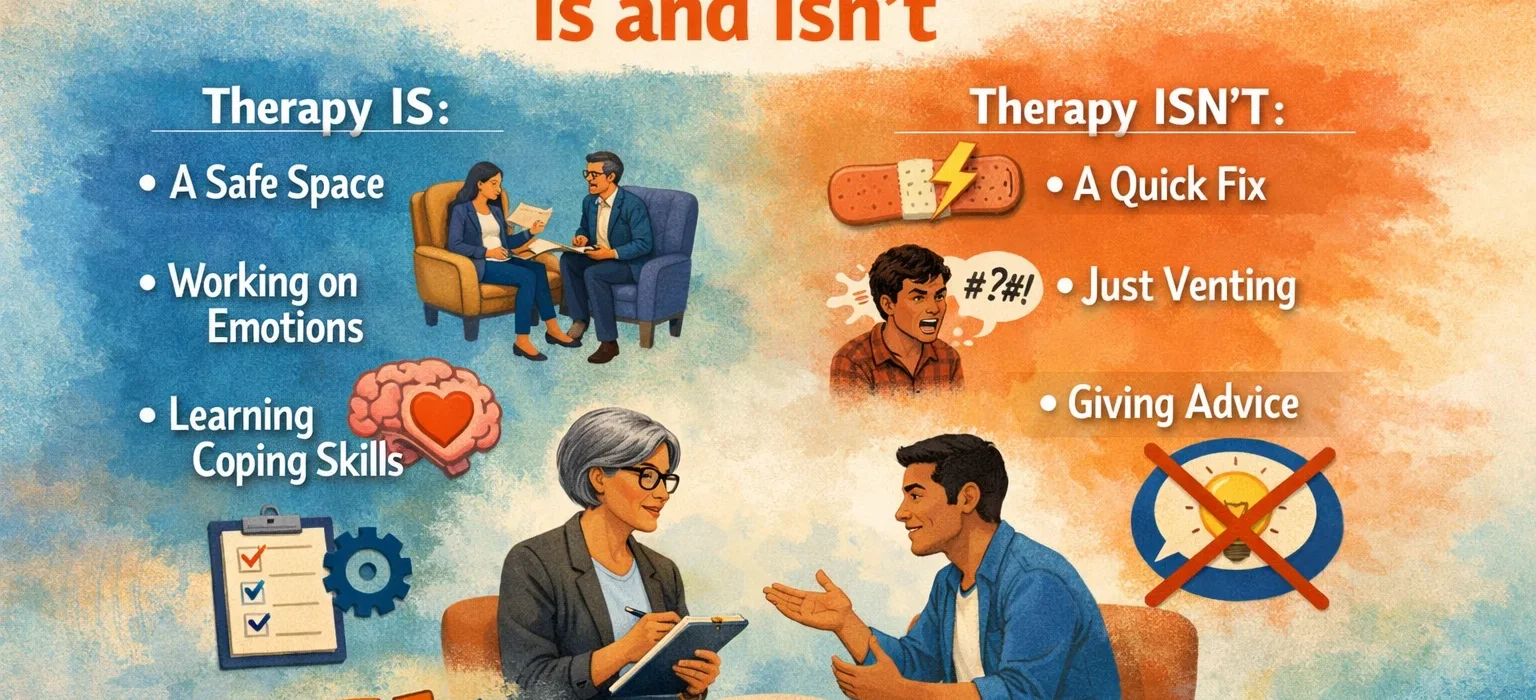

Many people come to therapy hoping for relief, clarity, or simply a place to breathe. Before you begin — or if you’re wondering whether to begin — here is an honest, compassionate look at what therapy truly offers, and what it gently does not.
📅 July 6, 2026 | ⏱ 9 min read | 🧠 Mental Health
There is a moment that many people describe before they first reach out for therapy. A quiet moment — sometimes in the middle of the night, sometimes mid-drive, sometimes in the shower — when something shifts. When the weight of whatever they’ve been carrying becomes clearer, or heavier, or both. When the thought arrives: I think I need to talk to someone.
And then, often, comes the uncertainty. What will it actually be like? What is the therapist going to do? Will I have to talk about things I’m not ready for? Will it even help? Am I too much — or not enough — to bring to a room like that?
These questions are worth answering honestly. Because therapy, when it is genuinely understood, becomes far less frightening — and far more accessible. And because one of the biggest barriers to people getting support is a misunderstanding of what that support actually is.

What Therapy Is 🤍
Therapy — in its many forms — is a professional, confidential relationship dedicated entirely to your wellbeing. It is one of the few spaces in human life where the full focus is on you: your experiences, your feelings, your patterns, your growth.
A good therapeutic relationship offers something that is genuinely rare — someone who is trained to listen without judgment, to reflect without projection, and to hold space for the full complexity of who you are and what you’ve been through.
Here is what a safe, skilled therapeutic space genuinely can offer:
🫂
Understanding, empathy, and emotional support
Being genuinely heard — perhaps for the first time — by someone whose only agenda is your wellbeing. No advice before understanding. No fixing before listening.
🔍
Help making sense of difficult feelings
Emotions that feel overwhelming or confusing often become more manageable when examined in a supported space. Therapy helps you understand what you feel — and why.
🧰
Tools to cope, reflect, and grow
Practical skills for emotional regulation, communication, boundary-setting, and cognitive patterns. Things you can carry with you and use in real life.
🌿
Normalising your experiences without judgment
Many people discover in therapy that what felt uniquely shameful or “too much” is a profoundly human experience — one that others share, one that has a name, one that can be worked with.
🛡️
Encouraging healthy boundaries and self-trust
Therapy supports the rebuilding of your relationship with yourself — helping you learn to trust your own perceptions, needs, and sense of what is and isn’t okay for you.
🚶
Walking beside you as you do the work
A therapist does not do the work for you. They walk alongside you — offering perspective, skill, and consistent presence as you do the hard and worthwhile work of change.
“Healing is not about being fixed. It’s about feeling supported enough to listen to yourself again.”
What Therapy Isn’t
Just as important as understanding what therapy offers is understanding what it does not — and cannot — do. These are not shortcomings of therapy. They are the boundaries that make it ethical, respectful, and genuinely supportive rather than controlling or dependency-creating.
🚫
Make decisions for your life
A therapist will never tell you to leave a relationship, change your job, or make a specific life choice. Those decisions belong to you. Therapy helps you access your own clarity — not replace it with someone else’s.
⚡
Push quick fixes or instant change
Genuine psychological change takes time. Therapy is a process, not a prescription. If you are told you will be “fixed” in three sessions, be cautious — real therapeutic work is neither that fast nor that simple.
🔇
Replace your voice, values, or choices
Therapy is not about the therapist’s values. A good therapist holds their own opinions respectfully aside and works within the framework of what matters to you. Your voice is not replaced — it is amplified.
🎮
Force outcomes or control relationships
Therapy cannot change other people. It cannot force a partner to become healthier, a parent to acknowledge harm, or a friendship to be repaired. It works on what is within your sphere — your responses, your wellbeing, your choices.
🩹
“Fix” you — because you are not broken
The medical-model framing of therapy as “treating a problem” misses something important. Most people who come to therapy are not broken. They are human — carrying difficult things, navigating hard circumstances, and deserving of support.
🔮
Guarantee a specific outcome
Therapy is a collaborative process between two people — and like all human endeavours, it doesn’t come with guarantees. What research does show is that the therapeutic relationship itself is the strongest predictor of positive outcomes.
What to Expect When You First Begin
One of the biggest barriers to starting therapy is not knowing what will actually happen in that first session — and the anxiety that uncertainty creates. Here is an honest, practical picture of what beginning therapy usually looks like.
The First Session
The first session is almost always an assessment and introduction — for both of you. Your therapist will ask questions about what brings you to therapy, a little about your background, and what you’re hoping for from the process. You are not expected to open up completely in session one. You are not expected to have everything figured out or articulately framed. You are allowed to say “I’m not sure where to start” — because that is a very normal place to begin.
You are also, from the very first session, allowed to have an opinion about whether this therapist feels right for you. The therapeutic relationship is a working partnership — and like any relationship, compatibility matters. If after two or three sessions the fit doesn’t feel right, that is information, not failure. Finding the right therapist is sometimes a process.
The Pace Is Yours
Therapy does not require you to discuss anything before you are ready. A skilled therapist will follow your lead — gently exploring, never forcing. If something feels too big or too close right now, you can say so. “I’m not ready to talk about that yet” is a complete and acceptable sentence in a therapy room. Your readiness is respected, always.
It Doesn’t Always Feel Good in the Moment
This is important to know before you begin: therapy sometimes feels harder before it feels easier. Bringing things into the light — things that have been kept quietly in the background for a long time — can initially feel more, not less, overwhelming. This is not a sign that therapy is making things worse. It is often a sign that real work is happening. Most people find that this temporary discomfort gives way to a steadier, more manageable sense of themselves over time.

Types of Therapy: Finding What Fits
Therapy is not one thing. There are many approaches — each with its own philosophy, methods, and evidence base — and different approaches work better for different people and different difficulties. This is not a comprehensive list, but an orientation to the most widely used:
| Approach | What It Focuses On | Often Helpful For |
|---|---|---|
| Cognitive Behavioural Therapy (CBT) | The relationship between thoughts, feelings, and behaviour — identifying and changing unhelpful thinking patterns | Anxiety, depression, phobias, OCD, eating difficulties, PTSD |
| Acceptance and Commitment Therapy (ACT) | Accepting difficult thoughts and feelings rather than fighting them; living in alignment with your values | Anxiety, chronic pain, depression, life transitions, avoidance |
| Person-Centred Therapy | Unconditional positive regard and empathy; trusting the client’s capacity for growth and self-direction | Self-esteem, identity, relationship difficulties, general emotional support |
| Psychodynamic Therapy | How past experiences — especially early relationships — shape present patterns of feeling, thinking, and relating | Relationship patterns, complex trauma, depression, self-understanding |
| EMDR | Processing traumatic memories through bilateral stimulation; reducing the emotional charge of difficult experiences | PTSD, trauma, phobias, distressing memories |
| Dialectical Behaviour Therapy (DBT) | Balancing acceptance and change; building skills in emotional regulation, distress tolerance, mindfulness, and interpersonal effectiveness | Emotional dysregulation, self-harm, borderline personality, intense relationship difficulties |
Most experienced therapists are integrative — drawing from multiple approaches depending on what the client needs — rather than rigidly applying a single model. The most important factor in therapeutic outcome is not the specific approach used, but the quality of the therapeutic relationship itself.
The Work Between Sessions
Therapy is an hour (or so) a week. The rest of your life is everything else. Some of the most important therapeutic work happens not in the session, but in the space between them — in how you apply what you’ve explored, practise the skills you’ve been given, and bring awareness to the patterns you’ve begun to notice.
This is not about adding pressure or homework to an already full life. It is about recognising that insight without application rarely produces lasting change. The session plants a seed. The life between sessions is where it grows.
Supportive practices between therapy sessions might include:
- Grounding and mindfulness practices — techniques that anchor you in the present moment when anxiety, overwhelm, or emotional intensity arise
- Journalling and self-reflection — continuing the conversations begun in session, noticing patterns, recording what comes up between appointments
- Emotional regulation tools — breathing techniques, body-based practices, and strategies for managing difficult emotional states in real time
- Boundary-setting practices — identifying where boundaries are needed, rehearsing how to communicate them, and noticing where old patterns reassert themselves
- Self-care foundations — sleep, movement, nutrition, and connection — the biological infrastructure on which all psychological work depends
- Overwhelm and burnout support — learning to recognise depletion early, and building the permission and skills to step back before crisis
Many people find it helpful to have a structured set of resources they can draw on between sessions — not to replace therapy, but to extend and support it. Having access to grounding exercises, self-care frameworks, boundary worksheets, and emotional regulation tools between appointments can significantly deepen the impact of the therapeutic work itself.
Common Myths About Therapy — Gently Addressed
| The Myth | The Reality |
|---|---|
| “Therapy is only for people with serious mental illness” | Therapy is for anyone navigating something difficult — grief, stress, relationship strain, life transitions, low self-worth, identity questions. You don’t need to be in crisis to benefit. Many people come to therapy simply to understand themselves better. |
| “Going to therapy means I’ve failed” | Seeking therapy is one of the most self-aware and courageous decisions a person can make. It is a sign of knowing yourself well enough to recognise when professional support would help — and caring enough about yourself to seek it. |
| “The therapist will judge me or tell people what I share” | Confidentiality is a cornerstone of ethical therapy — what you share stays in the room, with very limited and legally defined exceptions. And a good therapist brings curiosity and care to everything you share — not judgment. |
| “I should be able to work through this on my own” | Human beings are not designed for self-sufficiency in the face of significant emotional difficulty. We are wired for connection and co-regulation. Needing support is not a failure of self-sufficiency — it is a recognition of your nature as a relational being. |
| “Talking about it will just make it worse” | Unexpressed and unexamined difficulties do not resolve on their own — they are more likely to compound, deepen, or emerge in other ways. Talking about something in a supported context typically reduces its psychological weight over time, not increases it. |
| “I have to be ready before I start” | Readiness is rarely a prerequisite for beginning — it is often something that develops through beginning. Many people discover that they were ready the moment they made the appointment, even though it didn’t feel that way until they were in the room. |
How to Know If You’re Ready
The honest answer is: you don’t need to feel ready. Readiness is rarely a clean, clearly felt state. Most people who begin therapy begin with uncertainty, hesitation, and a quiet hope that it might help. That is enough. That has always been enough.
A few gentle questions to sit with:
- Is there something you’re carrying that feels too heavy to carry alone?
- Are the same patterns showing up in your relationships, your thinking, or your wellbeing — and have been for a while?
- Is there something you need to talk about with someone who has no stake in the outcome?
- Do you find yourself wondering, even occasionally, whether talking to someone might help?
If you are answering yes to any of these — that wondering, that quiet acknowledgement — is the beginning of readiness. You don’t need more certainty than that to make the call.
✦ Key Takeaways
- Therapy offers understanding, empathy, practical tools, and a space to make sense of difficult feelings — it does not offer quick fixes, life decisions, or control over other people.
- You are not broken. Therapy is not about being fixed. It is about being supported enough to hear yourself again — and to move forward with more clarity, more compassion, and more of your own voice.
- The therapeutic relationship is the most important factor in positive outcomes — more than the specific approach used. Finding a therapist who feels safe is worth taking time over.
- The work between sessions matters as much as the sessions themselves. Grounding practices, self-reflection, emotional regulation tools, and self-care foundations extend and deepen what happens in the therapy room.
- You do not need to be in crisis, have a diagnosis, or feel fully ready to begin. Wondering whether it might help is enough of a reason to reach out.
- Asking for help is not weakness. It is one of the most human and courageous things you can do.
A final, gentle word 🤍
You are allowed to want support. You are allowed to not have it all together. You are allowed to need help making sense of things that feel too big or too complicated to hold by yourself. Therapy is one of the ways human beings take care of themselves — one of the ways we say, to ourselves and to the world: I matter enough to invest in.
Whatever you’re carrying right now — whether you’ve been in therapy before, whether you’re considering it for the first time, or whether you’re simply trying to understand yourself a little better — you deserve a space where you are fully welcome. Including all the parts you’ve been keeping quiet.
Frequently Asked Questions
How do I find the right therapist?
Start by identifying what you most need support with — this can help narrow the type of therapy and therapist to look for. Consider practical factors like location, availability, cost, and whether you’d prefer in-person or online sessions. Many therapists offer a brief introductory call before committing to regular sessions — this is worth taking up. Notice how you feel in the first session or two: do you feel heard? Safe? Respected? The therapeutic relationship is the most important variable in outcomes, and it’s reasonable to take time to find the right fit. If a therapist doesn’t feel right after a few sessions, you can say so and, if needed, look elsewhere. That’s not giving up — it’s good self-care.
How often should I go to therapy?
Most people begin with weekly sessions, which allows continuity and momentum in the therapeutic process. As the work progresses, the frequency may reduce — fortnightly, then monthly — as the skills and insights developed in therapy are integrated into daily life. The right frequency is a conversation between you and your therapist, based on your needs, your goals, and your practical circumstances. There is no universal prescription.
What if I don’t know what to talk about?
This is more common than people realise — and it is never a problem. Your therapist is trained to help you find where to begin. Saying “I don’t know where to start” or “I’m not sure what I need” is a completely valid opening. The conversation will find its way. Often, what feels most insignificant to mention turns out to be exactly the right place to begin.
Is online therapy as effective as in-person?
The research on this has grown substantially in recent years, and the overall picture is encouraging: online therapy (video-based) is broadly comparable in effectiveness to in-person therapy for most conditions and most people. For some people, the accessibility and reduced anxiety of being in a familiar space make online therapy preferable. For others, the physical presence of the therapist matters significantly. Both are valid — and the most important factor, as always, is the quality of the therapeutic relationship rather than the medium through which it occurs.
How long does therapy take?
This depends enormously on the person, the difficulty being addressed, and the goals of therapy. Brief, focused CBT for a specific anxiety might take 8–16 sessions. Deeper work on long-standing patterns, trauma, or identity may take considerably longer — months or even years. There is no universal timeline, and comparing your progress to someone else’s journey in therapy is rarely useful. What matters is whether the work is moving in a direction that feels meaningful to you.
What if therapy brings up things that feel overwhelming?
This can happen — and it is important to know that your therapist is trained to work with it. If something feels too intense, you can say so in the session: “This feels like too much right now — can we slow down?” A skilled therapist will respond to that with care. Between sessions, having grounding practices, a safety plan, and trusted people you can reach out to provides an important additional layer of support. If you’re concerned about being overwhelmed between appointments, discuss it with your therapist — they can help you build the resources and strategies to manage what arises.
If you are in crisis or need immediate mental health support, please contact a crisis service in your country. Therapy is one important form of support — but in a crisis, immediate help is always the right first step.
Evidence-based wellness content to help you feel your best — body and mind. | The Whole You Wellness




Leave a Comment