

Grief doesn’t move from sad to healed. It moves in waves — sometimes back and forth within the same hour. The Dual Process Model helps us understand why that’s not a sign that something has gone wrong. It’s a sign that you’re human.
📅 June 29, 2026 | ⏱ 10 min read | 🧠 Mental Health
- What Is the Dual Process Model of Grief?
- Loss-Oriented Coping: Turning Toward the Pain
- Restoration-Oriented Coping: Turning Back Toward Life
- The Oscillation: Moving Between Both
- Why the Dual Process Model Matters
- Beyond the Five Stages: A More Honest Picture of Grief
- The Dual Process Model Across Different Types of Loss
- Supporting Someone Who Is Grieving
- When Grief Gets Stuck
- Frequently Asked Questions
You cried in the shower this morning. By lunchtime, you were laughing at something a colleague said. By evening, the grief was back — heavier than ever. And part of you wonders: what is wrong with me?
Nothing. Nothing is wrong with you.
Grief does not behave the way most of us were told it would. It doesn’t arrive in neat, orderly stages and resolve in one direction toward healing. It arrives in waves. It doubles back. It disappears for an hour and returns with full force. It lets you laugh at a joke and then makes you feel guilty for laughing. It asks you to carry on with ordinary life and to stop and grieve, often on the same day, sometimes in the same hour.
The Dual Process Model of Grief — developed by Dutch researchers Margaret Stroebe and Henk Schut in 1999 — offers perhaps the most honest and clinically useful framework for understanding this experience. It doesn’t describe grief as a problem to be solved or a path to be completed. It describes it as a natural, oscillating human process — one that involves two entirely different kinds of coping, moving back and forth between them for as long as you need to.

What Is the Dual Process Model of Grief?
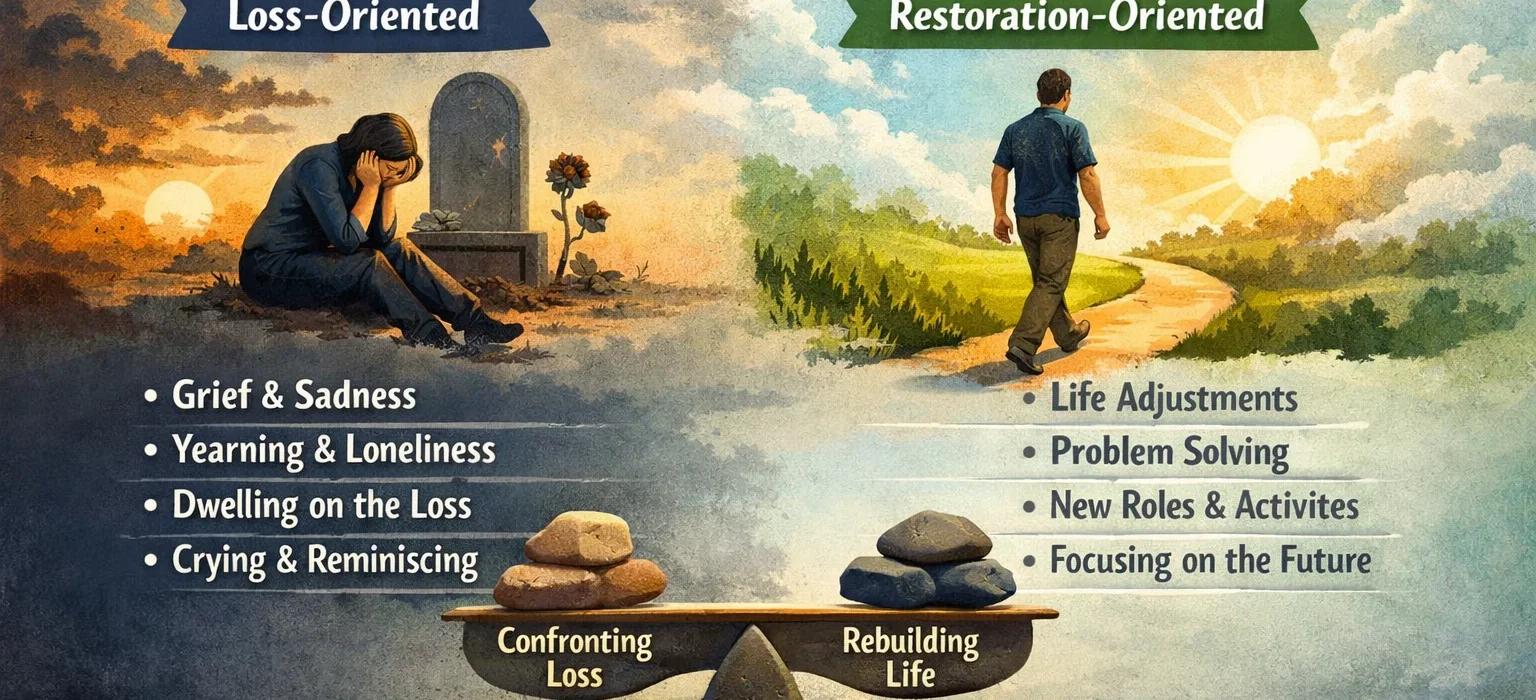
The Dual Process Model (DPM) proposes that when we grieve, we don’t cope with loss in a single, uniform way. Instead, we move — sometimes hour by hour, sometimes day by day — between two distinct orientations:
- Loss-oriented coping: turning toward the loss itself — the pain, the memories, the absence, the love
- Restoration-oriented coping: turning back toward life — the practical tasks, the new roles, the changed world, the need to function
And crucially: neither of these is the “real” grieving. Both are. Healthy grief involves moving between them — what Stroebe and Schut called oscillation — rather than staying fixed in either.
Before the DPM, grief models — most famously Elisabeth Kübler-Ross’s five stages — described grief primarily as an inward, linear process of emotional confrontation. The DPM was groundbreaking because it recognised something that grieving people had always known but rarely been validated in: that you cannot only grieve. You also have to live. And that living — going to work, doing the shopping, caring for children, making plans — is not a failure of grief. It is a necessary and equally valid part of it.
🔬 Research Background: The Dual Process Model was developed by Margaret Stroebe and Henk Schut at Utrecht University in the Netherlands and published in 1999 in the journal Death Studies. It has since become one of the most widely used and empirically supported models in grief research and grief counselling worldwide. It is particularly valued for its acknowledgement of the functional, day-to-day dimension of grief — the part that most previous models had largely ignored.
Loss-Oriented Coping: Turning Toward the Pain
Loss-oriented coping is what most people recognise when they think of grief. It is the part that faces the loss directly — that turns toward the pain rather than away from it.
In loss-oriented coping, you are focused on the person or thing you have lost. You are in the experience of grief itself — the sadness, the longing, the disbelief, the anger, the guilt, the waves of missing that arrive without warning and take your breath away.
This is where the grief work happens:
| Loss-Oriented Activities | What They Look Like |
|---|---|
| Grief work — therapy, journalling, support groups, workbooks | Actively engaging with the grief in a supported or structured way; giving the loss a voice |
| Thinking about the person you’ve lost | Replaying memories, looking at photographs, revisiting places you shared, hearing their voice in your mind |
| Feeling the emotions of grief | Allowing sadness, crying, expressing anger, sitting with longing — not distracting or suppressing |
| Missing your old life | Grieving not only the person but the life, the routines, the future you imagined, the version of yourself that existed before the loss |
| Focusing on life before | Reminiscing, storytelling, maintaining connection to who and what you’ve lost through memory, ritual, or meaningful objects |
Loss-oriented coping can feel overwhelming and exhausting — but it is not something to be avoided or shortened. Allowing space for this kind of grief is not wallowing. It is acknowledging that something real and irreplaceable has been lost, and that the love behind that loss deserves to be felt.
The risk in loss-oriented coping is not in doing it — it is in getting stuck in it exclusively, without the balancing movement toward restoration. People who cannot access restoration-oriented coping at all are at higher risk for complicated or prolonged grief.
Restoration-Oriented Coping: Turning Back Toward Life
Restoration-oriented coping is the side of grief that is most frequently misunderstood — and most frequently used as evidence against oneself. It is when you turn away from the direct confrontation of loss, however temporarily, and back toward the business of living.
This is the part of grief where you go back to work. Where you make dinner, attend an appointment, answer emails, and manage the practical demands of a life that continues even when you don’t feel ready for it. It is also where something more active begins to emerge: the gradual, often painful, often surprising process of adapting to a changed world.
| Restoration-Oriented Activities | What They Look Like |
|---|---|
| Figuring out your new life role | Learning to be a widow rather than a spouse, a parent rather than a child, a solo person rather than part of a pair — renegotiating your identity in relation to the loss |
| Creating new traditions | Finding new ways to mark occasions that used to be shared; building rituals that honour the loss while accommodating its reality |
| Doing new things and new experiences | Re-engaging with the world — trying new activities, going places, finding interests and experiences that belong to the life after loss |
| Forming new relationships | Opening, in time, to new friendships, support connections, or — when relevant — new intimate relationships |
| Adjusting family roles | Redistributing responsibilities, renegotiating how the family system functions, finding a new equilibrium in the relational landscape left by loss |
The most important thing to understand about restoration-oriented coping is this: it is not moving on. It is moving forward — with the loss, not away from it. When you laugh at something, book a holiday, accept a dinner invitation, or find yourself genuinely engaged in a task — this is not a sign that you have stopped grieving or that the loss has faded. It is a sign that you are, moment by moment, learning how to carry it.
Many people feel profound guilt when restoration-oriented coping emerges — as if enjoying anything, functioning competently, or feeling hope is a betrayal of the person they’ve lost. It is not. It is one half of what healthy grief requires.

The Oscillation: Moving Between Both
The most important — and most liberating — concept in the Dual Process Model is oscillation: the natural, necessary movement between loss-oriented and restoration-oriented coping.
Oscillation is not a sign of instability. It is not evidence that you are “doing grief wrong.” It is the description of how human beings actually grieve — in real life, in real time, without the tidy progression that cultural narratives about grief suggest.
It might look like this:
A day in grief — what oscillation looks like:
- Woke at 3am and couldn’t stop thinking about them — loss-oriented
- Made breakfast and got dressed — restoration-oriented
- Saw something in the kitchen that reminded me of them and cried — loss-oriented
- Went to work and managed to focus for two hours — restoration-oriented
- A song came on and the grief arrived in full force — loss-oriented
- Had lunch with a friend and laughed at something — restoration-oriented
- Felt guilty for laughing — loss-oriented
- Finished what needed finishing and went home — restoration-oriented
- Sat quietly and let the grief be there — loss-oriented
- Slept — restoration-oriented
There is no correct balance between the two orientations. The DPM makes no prescription about how much time should be spent on each side, or in what ratio. What it does suggest is that problems arise when a person becomes stuck at one extreme — either unable to access any relief from the direct confrontation of loss, or unable to access loss-oriented grief at all (suppressing it entirely in the business of functioning).
The oscillation itself is the health indicator — not the proportion of time spent in each state, but the capacity to move between them.
Why the Dual Process Model Matters
The DPM is not merely an academic framework. For grieving people, understanding it can be genuinely and meaningfully relieving. Here is what it clarifies that most people urgently need to hear:
| What People Often Fear | What the DPM Clarifies |
|---|---|
| “I’m laughing — does that mean I didn’t love them enough?” | No. Restoration-oriented moments are a natural and necessary part of healthy grief. They are not evidence of insufficient love. |
| “I seem fine at work but fall apart at home — something is wrong with me” | This is oscillation in action. Different contexts support different orientations — both are valid expressions of grief. |
| “It’s been months — I should be ‘over it’ by now” | There is no fixed timeline in the DPM. The oscillation continues for as long as it needs to — and its rhythm changes gradually over time, not suddenly. |
| “I’m coping — does that mean I’m not grieving properly?” | Coping is not the opposite of grieving. Restoration-oriented coping is grief. Both orientations are equally part of the process. |
| “I felt better last week but I’m devastated again today — am I going backwards?” | No. Grief does not progress linearly. Moving between states is expected — not a regression. |
Beyond the Five Stages: A More Honest Picture of Grief
Most people are familiar with Elisabeth Kübler-Ross’s five stages of grief — denial, anger, bargaining, depression, acceptance. Originally developed in 1969 to describe the emotional experience of terminally ill patients (not, as is commonly assumed, bereaved family members), the five stages model has become so culturally embedded that many people treat it as a prescription: a sequence they should follow, a checklist for grief they should complete.
The problem is that this is not how grief actually works — and the research accumulated in the decades since Kübler-Ross published her work has made that increasingly clear.
Grief does not progress in a fixed order through these stages. Many people never experience some of them at all. Others experience them simultaneously, or in a completely different sequence. And the idea of “acceptance” as a final destination — a place where grief is resolved and you arrive, changed but okay — misrepresents the ongoing, lifelong nature of significant loss.
The Dual Process Model offers something more honest: not a path through grief, but a description of how grief actually lives in daily life. It doesn’t tell you where you should be. It helps you understand where you are — and gives you permission to be there.
💡 Worth Knowing: Kübler-Ross herself, in her later writings, expressed concern about how rigidly her stages model had been applied. She clarified that the stages were not meant to be prescriptive — that people grieve in deeply individual ways, and that her framework was a guide to understanding emotional experiences, not a rulebook for grief. The DPM builds on this intention by offering a model that is descriptive rather than prescriptive, flexible rather than linear.
The Dual Process Model Across Different Types of Loss
The DPM was developed in the context of bereavement — the loss of a person through death — but its framework applies meaningfully across the full spectrum of significant losses. Grief is not exclusive to death:
| Type of Loss | Loss-Oriented Coping | Restoration-Oriented Coping |
|---|---|---|
| Death of a loved one | Missing them, feeling their absence, grief work, remembering | Adjusting to a household without them, taking on new responsibilities, rebuilding social life |
| Relationship ending | Grieving the person, the shared future, the version of yourself in the relationship | Learning to live as a single person, forming new routines and friendships, redefining identity |
| Serious illness or disability | Grieving the health, capacity, or future that existed before the diagnosis | Adapting to new physical realities, finding meaning within limitation, building a life alongside illness |
| Job loss or career change | Grieving professional identity, financial security, daily structure, and sense of purpose | Exploring new directions, rebuilding routine, redefining professional and personal identity |
| Pregnancy loss or infertility | Grieving the specific loss and the imagined future — the child, the family, the life that was hoped for | Finding a path forward — whether through further treatment, adoption, child-free living, or another direction |
In each of these contexts, the same oscillation applies. The same permission to move between turning toward the pain and turning back toward living. The same absence of a fixed timeline. The same truth that both orientations are equally part of grief — and that neither represents doing it wrong.

Supporting Someone Who Is Grieving
Understanding the Dual Process Model also changes how we support grieving people — often for the better. The most common mistakes people make when supporting someone in grief stem from the same cultural misunderstandings that the DPM addresses:
- Pushing too quickly toward restoration. “You need to get back out there,” “You need to keep busy,” “They would want you to be happy” — all of these, however well-intentioned, can communicate that the loss-oriented grief is unwelcome or taking too long. Grief needs space to be felt, not just managed.
- Becoming uncomfortable with restoration. Conversely, when a grieving person laughs, seems okay, or returns to functioning, some people around them feel uneasy or even judgmental — as if coping is a sign of insufficient love. This discomfort can inadvertently communicate that the grieving person should be sadder than they are.
- Imposing a timeline. Comments like “It’s been a year now” or “It’s time to move on” impose an external timeline onto a profoundly internal and individual process. There is no correct schedule for grief.
What actually helps is simpler and harder than advice: presence without prescription. Being with someone in their grief — meeting them in whatever orientation they’re currently in, without trying to move them to the other one — is the most useful thing another person can offer. You don’t need to fix it. You can’t fix it. You can simply show up, listen, and let them move between the loss and the living at their own pace.
When Grief Gets Stuck
While the oscillation between loss-oriented and restoration-oriented coping is the healthy norm, grief can sometimes become stuck — at either extreme — in ways that cause prolonged suffering and require professional support.
Stuck in Loss-Oriented Coping
When a person remains locked in the loss-oriented orientation — unable to access any relief, restoration, or forward movement — this can indicate prolonged grief disorder (sometimes called complicated grief). Characteristics include intense longing and yearning that doesn’t diminish over time, difficulty accepting the reality of the loss, an inability to engage with life or future planning, and a sense of meaninglessness without the person or thing lost.
Prolonged grief disorder is a recognised clinical condition — distinct from depression, though often co-occurring with it — that responds well to specific therapeutic approaches including Complicated Grief Treatment (CGT) and trauma-focused therapies.
Stuck in Restoration-Oriented Coping
Equally, some people never allow themselves to turn toward the loss at all — filling every moment with activity, busyness, and forward focus as a way of avoiding the direct experience of grief. This suppression of loss-oriented coping may look like resilience from the outside, but it often means the grief is deferred rather than processed — and may emerge later, sometimes in unexpected or intensified forms.
If grief feels immovable — whether overwhelmingly present or completely suppressed — professional support is available and effective. Grief is not a condition that requires you to manage alone.
✦ Key Takeaways
- The Dual Process Model describes grief as a movement between two orientations: loss-oriented coping (turning toward the pain) and restoration-oriented coping (turning back toward life).
- Both orientations are equally part of grief. Restoration-oriented moments — laughing, functioning, coping — are not evidence of insufficient love or premature recovery. They are necessary.
- Healthy grief involves oscillation between these two states — moving back and forth, sometimes within the same hour. This movement is not weakness or instability. It is how human beings grieve.
- There is no correct balance between the two orientations, no fixed timeline, and no point at which grief should be “done.” The oscillation shifts gradually over time as the loss is integrated into the life that continues.
- Grief is not about letting go of love. It is about learning to carry that love forward into a world that has been changed by loss — and finding, slowly and imperfectly, how to live there.
- If grief feels completely stuck — in either direction — professional support is available, effective, and worth reaching for.
Grief is not about letting go.
It is about learning how to carry love forward — into a world that looks different now, that has a shape you didn’t choose, that asks you to keep living even when living feels hard. The back and forth between the pain and the continuing is not you failing to grieve properly. It is you doing the most human thing there is: holding loss and life at the same time, for as long as you need to, without a deadline, without a rulebook, and without a wrong way through.
Frequently Asked Questions
Is it normal to feel fine and then devastated again?
Yes — completely and entirely. This is oscillation, and it is exactly what the Dual Process Model describes as normal and healthy grief. Feeling better does not mean you are “over it.” Feeling devastated again does not mean you are going backwards. Grief moves in waves, and the waves do not follow a schedule. On some days the water is calmer; on others it surges without warning. Both are part of the same sea. Nothing has gone wrong.
Am I grieving wrong if I can still laugh and function?
No. Laughing, functioning, going to work, enjoying a meal, being interested in something — these are restoration-oriented coping behaviours, and they are an equally valid and necessary part of grief. If you are experiencing these moments alongside moments of deep loss and sadness, you are oscillating — which is exactly what healthy grief looks like. The guilt that often accompanies restoration-oriented moments is understandable, but it is not based on an accurate picture of what grief requires.
How long does grief last?
There is no universal answer to this — and the Dual Process Model deliberately makes no prescription about duration. Research on bereavement suggests that for most people, the most acute phase of grief begins to shift within the first year — but this varies enormously depending on the nature of the loss, the relationship, the presence of support, the individual’s history, and many other factors. More importantly: grief does not necessarily “end.” Significant losses become integrated into the life that continues — the oscillation shifts and slows, the waves become less overwhelming, but the love and the loss remain. The goal is not to stop grieving. It is to grieve in a way that allows you to keep living.
What is complicated grief and how do I know if I have it?
Complicated grief — now sometimes termed prolonged grief disorder — is characterised by intense, persistent grief that does not shift or diminish over time, that significantly impairs daily functioning, and that is accompanied by an inability to accept the loss or to engage with life going forward. It differs from normal grief not in its intensity (which can be equally intense in the early stages of normal grief) but in its persistence and its resistance to any restoration-oriented movement. If you have experienced a significant loss and find, many months or more than a year later, that the grief remains as overwhelming as it was in the immediate aftermath — with no oscillation, no periods of restoration, no capacity to engage with life — speaking with a grief-informed therapist is strongly encouraged.
Can children experience dual process grief?
Yes — and in some ways, children demonstrate the dual process more visibly than adults. A child who is devastated by a loss one moment and playing happily the next is not being callous or insufficiently affected. They are oscillating in the most natural way — their capacity to tolerate the direct experience of loss is developmentally limited, and the restorative movement into play and activity is their nervous system’s way of managing what would otherwise be overwhelming. Adults sometimes misread this as the child “not really grieving” when in fact the child is grieving in exactly the way their development supports.
Does the Dual Process Model work for all types of grief?
Yes — the DPM was originally developed for bereavement but has been applied widely and found to be a useful framework for understanding grief across many types of significant loss: relationship endings, illness, disability, pregnancy loss, career loss, and major life transitions. The specific content of the loss-oriented and restoration-oriented coping changes depending on what has been lost — but the oscillating structure of grief, and the equal importance of both orientations, applies across the full spectrum of human loss.
If you are experiencing grief that feels overwhelming or unmanageable, please reach out to a grief counsellor, therapist, or mental health support service. You do not have to carry this alone.
Evidence-based wellness content to help you feel your best — body and mind. | The Whole You Wellness



Leave a Comment