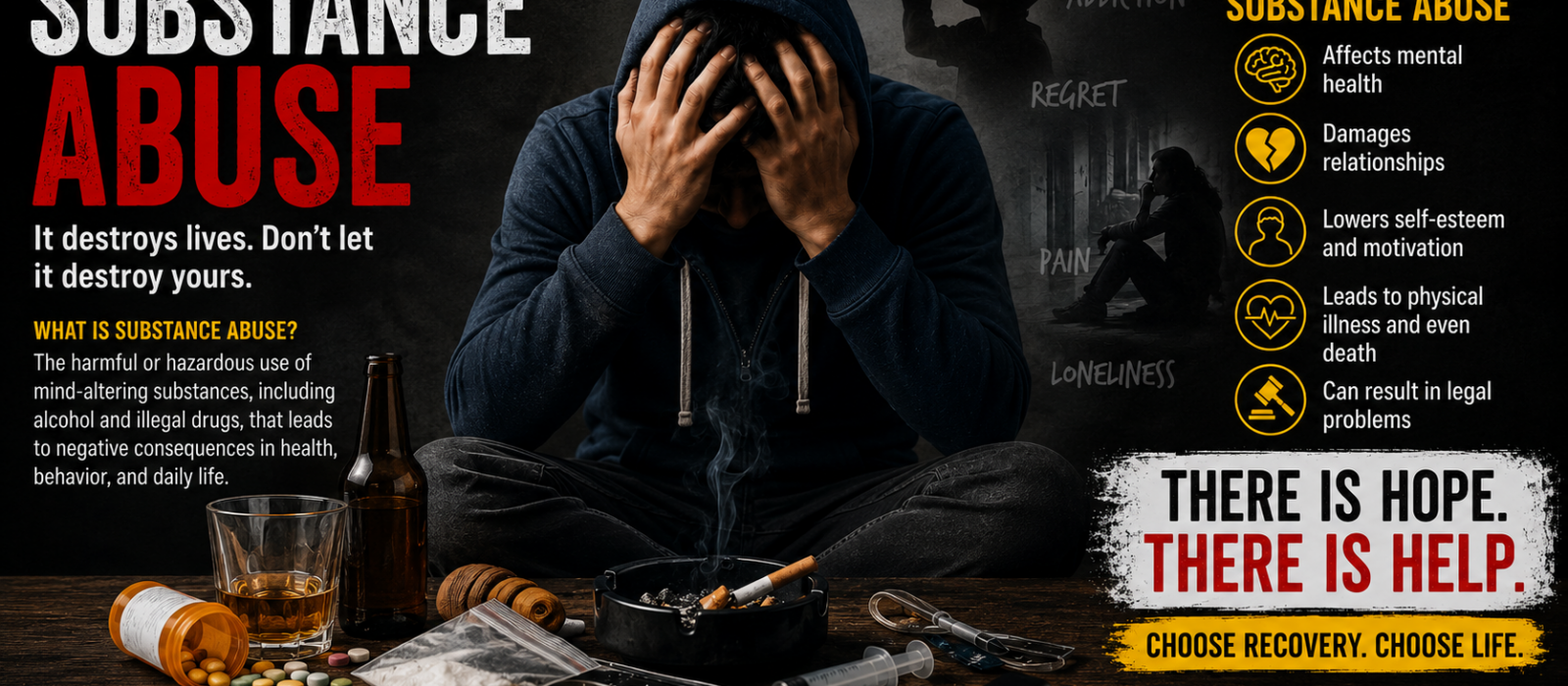

Substance abuse is not a moral failing. It is not a sign of weakness or bad character. It is a complex condition with real roots, real causes, and real paths to recovery — and it responds to compassion far better than it responds to shame.
📅 March 25, 2026 | ⏱ 12 min read | 🧠 Mental Health
- What Is Substance Abuse?
- Why It Happens: The Real Roots
- What Substances Do to the Brain
- Types of Substances and Their Effects
- Signs and Symptoms
- Substance Abuse and Mental Health
- The Wider Impact
- Recovery: What It Looks Like
- Treatment Approaches
- Supporting Someone You Love
- When and How to Seek Help
- Frequently Asked Questions

What Is Substance Abuse?
Substance abuse — also referred to as substance use disorder (SUD) in clinical settings — is a pattern of using alcohol, drugs, or other substances in a way that causes significant harm to a person’s health, relationships, functioning, and quality of life, and that continues despite that harm being known.
It is important to distinguish between different levels of substance use, because not all use constitutes abuse:
| Level of Use | What It Looks Like |
|---|---|
| Experimental use | Trying a substance out of curiosity, in a specific social context, without intention to repeat. Most people who try substances do not develop a problem. |
| Social or recreational use | Using occasionally in social settings, with some degree of control, not causing significant impairment to daily life. Still carries risks depending on the substance. |
| Harmful use / abuse | Use that is causing clear harm — to health, relationships, work, or functioning — but may not yet involve physical dependence. This is the stage where intervention can be most impactful. |
| Dependence / addiction | A chronic condition characterised by compulsive use despite harmful consequences, difficulty controlling or stopping use, and often physical and psychological dependence. Requires comprehensive support to address. |
The American Psychiatric Association’s DSM-5 uses the umbrella term “substance use disorder” — ranging from mild to severe — based on the number of diagnostic criteria met. Substance use disorders involve compulsive use despite negative consequences, a loss of control over use, and increasing amounts of time, energy, and life organised around the substance.
A note on language: Terms like “addict,” “junkie,” or “drunk” carry significant stigma and have been shown to reduce both help-seeking behaviour and the quality of care people receive. Person-first language — “a person with a substance use disorder” or “someone struggling with alcohol dependence” — reflects clinical best practice and basic human dignity. We use that language throughout this article.
Why It Happens: The Real Roots 🌱
One of the most important — and most widely misunderstood — things about substance abuse is why it happens. The simple answer that most people carry is: because the person chose it. Because they lacked willpower. Because they are weak or selfish or broken in some fundamental way.
This explanation is not only unhelpful. It is inaccurate. And it causes enormous harm by keeping people from seeking help (out of shame) and by keeping communities from providing it (out of judgment).
The real picture is far more complex — and far more human. Substance use disorders develop from a convergence of biological, psychological, social, and environmental factors. No single factor causes it, and no single factor prevents it.
The most significant contributing factors:
Genetic predisposition
Research suggests that 40–60% of vulnerability to addiction is genetically influenced. Having a parent or sibling with a substance use disorder significantly increases risk — through inherited differences in brain chemistry, reward sensitivity, and impulse control. This does not mean addiction is inevitable, but it does mean some people start with a steeper hill.
Trauma and adverse childhood experiences
The ACE (Adverse Childhood Experiences) study — one of the largest investigations into the long-term effects of childhood trauma — found a powerful dose-response relationship between childhood trauma and adult substance abuse. People with four or more ACEs had a 700% higher likelihood of alcohol dependence than those with none. Trauma dysregulates the stress response system, creates emotional pain that substances temporarily relieve, and reduces the capacity for self-regulation that healthy coping requires.
Mental health conditions
Depression, anxiety, PTSD, ADHD, bipolar disorder, and other mental health conditions significantly increase the risk of substance abuse — often because substances provide temporary relief from symptoms that are painful and untreated. This is called self-medication. The substance “works” in the short term, which reinforces its use — until the dose required increases and the consequences mount.
Social and environmental factors
Peer influence, social norms around substance use, easy availability of substances, poverty, unemployment, housing instability, and lack of meaningful social connection all increase vulnerability. Substances often fill the space left by connection, purpose, and safety that are absent from a person’s environment.
Age of first use
The earlier a person begins using substances, the higher their risk of developing a disorder. This is because adolescent brains — still developing, particularly in the prefrontal cortex responsible for impulse control and decision-making — are significantly more vulnerable to the neurological effects of substances.
Dr Gabor Maté, one of the world’s leading voices on addiction, offers perhaps the most compassionate and accurate framing: “The question is not why the addiction, but why the pain.” Substance use disorders, in most cases, began as an attempt to manage something unbearable — pain, fear, loneliness, trauma, numbness — with the best available tool at the time.
What Substances Do to the Brain 🧪
Understanding the neuroscience of addiction helps explain why stopping is so much harder than it appears from the outside — and why “just stop” is as unhelpful as telling someone with a broken leg to “just walk.”
The reward system hijack
All addictive substances — alcohol, opioids, cocaine, methamphetamine, nicotine — work by directly or indirectly triggering the release of dopamine in the brain’s reward pathway (the mesolimbic system). Dopamine is the brain’s signal for “this is important — remember it, seek it again.” Natural rewards — food, connection, sex, achievement — release dopamine in moderate amounts. Addictive substances release it in quantities far beyond anything natural rewards produce.
Over time, the brain adapts to this flood of dopamine by reducing its own dopamine production and the sensitivity of dopamine receptors — a process called downregulation. The result is a brain that:
- Needs increasing amounts of the substance to feel the same effect (tolerance)
- Feels little pleasure from natural rewards — food, relationships, activities — that once provided satisfaction
- Experiences intense craving and discomfort in the absence of the substance (withdrawal)
- Has a reward system so conditioned to the substance that cues associated with it (places, people, emotions, smells) trigger powerful craving even years into recovery
The prefrontal cortex and loss of control
Chronic substance use also impairs the prefrontal cortex — the brain region responsible for decision-making, impulse control, planning, and the ability to weigh consequences. This is why people with severe substance use disorders continue using despite clearly understanding the harm: the decision-making machinery itself has been compromised. The knowledge that it is harmful and the capacity to stop are processed in different parts of the brain — and the latter has been significantly damaged by the very substance the person is trying to stop.
🔬 Important: The American Society of Addiction Medicine, the World Health Organization, and most major medical bodies classify addiction as a chronic brain disorder — not a moral failure. It involves measurable changes in brain structure and function that are visible on neuroimaging. Recovery, likewise, involves measurable neurological healing — the brain has significant capacity to restore itself given time, support, and the right conditions.
Types of Substances and Their Effects 💊
| Substance Category | Examples | Short-Term Effects | Long-Term Risks |
|---|---|---|---|
| Alcohol | Beer, wine, spirits | Relaxation, lowered inhibition, impaired coordination and judgment | Liver disease, brain damage, cardiovascular disease, cancer, dependence |
| Opioids | Heroin, morphine, codeine, prescription painkillers (oxycodone) | Intense euphoria, pain relief, sedation | Severe dependence, overdose risk (respiratory depression), withdrawal syndrome |
| Stimulants | Cocaine, methamphetamine, ADHD medications misused | Increased energy, confidence, reduced appetite, euphoria | Heart disease, psychosis, severe depression on withdrawal, cognitive damage |
| Cannabis | Marijuana, dagga (in South Africa) | Relaxation, altered perception, increased appetite, anxiety in some | Cannabis use disorder, psychosis risk (especially in adolescents), motivation and memory effects |
| Sedatives/Benzodiazepines | Valium, Xanax, prescription sleep medications | Anxiety relief, sedation, muscle relaxation | Dependence, cognitive impairment, dangerous withdrawal (potentially fatal if stopped abruptly) |
| Inhalants | Glue, petrol, aerosols (more common in adolescents and lower-income contexts) | Brief euphoria, dizziness, hallucinations | Sudden death syndrome, severe brain damage, organ failure |
Signs and Symptoms ⚠️
Recognising substance abuse — in yourself or someone you care about — is often the first and most difficult step. Substance use disorders are characterised by denial, minimisation, and hiding, which makes recognition harder. These signs, taken together, may indicate a developing or established problem:
🧠 Psychological signs
- Mood swings, irritability, or anxiety
- Paranoia or unusual fearfulness
- Difficulty concentrating
- Memory problems
- Increasing secrecy or defensiveness
- Denial that use is a problem
🏃 Behavioural signs
- Neglecting responsibilities at work, school, or home
- Withdrawing from family and friends
- Giving up activities once enjoyed
- Continuing to use despite consequences
- Taking risks under the influence
- Financial difficulties from spending on substances
💪 Physical signs
- Changes in appetite or weight
- Disrupted sleep patterns
- Bloodshot or glazed eyes
- Deteriorating physical appearance
- Unexplained marks, sores, or track marks
- Tremors, sweating, or nausea when not using
🔁 Use-pattern signs
- Needing more to get the same effect
- Using first thing in the morning
- Unsuccessful attempts to cut down
- Spending significant time obtaining, using, or recovering
- Strong cravings or urges to use
- Continuing despite wanting to stop
Substance Abuse and Mental Health 🔗
Substance use disorders and mental health conditions are deeply intertwined — so much so that they co-occur at rates far higher than chance. Research consistently shows that approximately 50% of people with a substance use disorder also have at least one co-occurring mental health condition, and vice versa.
This is called a dual diagnosis or co-occurring disorder — and it significantly affects both how the conditions present and how they need to be treated.
| Mental Health Condition | Common Substance Co-occurring | The Connection | |||
|---|---|---|---|---|---|
| Depression | Alcohol, cannabis, opioids | Alcohol is a depressant that temporarily numbs emotional pain; opioids provide relief from emotional as well as physical pain. Substance use then worsens depression neurologically over time. | |||
| Anxiety | Alcohol, benzodiazepines, cannabis | These substances reduce anxiety in the short term; over time, tolerance builds and anxiety actually worsens — requiring more substance to manage what is now partly substance-induced anxiety. | |||
| PTSD and substance use disorder have a particularly high co-occurrence rate. | |||||
| ADHD | Cannabis, alcohol, stimulants | Undiagnosed or untreated ADHD significantly increases the risk of substance use — as substances are used to manage attention, restlessness, and emotional dysregulation that ADHD produces. |
Treating only the substance use without addressing the underlying mental health condition — or only the mental health condition without addressing the substance use — produces significantly worse outcomes than treating both simultaneously. Integrated dual diagnosis treatment is the evidence-based standard of care.
The Wider Impact 🌊
Substance abuse does not only affect the person using. Its ripple effects extend across families, communities, and generations.
👨👩👧
Family impact
Children of parents with substance use disorders face elevated risks of emotional, behavioural, and developmental difficulties. Relationships become organised around managing the person with the disorder — producing codependency, enabling, and the transmission of trauma to the next generation.
💼
Occupational and financial impact
Lost productivity, absenteeism, job loss, and the financial drain of sustaining substance use can devastate financial stability — affecting not only the individual but their dependents.
⚖️
Legal impact
Substance use increases the risk of legal difficulties — through possession, driving under the influence, or behaviour driven by intoxication or withdrawal. Legal consequences create further barriers to recovery and employment.
🏥
Physical health impact
Substance abuse is a leading contributor to preventable illness and death globally — through liver disease, cardiovascular disease, cancer, overdose, injury, and weakened immune function. Infectious disease transmission through shared needles adds additional risk.
Recovery: What It Looks Like 🌱
Recovery from substance abuse is real, possible, and happens every day — for people who have struggled for months, and for people who have struggled for decades. It is not reserved for people with the “right” circumstances, the “right” support, or a single defining moment of clarity.
Recovery is not a single event. It is a process — non-linear, sometimes slow, often difficult, and deeply individual. There is no single right way to recover, no fixed timeline, and no universal definition of what recovery looks like at the end.
Recovery may involve:
- Complete abstinence from the substance — chosen by many as the clearest and most sustainable path
- Harm reduction — reducing use and associated harms as a first step, particularly for those not yet ready or able to stop completely
- Medication-assisted treatment (MAT) — using medications like methadone, buprenorphine, or naltrexone to manage withdrawal, reduce craving, and support recovery
- Rebuilding relationships that were damaged by the period of active use
- Addressing the underlying pain — the trauma, mental health conditions, or life circumstances that drove the use in the first place
- Building a meaningful life in which the substance is no longer needed — through connection, purpose, structure, and a developing sense of self
Relapse — a return to substance use after a period of abstinence or reduced use — is common in the recovery process. Research suggests that relapse rates for substance use disorders are comparable to those for other chronic conditions like diabetes and hypertension. Relapse is not failure. It is clinical information — about what triggers remain active, what support is insufficient, and what adjustments the recovery plan needs. The response to relapse that produces the best outcomes is not shame and punishment but curiosity, compassion, and a return to support.

Treatment Approaches 🏥
Effective treatment for substance use disorders is never one-size-fits-all. The most successful approaches are individualised, comprehensive, and address the full complexity of the person — not only their substance use.
| Treatment Approach | What It Involves | Best For |
|---|---|---|
| Detoxification | Medically supervised withdrawal from the substance — managing withdrawal symptoms safely. | |
| This is the beginning, not the treatment itself. | Anyone with physical dependence — essential for alcohol and benzodiazepine withdrawal, which can be medically dangerous | |
| Medication-Assisted Treatment (MAT) | Medications that reduce craving, manage withdrawal, or block the pleasurable effects of substances — combined with counselling | Opioid and alcohol dependence particularly — strong evidence base, significantly reduces overdose death |
| Individual counselling / psychotherapy | One-to-one therapeutic work addressing the psychological, emotional, and relational dimensions of substance use — including underlying trauma and mental health | All presentations — the core of most recovery programmes |
| Cognitive Behavioural Therapy (CBT) | Identifying and changing thought patterns and triggers that maintain substance use; building coping skills for high-risk situations | Strong evidence across most substance use disorders |
| Motivational Interviewing | Resolving ambivalence about change; building internal motivation for recovery from the client’s own values | Early intervention; people who are ambivalent or resistant to treatment |
| Group therapy and peer support | Therapeutic groups facilitated by a professional; peer support programmes like AA, NA, or SMART Recovery — reducing isolation and providing shared experience | Most presentations — connection and community are among the strongest protective factors in recovery |
| Residential / inpatient treatment | Structured residential programme providing 24-hour support, removing the person from their using environment, and providing intensive therapeutic work | Severe dependence; when outpatient treatment has been insufficient; when the home environment is actively harmful to recovery |
Supporting Someone You Love 🤍
Loving someone with a substance use disorder is one of the most painful and disorienting experiences a family member or friend can have. The relationship becomes consumed by the disorder — by managing, worrying, covering up, rescuing, and grieving the person who seems to have disappeared behind the substance.
Here is what the evidence suggests actually helps — and what doesn’t:
| What tends to help | What tends not to help |
|---|---|
| Maintaining clear, compassionate boundaries about what you will and won’t do | Covering up consequences, lending money, or rescuing from consequences (“enabling”) |
| Expressing concern calmly and specifically about behaviour, not character | Shaming, lecturing, or arguing when the person is intoxicated |
| Seeking support for yourself — through therapy, Al-Anon, or other family support programmes | Neglecting your own needs while focusing entirely on theirs |
| Educating yourself about substance use disorders as a health condition | Treating use as a character failure — which increases shame and reduces help-seeking |
| Remaining available with genuine warmth when they are ready to seek help | Issuing ultimatums without following through — which teaches that there are no real consequences |
You cannot force someone to recover. Recovery requires the person’s own desire and readiness — however you can support the conditions that make that readiness more likely. And taking care of yourself — your mental health, your relationships, your boundaries — is not selfish. It is essential, both for your own wellbeing and for your capacity to be genuinely helpful over the long term.
When and How to Seek Help 🌿
If you are concerned about your own substance use — or someone else’s — the most important thing is to seek help sooner rather than later. Substance use disorders respond best to early intervention. The longer the pattern continues, the more entrenched it becomes — neurologically, psychologically, and socially.
Consider reaching out if:
- Your substance use is affecting your health, relationships, work, or finances
- You have tried to cut down or stop and have not been able to
- You are using substances to cope with emotional pain, anxiety, or difficult memories
- People who care about you have expressed concern
- You are experiencing withdrawal symptoms when you stop
- You are experiencing thoughts of harming yourself
First steps to take:
- Speak to your GP or general practitioner — they can assess, refer, and in some cases prescribe medication support
- Contact a local addiction counselling service or community health clinic
- Reach out to a private psychologist or counsellor with experience in substance use disorders
- In South Africa, the South African National Council on Alcoholism and Drug Dependence (SANCA) provides counselling, treatment referrals, and support nationwide
- Explore peer support — Alcoholics Anonymous, Narcotics Anonymous, and SMART Recovery all offer free meetings and community
✦ Key Takeaways
- Substance abuse is a complex health condition — not a moral failing. It develops from an interaction of genetic, psychological, social, and environmental factors, and it responds to compassion and professional support.
- Substances hijack the brain’s reward system, producing tolerance, withdrawal, and craving that make stopping far harder than willpower alone can manage. This is biology, not weakness.
- Approximately 50% of people with substance use disorders have a co-occurring mental health condition. Treating both together produces significantly better outcomes than treating either alone.
- Recovery is possible — at any stage, at any age, after any duration of use. Relapse is part of the process for many people, not the end of the road.
- Effective treatment is individualised and comprehensive — addressing the substance use, the underlying factors, and the wider impact on relationships and functioning.
- If you or someone you love is struggling — please reach out. Help is available, recovery is real, and no one has to do this alone. 🌱
Frequently Asked Questions
Is addiction a choice or a disease?
This is one of the most debated questions in the field — and the most honest answer is: both, and neither completely. The initial decision to use a substance involves choice. But as use continues and the brain changes, the capacity for free choice is progressively compromised — by neurological changes to the reward system and prefrontal cortex, by the overwhelming pull of craving, and by the restructuring of daily life around the substance. Most major medical bodies — including the American Medical Association and the World Health Organization — classify addiction as a chronic brain disorder that involves both biological and behavioural components. Understanding it this way is not excusing harmful behaviour. It is creating the conditions under which effective treatment — rather than punishment and shame — becomes possible.
Can someone recover without professional help?
Yes — some people do. Research on “natural recovery” (recovering without formal treatment) shows it is possible, particularly for those with milder presentations and strong social support. However, for moderate to severe substance use disorders — particularly those involving physical dependence, co-occurring mental health conditions, or long duration — professional support significantly improves outcomes and reduces risk. Attempting to withdraw from alcohol or benzodiazepines without medical supervision can be physically dangerous. If there is any doubt, seeking professional assessment first is always the safer choice.
How do I talk to someone I’m worried about?
Choose a calm moment when they are sober. Express your concern in terms of specific behaviours you have observed and how they affect you — “I’ve noticed you seem to be drinking more, and I’m worried about you” — rather than labels or accusations. Avoid ultimatums unless you are prepared to follow through. Listen more than you speak. Don’t expect one conversation to produce change — the goal is to plant a seed of concern, maintain the relationship, and be available when they are ready. If you are not sure how to approach it, speaking to a counsellor yourself first can help you prepare.
What is harm reduction — and is it a valid approach?
Harm reduction is a public health approach that aims to reduce the negative consequences of substance use without necessarily requiring abstinence as an immediate goal. It includes approaches like needle exchange programmes, naloxone distribution to prevent overdose deaths, safe injection sites, and strategies that help people use more safely while working toward eventual reduction or cessation. Harm reduction is strongly evidence-based — it saves lives, reduces disease transmission, and keeps people engaged with services until they are ready for further change. It is not “giving up” or “enabling.” It is meeting people where they are, which the evidence shows is the most effective starting point for change.
How long does treatment take?
Because substance use disorders are chronic conditions, treatment is often best understood as ongoing rather than time-limited — similar to how we approach diabetes or hypertension. Acute treatment (detox, residential) may last days to months. Outpatient counselling may continue for a year or more. Peer support and maintenance strategies often continue indefinitely. Research shows that longer engagement with treatment produces better outcomes, and that brief treatment followed by no ongoing support has higher relapse rates. The goal is not to complete a programme — it is to build a life in which long-term recovery is sustainable.
🌸
Recovery is not the absence of struggle. It is the presence of hope.
If you are struggling with substance use — or loving someone who is — please know that help exists, recovery happens, and you do not have to face this alone. Reaching out is the first and bravest step. 💚
If you or someone you know is in immediate danger due to substance use, please contact emergency services. For substance abuse support in South Africa, contact SANCA on 011 892 3829 or visit sanca.co.za. For crisis support, contact the South African Depression and Anxiety Group (SADAG) on 0800 21 22 23.
Evidence-based wellness content to help you feel your best — body and mind. | The Whole You Wellness
Leave a Comment