
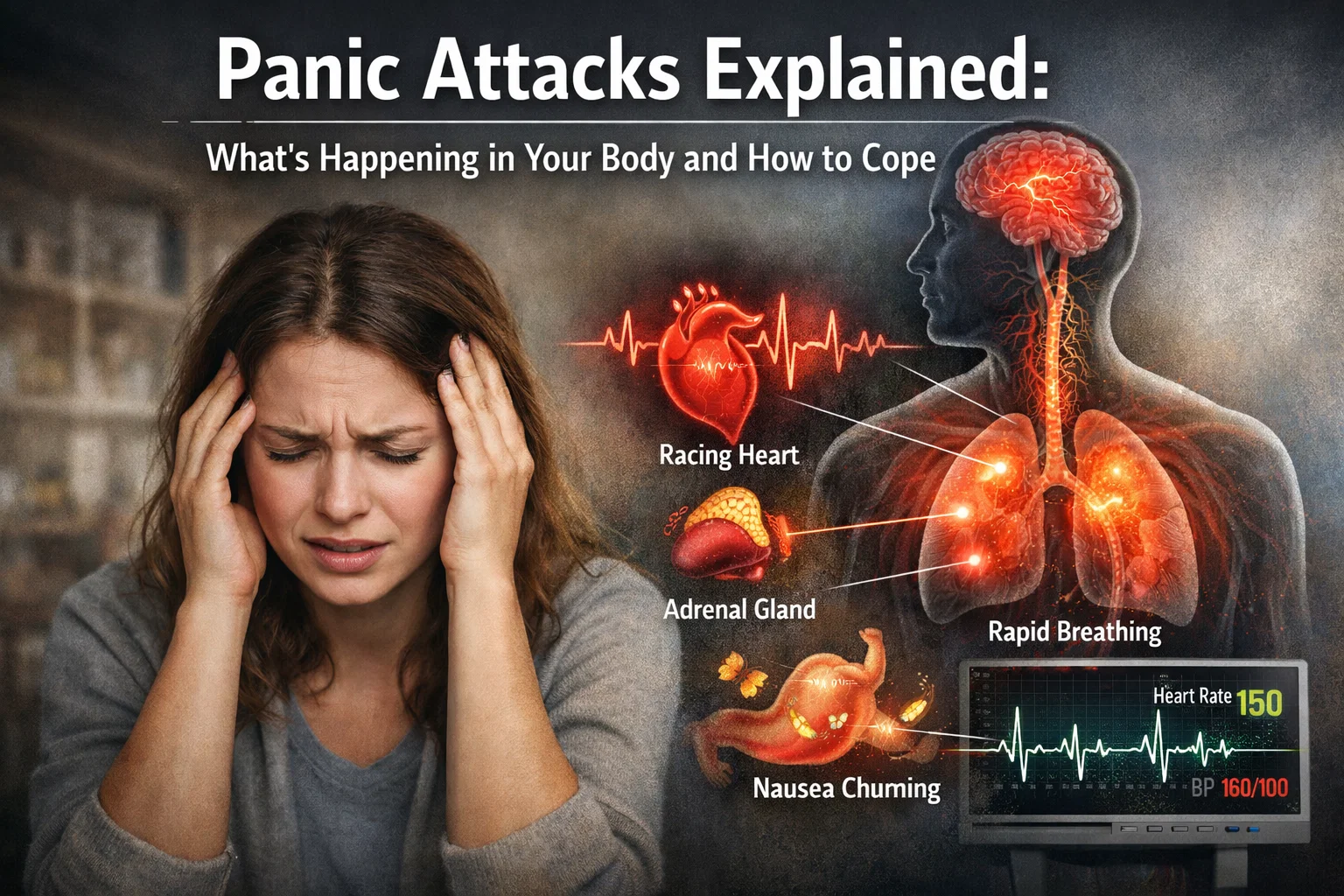

Your heart is pounding so hard you’re convinced it will burst through your chest. You can’t catch your breath. Your hands are tingling, your vision is narrowing, and waves of dizziness wash over you. You’re absolutely certain something catastrophic is happening—a heart attack, a stroke, or that you’re losing your mind. The terror is so overwhelming that you’re convinced you might die right here, right now.
Then, as suddenly as it began, the intensity starts to fade. Within minutes, the worst is over, leaving you shaken, exhausted, and deeply afraid of when it might happen again.
If you’ve experienced this, you’ve likely had a panic attack—one of the most frightening experiences a person can have, yet surprisingly common and, importantly, not dangerous. Understanding what panic attacks are, why they happen, and how to manage them can transform your relationship with these episodes from one of terror to one of informed coping.
What Is a Panic Attack?
A panic attack is a sudden surge of overwhelming anxiety and physical symptoms that reaches peak intensity within minutes. Despite feeling like something is seriously wrong with your body, panic attacks are not medically dangerous. They cannot cause heart attacks, strokes, or death, though they certainly feel life-threatening in the moment.
Panic attacks are characterized by an abrupt onset of intense fear or discomfort, accompanied by at least four of the following symptoms:
- Pounding or racing heart (palpitations)
- Sweating, often profuse
- Trembling or shaking
- Shortness of breath or feelings of being smothered
- Feelings of choking
- Chest pain or discomfort
- Nausea or abdominal distress
- Feeling dizzy, unsteady, lightheaded, or faint
- Chills or heat sensations
- Numbness or tingling sensations (paresthesias)
- Feelings of unreality (derealization) or being detached from oneself (depersonalization)
- Fear of losing control or “going crazy”
- Fear of dying
Most panic attacks peak within 10 minutes and rarely last longer than 30 minutes, though the emotional aftershock can linger for hours. Some people experience what’s called “limited symptom panic attacks,” which involve fewer than four symptoms but can still be distressing.
The Science Behind Panic: What’s Actually Happening
Understanding the biology of panic attacks can be incredibly reassuring. When you know what’s actually happening in your body, the symptoms become less mysterious and frightening.
Your Body’s Alarm System
Panic attacks are essentially a misfiring of your body’s threat response system—what’s commonly called the “fight or flight” response. This system evolved to protect you from genuine physical danger, like encountering a predator. When your brain perceives a threat, it activates your sympathetic nervous system, triggering a cascade of physical changes designed to help you fight or flee.
The problem with panic attacks is that this alarm system activates when there’s no actual danger. Your body is responding as if you’re facing a life-threatening situation when you’re actually sitting in traffic, standing in a queue, or even lying in bed.
The Chemical Cascade
When a panic attack begins, your amygdala—the brain’s fear center—signals danger. This triggers your hypothalamus to activate your autonomic nervous system. Your adrenal glands release a surge of stress hormones, primarily adrenaline (epinephrine) and cortisol.
Adrenaline causes your heart to beat faster and harder, pumping more blood to your muscles. Your breathing quickens to take in more oxygen. Blood flow is redirected from your digestive system and extremities to your large muscle groups. Your pupils dilate to improve vision. You begin sweating to cool your body down in preparation for physical exertion.
All of these responses would be extremely useful if you were actually facing a physical threat. They’d give you the energy and strength to run or fight. But when there’s no danger to flee from or fight, these sensations just feel terrifying and inexplicable.
The Vicious Cycle
What makes panic attacks particularly intense is the self-perpetuating cycle they create. You notice your racing heart or shortness of breath, which makes you anxious about what these symptoms mean. This anxiety triggers more adrenaline release, which intensifies the physical symptoms, which increases your fear, which releases more adrenaline—and the cycle escalates rapidly.
This is why panic attacks reach such intense peaks so quickly. Each symptom feeds the fear, which feeds more symptoms, creating an upward spiral of panic.
Why Panic Attacks End
The good news is that panic attacks are self-limiting. Your body cannot maintain this level of activation indefinitely. After several minutes, even without intervention, your body will begin activating the parasympathetic nervous system—the “rest and digest” system that calms you down.
Additionally, your body metabolizes and reabsorbs the stress hormones that were released. Adrenaline has a half-life of only a few minutes, which is why panic attacks typically peak within 10 minutes and then begin to subside.
Understanding that panic attacks naturally end can be reassuring when you’re in the midst of one. No matter how terrible it feels, it will pass, typically within 20-30 minutes.
Types of Panic Attacks
Panic attacks are generally categorized into two types based on what triggers them:
Expected (Cued) Panic Attacks
These occur in response to a known trigger or feared situation. For example, someone with a fear of enclosed spaces might have a panic attack when entering an elevator. Someone afraid of public speaking might panic before giving a presentation. Someone who’s claustrophobic might panic in a crowded taxi.
Expected panic attacks make a certain kind of sense—you can identify what triggered the attack. While still distressing, they feel somewhat predictable, and you can often anticipate situations where they might occur.
Unexpected (Uncued) Panic Attacks
These seem to come out of nowhere, with no identifiable trigger. You might be watching television, shopping at a mall, or even sleeping when a panic attack suddenly strikes. These are particularly frightening because their unpredictability makes you feel vulnerable and unsafe anywhere, at any time.
Many people who experience unexpected panic attacks develop intense anxiety about having another attack, which can lead to panic disorder.
Panic Disorder: When Panic Attacks Become Chronic
Having one or even a few panic attacks doesn’t necessarily mean you have panic disorder. Many people have a panic attack in response to extreme stress, a traumatic event, or significant life changes and never experience another one.
Panic disorder is diagnosed when you experience recurrent unexpected panic attacks, and you spend at least a month or more worrying about having another attack, worrying about what the attacks mean (e.g., fearing you have a serious medical condition), or changing your behavior because of the attacks (avoiding certain places or activities).
This persistent worry and behavioral change is what distinguishes panic disorder from isolated panic attacks. The fear of future panic attacks can become as disabling as the attacks themselves.
Agoraphobia: Fear of Panic in Public
Many people with panic disorder develop agoraphobia—anxiety about being in situations where escape might be difficult or embarrassing if a panic attack occurs, or where help might not be available. This might include crowded places like shopping centers, taxis, or trains; open spaces like parking lots or bridges; enclosed spaces like lifts or small shops; standing in queues or being in crowds; or being outside the home alone.
Agoraphobia develops as a protective strategy—if you’ve had panic attacks in certain situations, you start avoiding those situations to prevent future attacks. Over time, the number of “safe” places shrinks, and in severe cases, people become homebound.
In South Africa’s context, agoraphobia can be complicated by legitimate safety concerns. If you’re avoiding certain areas or situations partly due to crime concerns and partly due to panic, it can be difficult to tease apart realistic caution from anxiety-driven avoidance.
Common Triggers and Risk Factors
While unexpected panic attacks seem to have no trigger, certain factors can increase vulnerability to panic attacks:
Physical Triggers
Caffeine consumption, particularly in large amounts, can trigger panic-like symptoms in sensitive individuals. Sleep deprivation disrupts emotional regulation and increases anxiety vulnerability. Dehydration can cause symptoms like dizziness and rapid heartbeat that might be misinterpreted as panic.
Certain medications and substances can trigger panic, including stimulants, some cold medications, and withdrawal from alcohol or benzodiazepines. Medical conditions like hyperthyroidism, hypoglycemia, and cardiac arrhythmias can produce panic-like symptoms.
Low blood sugar from skipping meals can trigger panic symptoms. Even intense physical sensations from exercise, especially if you’re not used to them, can be misinterpreted as dangerous and trigger panic in some people.
Psychological Triggers
Major life stressors like job loss, relationship problems, financial difficulties, or bereavement can precipitate panic attacks. Significant life transitions, even positive ones like getting married, having a baby, or moving to a new city, can increase vulnerability.
Chronic stress that keeps your nervous system in a state of heightened arousal makes panic attacks more likely. Trauma, particularly if it involved feeling helpless or trapped, can increase panic vulnerability.
Thinking Patterns
Catastrophic thinking—immediately jumping to worst-case scenarios when you notice unusual bodily sensations—can trigger panic. Hypervigilance about your body, constantly scanning for signs that something is wrong, creates anxiety that can escalate into panic.
Anxiety sensitivity—fear of anxiety symptoms themselves—is one of the strongest predictors of panic attacks. If you’re terrified of having a racing heart or feeling dizzy, you’re more likely to panic when these sensations occur.
Genetic and Biological Factors
Panic disorder tends to run in families, suggesting a genetic component. Some people appear to have a more reactive nervous system that’s quicker to activate the fight-or-flight response. Imbalances in neurotransmitters like serotonin, norepinephrine, and GABA may increase panic vulnerability.
Environmental Factors
Growing up in an environment where anxiety was modeled by parents or caregivers can increase your risk. Overprotective parenting that didn’t allow you to develop confidence in handling challenges may contribute to panic vulnerability.
Cultural factors also play a role. In South Africa, exposure to crime, violence, or other traumatic events can increase baseline anxiety levels, making panic attacks more likely. Economic stress and uncertainty can maintain a state of chronic worry that increases vulnerability to panic.
The South African Experience of Panic Attacks
Several factors specific to the South African context can influence how panic attacks are experienced and understood:
Crime and Safety Trauma
South Africa’s high crime rates mean many people have experienced or witnessed traumatic events. This collective trauma can contribute to a heightened baseline level of vigilance and anxiety. For some, panic attacks may be triggered by situations that remind them of past traumatic experiences, even unconsciously.
The challenge is distinguishing between appropriate safety awareness and anxiety-driven hypervigilance. Someone who’s experienced a hijacking might understandably feel panic symptoms when driving in certain areas, but if this generalizes to all driving or leaves the person unable to function, professional help may be needed.
Healthcare Access and Response
When having a panic attack, many South Africans first go to hospital emergency departments, fearing a heart attack or serious medical condition. While ruling out medical causes is important, limited mental health resources in public healthcare means that after physical causes are excluded, patients may receive minimal follow-up or education about panic attacks.
Private healthcare offers more mental health resources, but cost remains a significant barrier for many. This can leave people struggling with panic attacks without adequate support or treatment.
Stigma and Cultural Understanding
In many South African communities, mental health conditions carry significant stigma. Panic attacks might be dismissed as weakness, attention-seeking, or lack of faith. Traditional or cultural explanations for panic symptoms might differ from Western medical models, which can be both a source of confusion and an alternative framework for understanding and coping.
Some people describe panic-like experiences using culturally specific language or attribute them to spiritual causes. These interpretations aren’t inherently problematic if they lead to effective coping strategies, but they can delay access to evidence-based treatment if they prevent people from seeking professional help.
Transportation and Public Spaces
South Africa’s reliance on taxis and public transportation can be particularly challenging for people with panic disorder. The crowded, sometimes unpredictable nature of taxi travel can trigger panic attacks or be avoided altogether, which can significantly limit mobility and employment opportunities.
Similarly, large shopping centers, stadiums, and other crowded public spaces that are part of daily life can become sources of intense anxiety for people with panic disorder.
Physical Symptoms Explained: Why They Feel So Scary
Understanding why each panic symptom occurs can reduce the fear surrounding it:
Racing Heart and Palpitations
Your heart pounds because adrenaline increases your heart rate to pump more blood to your muscles. It feels frightening because it’s unusual and seems out of control, but your heart is designed to handle this. Athletes regularly push their heart rates much higher during exercise without any harm. The sensation of palpitations (feeling like your heart is skipping beats or fluttering) often occurs when your heart rate is returning to normal, not because something is wrong.
Shortness of Breath
During panic, you breathe faster to take in more oxygen. Paradoxically, this rapid breathing (hyperventilation) often makes you feel like you can’t get enough air. You’re actually taking in too much oxygen and breathing out too much carbon dioxide, which alters your blood chemistry and creates sensations of breathlessness, chest tightness, and dizziness.
This is uncomfortable but not dangerous. Your body has protective mechanisms that won’t allow you to hyperventilate to the point of harm.
Chest Pain or Tightness
Chest tightness during panic comes from muscle tension in your chest wall and rapid breathing. It’s not your heart—it’s the muscles around your ribcage tensing up. Because we associate chest pain with heart attacks, this symptom is particularly frightening, but panic-related chest pain is muscular, not cardiac.
If you’re concerned about chest pain, especially if you have risk factors for heart disease, it’s appropriate to get medical evaluation. But once cardiac causes have been ruled out, you can be confident that chest tightness during panic, while uncomfortable, is not dangerous.
Dizziness and Lightheadedness
These sensations result from hyperventilation changing the carbon dioxide levels in your blood, which temporarily alters blood flow to your brain. It feels like you might faint, but fainting during a panic attack is extremely rare because your blood pressure is actually elevated, not dropping.
The fight-or-flight response is designed to keep you alert and active, not to make you pass out. If anything, you’re hyper-alert during panic.
Tingling and Numbness
The tingling sensations in your hands, feet, or around your mouth come from hyperventilation. The change in blood chemistry temporarily affects nerve function. This is the same sensation you’d get from blowing up many balloons in succession—harmless and temporary.
Nausea and Abdominal Distress
When the fight-or-flight response activates, blood flow is redirected away from your digestive system to your muscles. This can cause nausea, stomach cramps, or the sensation of needing to use the bathroom. Again, this is your body prioritizing immediate survival over digestion—uncomfortable but not dangerous.
Trembling and Shaking
Your muscles tense and may shake because they’re preparing for action. The excess adrenaline and muscle tension combine to create trembling. This is visible evidence of the activation of your nervous system, not a sign that something is wrong.
Sweating and Temperature Changes
Sweating helps cool your body during the anticipated physical exertion of fighting or fleeing. Temperature fluctuations—feeling intensely hot or suddenly cold—are part of your body’s attempt to regulate temperature in response to the metabolic changes occurring.
Feelings of Unreality or Detachment
Derealization (feeling like the world isn’t real) and depersonalization (feeling disconnected from yourself) are protective mechanisms. When you’re overwhelmed, your brain essentially creates some distance between you and the threatening experience. While these sensations are disturbing, they’re your mind’s way of protecting you from overwhelming fear, and they’re temporary.
Immediate Coping Strategies During a Panic Attack
When you’re in the midst of a panic attack, certain strategies can help reduce its intensity and duration:
Recognize It’s a Panic Attack
As soon as you recognize what’s happening, remind yourself: “This is a panic attack. It’s not dangerous. It will pass.” This simple recognition can prevent the fear-of-fear cycle that makes panic worse.
Even saying out loud, “I’m having a panic attack” can help activate the more rational parts of your brain and reduce the sense of mystery and danger.
Breathe Slowly and Deliberately
Instead of trying to take deep breaths (which often makes hyperventilation worse), focus on slowing your breathing. Try breathing in for a count of four, holding for a count of four, and breathing out for a count of six.
The key is making your exhale longer than your inhale, which activates your parasympathetic (calming) nervous system.
Some people find it helpful to breathe into cupped hands or a paper bag briefly, which can help rebalance carbon dioxide levels. However, don’t do this for more than a minute at a time, and never use a plastic bag.
Ground Yourself in the Present
Panic pulls you into catastrophic thoughts about the future (“What if I die?” “What if this never stops?”). Grounding techniques bring you back to the present moment where you are actually safe.
Try the 5-4-3-2-1 technique: Name five things you can see, four things you can touch, three things you can hear, two things you can smell, and one thing you can taste. This engages your senses and shifts your focus away from internal panic symptoms.
You can also hold something cold (ice cubes, a cold drink), feel your feet firmly on the ground, or press your hands together, focusing on the physical sensations.
Stay Where You Are
The urge to flee is powerful during panic, but running away reinforces the message that the situation is actually dangerous. If it’s safe to do so, stay where you are and ride out the panic attack.
This teaches your brain that the situation isn’t actually dangerous and that you can cope with panic without escaping. Over time, this reduces the likelihood of future attacks in similar situations.
If you must move, do so slowly and deliberately rather than frantically fleeing.
Use Self-Talk
Talk to yourself calmly and reassuringly, the way you’d speak to a frightened child. “You’re okay. This is uncomfortable but not dangerous. You’ve gotten through this before. It will pass soon.”
Avoid catastrophic self-talk like “Something terrible is happening” or “I can’t handle this.” Even if these thoughts arise, don’t engage with them or try to analyze them. Simply acknowledge them (“There’s that thought again”) and return to reassuring statements.
Focus on Something External
Count backwards from 100 by threes. Describe objects in detail in your mind. Recite song lyrics or poetry. Listen carefully to sounds around you. These activities occupy your mind and prevent the anxious escalation of fearful thoughts.
Accept Rather Than Fight
Paradoxically, fighting panic often makes it worse. The more you resist and fear the sensations, the more intense they become. Try instead to accept the panic: “Okay, this is happening. It’s unpleasant, but I can let it be here. It will pass on its own.”
This acceptance stance reduces the fight-or-flight response because you’re no longer treating the panic itself as a threat.
Remind Yourself of the Time Limit
Panic attacks typically peak within 10 minutes and resolve within 20-30 minutes. Remind yourself that no matter how terrible it feels, it will be over soon. Look at a clock or start a timer if it helps to see time passing.
Long-Term Strategies: Preventing and Reducing Panic Attacks
While immediate coping strategies help during an attack, long-term approaches can reduce the frequency and intensity of panic attacks overall:
Cognitive Behavioral Therapy (CBT)
CBT is the gold standard treatment for panic disorder. It helps you identify and challenge the catastrophic thoughts that fuel panic, understand the physical symptoms of panic and why they’re not dangerous, gradually face feared situations through exposure, and develop effective coping strategies.
Research consistently shows that CBT is highly effective for panic disorder, with many people experiencing significant improvement or complete remission of panic attacks.
Interoceptive Exposure
This specific type of exposure involves deliberately creating the physical sensations of panic in a safe, controlled way. For example, you might spin in a chair to create dizziness, breathe through a straw to create breathlessness, or run in place to increase your heart rate.
By repeatedly experiencing these sensations without catastrophe, you learn that the sensations themselves aren’t dangerous. Your fear of the physical symptoms decreases, which reduces panic attacks triggered by normal bodily sensations.
Situational Exposure
If you’ve been avoiding situations where you’ve had panic attacks or where you fear having them, gradual exposure to these situations is crucial. Create a hierarchy of feared situations from least to most anxiety-provoking, and work through them systematically.
For example, if you fear crowded places, you might start by visiting a quiet shop at an off-peak time, then a busier shop, then a shopping center, gradually working up to your most feared situation.
The key is to stay in each situation long enough for your anxiety to decrease naturally (usually 20-30 minutes), proving to yourself that you can handle it.
Lifestyle Modifications
Several lifestyle factors can reduce overall anxiety and make panic attacks less likely:
Regular exercise reduces baseline anxiety, improves stress resilience, and burns off excess adrenaline. Aim for 30 minutes of moderate activity most days.
Sleep hygiene is crucial—prioritize consistent sleep schedule, adequate sleep duration (7-9 hours), and good sleep environment.
Reduce caffeine and stimulants which can trigger panic-like symptoms in sensitive individuals.
Limit alcohol, which may seem to help anxiety in the moment but actually increases anxiety overall and can trigger panic during withdrawal.
Eat regularly to maintain stable blood sugar levels. Skipping meals can trigger panic symptoms.
Practice stress management through regular relaxation techniques, not just when you’re panicking.
Mindfulness and Meditation
Regular mindfulness practice helps you develop a different relationship with uncomfortable sensations and thoughts. Instead of reacting with fear to bodily sensations, you learn to observe them without judgment.
Even 10 minutes of daily mindfulness meditation can reduce overall anxiety levels and make you less reactive to panic triggers.
Build Your Stress Resilience
Since stress makes panic attacks more likely, developing overall stress management skills is important. This might include setting boundaries and learning to say no, delegating tasks when possible, building social support, engaging in enjoyable activities regularly, and addressing sources of chronic stress where possible.
Breathing Retraining
Learn and practice proper breathing techniques when you’re calm, so they’re easier to use during panic. Diaphragmatic breathing (breathing from your belly rather than your chest) activates the calming parasympathetic nervous system.
Practice this daily: place one hand on your chest and one on your belly. Breathe so that your belly hand moves while your chest hand stays relatively still. Breathe in for 4 counts, out for 6 counts.
Medication
For some people, medication can be a helpful part of treatment, particularly in the beginning when panic attacks are frequent and severe.
SSRIs (Selective Serotonin Reuptake Inhibitors) are often prescribed for panic disorder. They take several weeks to become effective but can significantly reduce panic attack frequency.
Benzodiazepines provide rapid relief during panic but are prescribed cautiously due to dependence risk. They’re sometimes used short-term while waiting for SSRIs to take effect or for occasional use in specific situations.
Beta-blockers can reduce physical symptoms like racing heart and may be helpful for situational panic.
Medication is most effective when combined with therapy. Many people use medication to reduce symptoms while learning psychological coping strategies, then gradually discontinue medication as their skills improve.
What NOT to Do During a Panic Attack
Certain responses, while understandable, can make panic worse or prevent you from learning to cope:
Don’t flee or escape unless you’re in actual danger. Running away reinforces fear and prevents you from learning that you can cope.
Don’t rely on safety behaviors like always having someone with you, carrying anxiety medication “just in case,” or staying near exits. These behaviors maintain the belief that panic is dangerous and prevent you from building confidence.
Don’t try to completely suppress or control the panic. The more you fight it, the worse it gets. Acceptance and allowing reduce panic more effectively than fighting.
Don’t catastrophize by imagining worst-case scenarios or assuming you’re having a medical emergency each time (once medical causes have been ruled out).
Don’t use alcohol or unprescribed drugs to cope with panic. This creates additional problems and doesn’t address the underlying issue.
Don’t avoid everything that makes you anxious. Avoidance maintains and worsens panic disorder over time.
When to Seek Professional Help
You should consider professional help if:
Panic attacks are recurring and affecting your quality of life. You’re avoiding important activities, places, or situations due to fear of panic. You’re developing agoraphobia or your world is shrinking. You’re experiencing significant distress between panic attacks, worrying constantly about when the next one will occur.
You’re using alcohol or substances to cope with panic. Panic attacks are accompanied by depression or other mental health concerns. Self-help strategies haven’t been effective after several weeks of consistent practice.
You’re having difficulty distinguishing panic attacks from medical emergencies and frequently seeking emergency medical care.
A mental health professional can provide proper assessment, evidence-based treatment like CBT, medication if appropriate, and support as you work through recovery.
Living Well Despite Panic: Long-Term Perspective
While panic attacks are intensely unpleasant, they become less frightening and less frequent as you understand them better and develop effective coping strategies. Most people who engage in treatment for panic disorder experience significant improvement.
Recovery doesn’t necessarily mean never having another panic attack. It means panic attacks, if they occur, no longer control your life. You have the tools to cope, the understanding to recognize what’s happening, and the confidence that you can handle it.
Many people find that once they stop fearing panic attacks, the attacks become less frequent or stop altogether. The fear of fear is often what maintains the cycle, and breaking that fear is the key to freedom.
Your journey with panic might involve setbacks and challenges, but each panic attack you get through builds evidence that you can cope, that panic is not dangerous, and that you are stronger than the fear.
If you’re struggling with panic attacks and need support, consider reaching out to a qualified mental health professional. In South Africa, contact:
- SADAG (South African Depression and Anxiety Group): 0800 567 567
- For immediate crisis support: Lifeline 0861 322 322
Remember, panic attacks are treatable, and you don’t have to face them alone.



Leave a Comment