


The invisible walls we build around our need for others — and what it costs us to keep them standing.
Most of us have been there — staring at our phone, composing a message in our head, then closing the app without sending it. The words exist. The need is real. And yet something holds us back with a grip so familiar we barely notice it anymore.
The Stories We Inherited

Long before we could articulate it, many of us absorbed a quiet lesson: needing help is a sign of weakness. It arrived through a parent who never asked for directions, a culture that celebrated the self-made individual, a classroom where admitting you didn’t understand felt like social suicide.
These aren’t flaws in character — they’re downloaded programs. Psychologists call them core schemas: deep, automatic beliefs about ourselves and the world that operate below conscious awareness. Common ones include “I should be able to handle this alone,” “asking burdens people,” and the quietly devastating “I’m not worth helping.”
The troubling part is that these beliefs feel like truth. Not like learned assumptions we can examine, but like facts of life — as self-evident as gravity. Unpacking them requires slowing down enough to ask: whose voice is actually saying I shouldn’t need this?
The Terrifying Act of Being Seen

Asking for help is an act of exposure. You are, in that moment, showing someone a gap — an unmet need, a limitation, a place where you haven’t figured things out. For many people, that feels less like reaching out and more like stepping off a ledge.
Fear of judgment is primary: Will they think less of me? But running just beneath it is something older and more tender — the fear of rejection. What if I ask and they say no? What if my need is inconvenient? What if I finally let someone see me struggling, and they look away?
Researcher Brené Brown famously described vulnerability as the birthplace of connection, love, and belonging — but also acknowledged it as the most accurate measure of courage we have. We know, on some level, that real closeness requires it. And still the door stays closed.
of people say they fear being judged when asking for help at work
adults report feeling lonely even within close relationships
more likely to help — how people respond when directly asked vs. not asked
Here is the painful irony: the very fear that keeps us silent — the fear of burdening people, of being a nuisance — often makes things worse. People who care about us notice when we’re struggling. Our silence doesn’t spare them; it just leaves them unable to do anything about it.
The Neuroscience of Holding Back

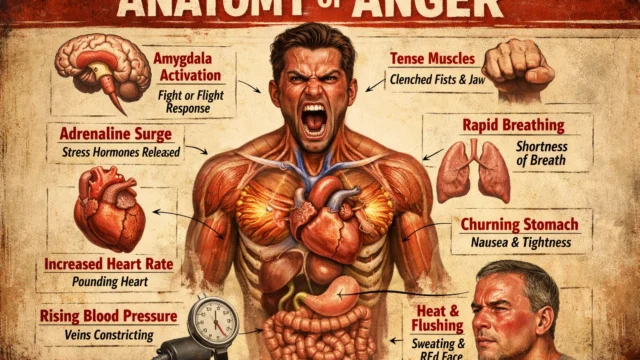
This isn’t just emotional — it’s biological. The brain’s threat-detection system, the amygdala, doesn’t distinguish very well between a predator and social risk. To the nervous system, the possibility of rejection or humiliation registers as genuinely dangerous, triggering a fight-flight-freeze response that makes asking feel impossible in the moment.
Add to this a phenomenon called egocentric bias: we overestimate how closely others are watching us, how harshly they’ll judge us, and how long they’ll remember our missteps. In reality, people are far more consumed by their own inner worlds than by cataloguing our shortcomings. We are, to most people, a supporting character — not the protagonist of their daily drama.
There’s also the mental load of asking itself. Formulating a request requires cognitive effort: choosing the right words, anticipating the other person’s reaction, timing it correctly. When we’re already depleted — which is precisely when we most need help — this overhead can feel insurmountable. The mind says: it’s easier to just handle it. And so we do. Until we can’t.
The World We’re Living In

Culture shapes what help-seeking looks like — and whether it feels permissible at all. In many Western, particularly Anglo-American contexts, independence is fetishized. “Pull yourself up by your bootstraps” isn’t just a phrase; it’s a moral framework that quietly implies that needing a hand is a personal failure.
Workplace culture compounds this further. Many professional environments still reward the appearance of effortless competence. Admitting you don’t know something, or that you’re struggling with a project, can feel career-threatening — even in organisations that nominally value “psychological safety.” The message is often: the door is open, but you sense it isn’t really.
Gender adds another dimension. Men, socialized toward stoicism, are statistically far less likely to seek mental health support, with serious consequences for wellbeing and mortality. Women, meanwhile, may face the opposite pull — socialized to provide help but sometimes dismissed when they need it for themselves.
Social media has quietly worsened this. When everyone’s feed presents curated versions of competence, travel, happiness, and abundance, the gap between our messy real lives and the polished versions we see grows unbearable. Asking for help means breaking the illusion — yours and, you fear, others’ perception of you.
What Actually Happens When You Don’t Ask

Silence has a price. It tends to be paid slowly, in increments small enough that we convince ourselves we’re managing fine — until we’re not. Unasked-for help accumulates into what researchers call allostatic load: the wear and tear of chronic stress on the body and mind over time.
Practically, it means problems that could have been solved quickly with one conversation compound into crises. Relationships suffer not from conflict but from distance — the particular loneliness of being surrounded by people who don’t truly know what you’re carrying. Mental health erodes. Burnout arrives not as a dramatic collapse but as a quiet flattening.
of burnout cases involve failure to delegate or ask for support early enough
increased risk of depression in people with low help-seeking behaviour
longer recovery time when mental health support is delayed beyond 6 months
There is also a relational cost that rarely gets named: when we never let people help us, we deprive them of something. Helping is meaningful. It creates connection, purpose, a sense of mattering. By always being the capable one, we can unintentionally create a one-sided dynamic that ultimately leaves both people lonelier than they should be.
You Were Never Meant to Do This Alone
If you’ve read this far, there’s probably something specific you’ve been carrying. Something you’ve been telling yourself you should be able to handle. Something you’ve been meaning to bring up with someone — a friend, a professional, a colleague — and haven’t yet.
Here is what we want you to know:
- Needing help is not a character flaw. It is the most honest thing a person can do.
- The people who love you would rather know. Most of them are waiting for you to let them in.
- Asking does not erase everything you’ve built or everything you are. It adds to it.
- You have helped others. You are allowed to receive what you’ve given.
- The first ask is always the hardest. It gets easier. It gets real. It gets you somewhere.
- Therapy, support groups, honest conversations with friends — these aren’t last resorts. They’re wisdom.
There is profound strength in the words “I need a hand with this.” It takes more courage than silence ever will.

Leave a Comment