
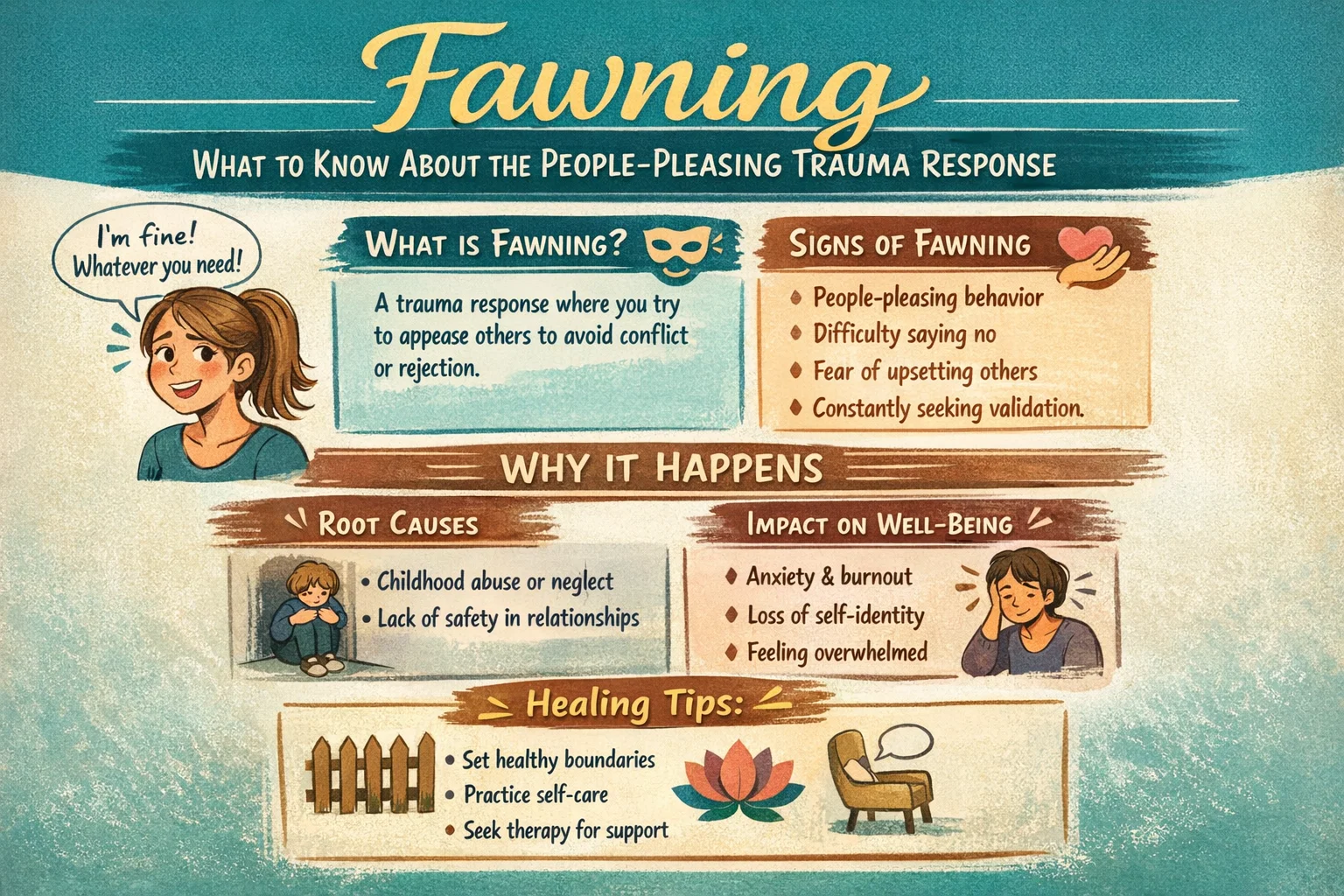

You can’t say no. When someone asks you for something—even when it’s unreasonable, even when you’re already overwhelmed, even when it costs you significantly—you automatically agree. You prioritize everyone else’s needs and feelings above your own, to the point where you’ve lost touch with what you actually want or need. You’re constantly scanning others for signs of displeasure, adjusting your behavior to keep them happy. The thought of someone being upset with you creates intense anxiety, so you do whatever it takes to maintain peace and approval.
You might recognize this as people-pleasing, but there’s often something deeper at play: fawning, a trauma response that’s less recognized than fight, flight, or freeze, but equally important to understand. Fawning is when you automatically appease, accommodate, or comply with others—particularly those who feel threatening or powerful—as a survival strategy developed in response to trauma or unsafe environments.
Understanding fawning is crucial because it masquerades as kindness, selflessness, or good social skills, when it’s actually a stress response that keeps you trapped in unhealthy patterns and relationships. In South Africa’s diverse cultural context, where communal values, respect for authority, and Ubuntu philosophy are important, distinguishing between healthy interdependence and trauma-driven fawning can be particularly complex.
This article explores what fawning is, how it develops, how it manifests in relationships and life, and most importantly, how to heal from fawning patterns and reclaim your authentic self.
Understanding Fawning as a Trauma Response
The Four F’s of Trauma Response
Most people are familiar with the “fight or flight” response—when facing danger, we either confront the threat (fight) or escape it (flight). But trauma experts recognize four primary trauma responses:
Fight: Confronting or attacking the threat. Manifests as anger, aggression, or opposition.
Flight: Escaping or avoiding the threat. Manifests as avoidance, withdrawal, or literally running away.
Freeze: Becoming immobilized when unable to fight or flee. Manifests as paralysis, numbness, or dissociation.
Fawn: Appeasing or accommodating the threat to prevent harm. Manifests as people-pleasing, compliance, and losing yourself to maintain safety.
What Is Fawning?
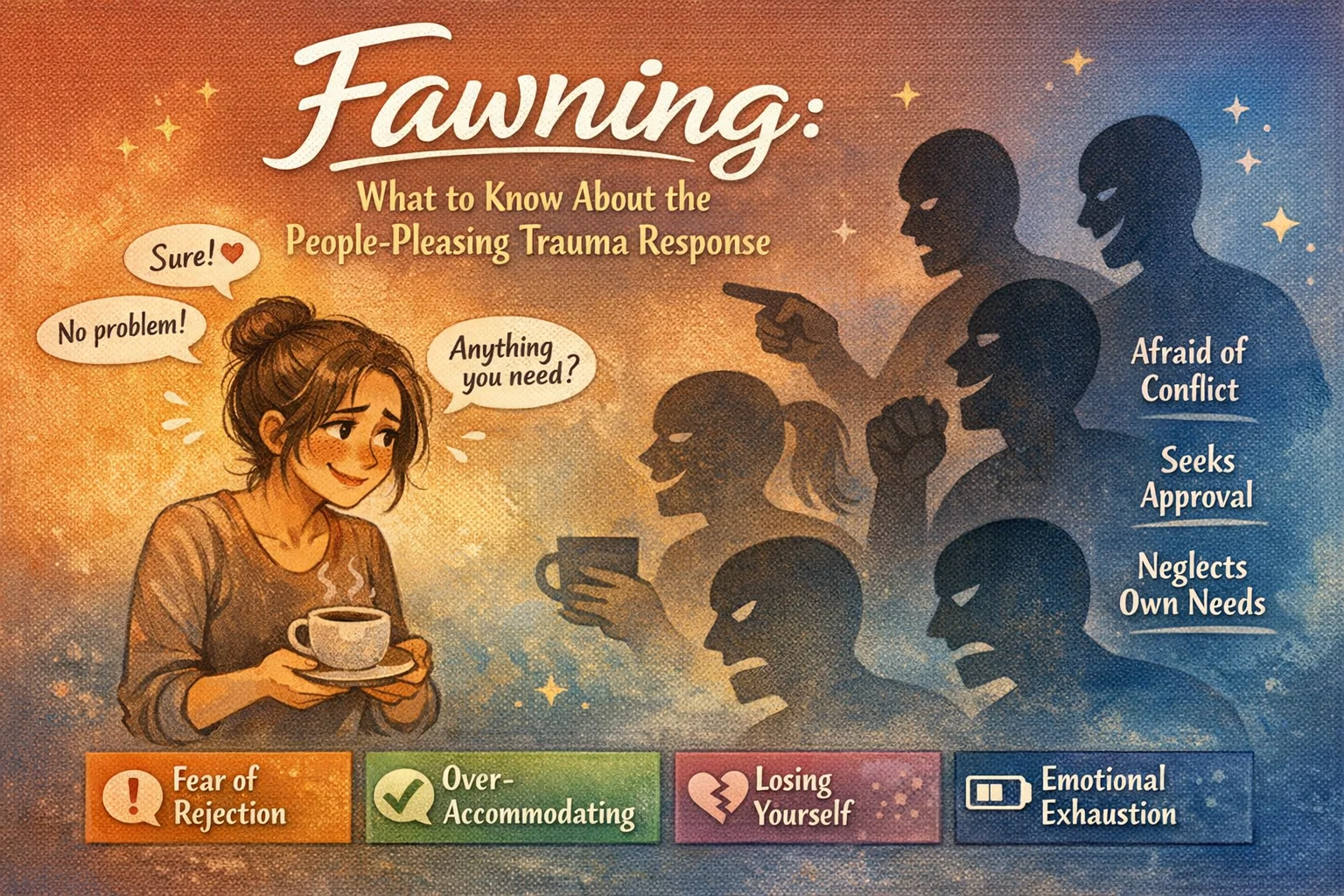
Fawning is an adaptive survival response where you attempt to avoid conflict, abuse, or harm by pleasing, appeasing, or caretaking the person who poses a threat. The term was coined by therapist Pete Walker to describe this fourth trauma response.
Core characteristics of fawning:
- Automatic compliance with others’ needs and wishes
- Difficulty saying no or setting boundaries
- Prioritizing others’ comfort over your own wellbeing
- Loss of sense of self and personal preferences
- Hypervigilance to others’ emotional states
- Anxiety when others might be displeased
- Identity built around being helpful, nice, or agreeable
- Difficulty identifying or expressing your own needs
The key distinction: Fawning isn’t just being kind or considerate—it’s an automatic, compulsive response driven by fear and the need for safety, not genuine care or choice.
How Fawning Develops
Fawning typically develops in childhood when fighting back or escaping isn’t possible, and freezing doesn’t resolve the threat. This often occurs in situations like:
Childhood abuse or neglect: When a child can’t physically fight or escape an abusive parent or caregiver, they learn that compliance and pleasing the abuser reduces harm.
Unpredictable parenting: Parents who are sometimes loving and sometimes rageful teach children to constantly monitor mood and appease to prevent anger.
Emotional manipulation: Parents who use guilt, silent treatment, or withdrawal of love teach children that their value depends on meeting others’ needs.
Enmeshed family systems: Families where children are expected to manage parents’ emotions or where boundaries between individuals don’t exist.
Authoritarian environments: Strict hierarchies where questioning authority is severely punished teach compliance as survival.
Domestic violence: Witnessing or experiencing intimate partner violence teaches that appeasing the aggressor prevents escalation.
The child learns: “If I’m good enough, helpful enough, agreeable enough, I’ll be safe. My survival depends on keeping others happy.”
Fawning in the South African Context
Cultural Considerations
Ubuntu and communalism: South African cultures emphasize interconnectedness and community. The challenge is distinguishing between healthy communal values (“I am because we are”) and trauma-driven loss of self.
Healthy Ubuntu involves mutual care where your needs matter as much as others’. Fawning involves sacrificing yourself entirely for others’ comfort.
Respect for elders and authority: Cultural emphasis on respecting elders and authority figures is valuable, but can also mask or enable fawning patterns when taken to extremes.
Questioning or disagreeing with elders might be culturally discouraged, making it harder to recognize when “respect” has become self-abandoning compliance.
Gender expectations: Traditional gender roles can reinforce fawning, particularly for women expected to be accommodating, nurturing, and self-sacrificing.
Boys and men who fawn may face additional stigma, as it conflicts with masculine expectations of assertiveness and dominance.
Apartheid’s lasting impacts: Generations of Black South Africans survived by appeasing white authority figures. This collective trauma created fawning patterns that can persist across generations.
Economic dependency: In contexts of high unemployment and economic vulnerability, fawning toward employers or those with power may feel necessary for survival, complicating healing.
Workplace Fawning
In South African workplaces, fawning might manifest as:
- Never questioning managers even when decisions are harmful
- Taking on excessive work to avoid appearing difficult
- Not reporting workplace violations for fear of being labeled a troublemaker
- Appeasing colleagues at cost to your wellbeing
- Unable to advocate for fair compensation or working conditions
The power dynamics of South Africa’s economy can make it difficult to distinguish between appropriate workplace behavior and fawning rooted in trauma or systemic oppression.
How Fawning Shows Up in Your Life
In Romantic Relationships
Loss of self: You become whoever your partner wants you to be. Your preferences, interests, and values shift to match theirs.
Inability to express needs: You suppress your needs to avoid burdening your partner or risk conflict.
Accepting unacceptable behavior: You tolerate disrespect, mistreatment, or abuse because confronting it feels impossible.
Anxiety about their mood: You’re hypervigilant to their emotional state, constantly adjusting to keep them happy.
One-sided relationships: You give constantly while receiving little, but feel you don’t deserve more.
Difficulty leaving unhealthy relationships: Even when you know a relationship is harmful, the thought of the other person’s displeasure prevents you from leaving.
Codependency: Your sense of worth depends entirely on your partner’s approval and happiness.
In Friendships
Always available: You drop everything when friends need you, even when inconvenient or costly, but struggle to ask for help.
Tolerating one-sided friendships: Friends take advantage of your generosity while giving little back, but you can’t address it.
Difficulty expressing disagreement: You automatically agree with friends’ opinions to avoid conflict.
Losing yourself in friend groups: You adopt the group’s interests, values, and behaviors even when they don’t align with yours.
Maintaining harmful friendships: You stay in friendships that drain or hurt you because you can’t bear the thought of ending them.
In Family Relationships
Carrying everyone’s emotions: You’re the family peacemaker, managing everyone’s feelings and conflicts.
Difficulty with boundaries: Family members cross your boundaries regularly, and you can’t enforce limits.
Parentification: You took care of your parents’ emotional needs as a child and continue doing so as an adult.
Inability to confront family dysfunction: Even when family patterns are harmful, speaking up feels impossible.
Guilt about your own needs: When you do express needs, overwhelming guilt makes you retract them.
At Work
Never saying no: You accept every task, even when overwhelmed or when it’s beyond your role.
Difficulty negotiating: You accept the first offer without advocating for yourself.
Tolerating mistreatment: You endure workplace bullying, discrimination, or exploitation without reporting it.
Avoiding leadership: You avoid promotions or leadership roles because they’d require assertiveness.
Overworking: You work excessive hours to prove your value and avoid criticism.
Taking blame: You accept responsibility for others’ mistakes to maintain peace.
With Authority Figures
Automatic deference: Doctors, police, government officials, teachers—anyone with authority elicits automatic compliance.
Inability to question: Even when you disagree or something seems wrong, you can’t voice concerns.
Accepting poor treatment: You tolerate being dismissed, talked down to, or mistreated by those in power.
Difficulty advocating: You can’t advocate for yourself with landlords, institutions, or service providers.
The Cost of Fawning
While fawning may have protected you in the past, chronic fawning in adulthood creates significant problems:
Loss of Identity
When you constantly mold yourself to others’ preferences, you lose touch with who you actually are. You might not know:
- What you truly enjoy versus what you do for others
- What your authentic opinions are
- What you want or need
- What your values are separate from others
- Who you’d be if you weren’t constantly accommodating
Resentment and Burnout
Constantly giving without receiving creates profound resentment, even if you’re not consciously aware of it. This resentment might emerge as:
- Passive-aggressive behavior
- Depression or anxiety
- Physical exhaustion and illness
- Emotional numbness
- Sudden angry outbursts seemingly from nowhere
Attracting Unhealthy Relationships
Fawning attracts people who take advantage—narcissists, abusers, and emotional vampires gravitate toward fawners because you provide endless supply without requiring reciprocity.
Healthy people often become uncomfortable with extreme fawning because they want mutual relationships, not one-sided ones.
Perpetuating Trauma
Fawning keeps you in situations reminiscent of original trauma. You unconsciously recreate childhood dynamics in adult relationships, staying stuck in patterns of abuse or mistreatment.
Physical Health Consequences
Chronic self-abandonment and stress from fawning affect physical health:
- Autoimmune disorders
- Chronic pain
- Digestive issues
- Cardiovascular problems
- Weakened immune function
- Sleep disturbances
Mental Health Impact
Fawning contributes to:
- Anxiety (hypervigilance to others’ emotions)
- Depression (suppressed authentic self)
- Low self-esteem
- Codependency
- Complex PTSD
- Eating disorders
Recognizing Fawning in Yourself
Do you:
- Feel guilty when saying no or prioritizing your needs?
- Automatically agree with others even when you disagree?
- Struggle to identify what you want because you’re focused on what others want?
- Feel anxious when someone seems upset, even when it’s not your fault?
- Find yourself apologizing constantly, even for things that aren’t your responsibility?
- Have difficulty accepting compliments or acknowledging your accomplishments?
- Feel your worth depends on being useful or helpful to others?
- Become whoever your partner, friend, or boss needs you to be?
- Tolerate mistreatment because confronting it feels impossible?
- Feel responsible for others’ emotions and comfort?
- Have weak or nonexistent boundaries?
- Suppress your authentic personality to fit in or keep peace?
If you recognize many of these patterns, fawning may be your primary trauma response.
Healing from Fawning
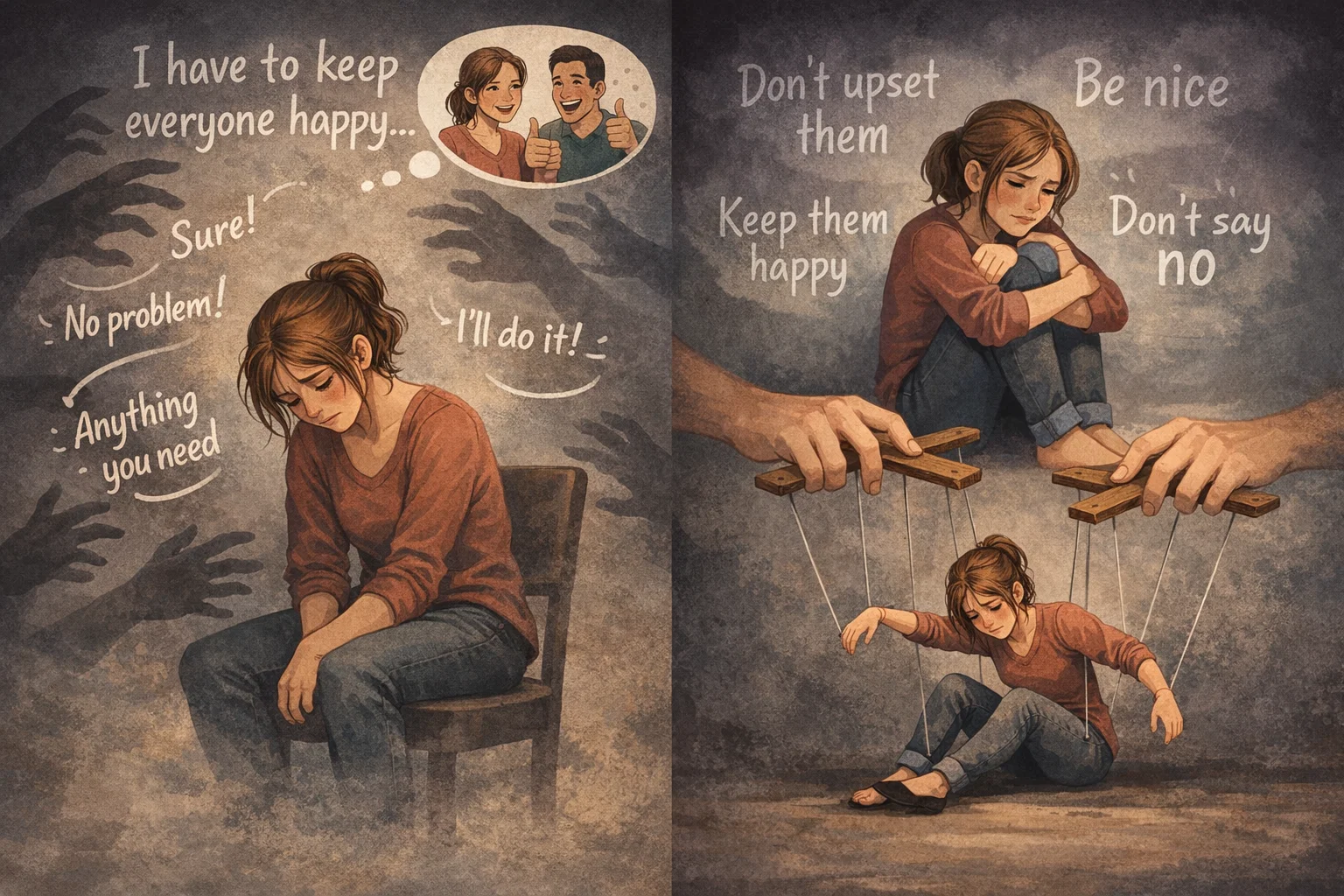
Recovery from fawning is possible, though it requires patience, support, and often professional help.
Recognize It’s a Trauma Response
The first step is understanding: Your people-pleasing isn’t a character flaw or inherent weakness—it’s an adaptive survival strategy that protected you when you were vulnerable.
Self-compassion is crucial: You developed fawning because you needed it to survive. It’s not your fault. Now, as an adult with more resources and options, you can develop healthier responses.
Develop Self-Awareness
Notice when you’re fawning: Pay attention to situations where you automatically comply, appease, or lose yourself. What triggers fawning? Who do you fawn with most?
Identify the fear: What are you afraid will happen if you don’t fawn? Rejection? Anger? Abandonment? Harm? Understanding the underlying fear helps address it.
Check in with your body: Fawning often involves disconnection from your body. Practice noticing physical sensations, particularly during interactions with others.
Reconnect with Yourself
Discover your preferences: Start small. What do you genuinely want for dinner? What music do you actually like? What are your opinions?
Journal: Writing helps you access your authentic thoughts and feelings without immediately censoring them.
Identify your values: What matters to you? What kind of person do you want to be, separate from what others want from you?
Notice your feelings: Practice identifying and validating your emotions rather than automatically suppressing them.
Learn to Set Boundaries
Start small: Begin with low-stakes situations. Say no to small requests before tackling major boundary-setting.
Practice phrases:
- “Let me think about that and get back to you”
- “That doesn’t work for me”
- “No, I’m not available for that”
- “I need to prioritize my own commitments right now”
Tolerate discomfort: Boundary-setting will feel uncomfortable initially. That’s normal. The discomfort doesn’t mean you’re doing something wrong.
Expect pushback: People accustomed to you fawning will likely resist your boundaries. This is their issue, not evidence that you shouldn’t have boundaries.
Don’t over-explain: “No” is a complete sentence. You don’t owe lengthy justifications for protecting yourself.
Practice Saying No
Saying no is a skill that improves with practice. Start with:
- Declining optional requests that don’t serve you
- Saying no to small asks from safe people
- Gradually working up to bigger boundaries
Challenge guilt: Feeling guilty about saying no is normal for fawners. Guilt doesn’t mean you’re doing something wrong—it means you’re doing something different from your usual pattern.
Remember: Saying no to others is saying yes to yourself. Your time, energy, and wellbeing matter.
Address Underlying Trauma
Therapy is invaluable: Working with a trauma-informed therapist helps address the root causes of fawning.
EMDR, somatic therapy, or trauma-focused CBT can help process traumatic experiences that created fawning patterns.
Inner child work: Healing the wounded child who learned fawning was necessary for survival.
Build Distress Tolerance
Fawning avoids conflict and others’ displeasure. Recovery requires learning to tolerate:
- Others being disappointed or upset
- Conflict and disagreement
- Not being liked by everyone
- Criticism or rejection
Practice grounding techniques when anxiety arises from setting boundaries or not fawning.
Remind yourself: You can survive others’ displeasure. Their emotions are their responsibility, not yours.
Cultivate Self-Worth Independent of Others
Develop internal validation: Learn to validate yourself rather than seeking constant external approval.
Acknowledge your inherent worth: You have value simply because you exist, not because of what you do for others.
Celebrate yourself: Notice and celebrate your accomplishments, qualities, and growth.
Affirmations: “My needs matter,” “I deserve respect,” “It’s okay to prioritize myself,” “I don’t need everyone’s approval.”
Build Healthy Relationships
Seek reciprocal relationships: Healthy relationships involve mutual give and take.
Communicate needs: Practice expressing what you need, even when uncomfortable.
Notice who respects boundaries: Healthy people will respect your boundaries. Those who don’t reveal themselves as unsafe.
Be willing to let go: Some relationships can’t survive your healing because they were built on you fawning. That’s okay. Letting go of unhealthy relationships makes space for healthy ones.
Work on Assertiveness
Assertiveness training: Learning to express your thoughts, feelings, and needs clearly and directly.
Practice in safe contexts: Role-play with a therapist or trusted friend before trying in more challenging situations.
Use “I” statements: “I feel,” “I need,” “I prefer” help own your experience without blaming.
Find your voice: Your opinions, preferences, and needs are valid and deserve expression.
Special Considerations
When Fawning Feels Necessary for Survival
In situations of ongoing danger (domestic violence, unsafe work environments), fawning may genuinely be your safest option in the moment. Safety first—don’t attempt to set boundaries with dangerous people without professional support and safety planning.
Cultural Sensitivity in Healing
Healing from fawning in collectivist cultures requires balancing:
- Honoring cultural values of community and respect
- While reclaiming your individual needs and boundaries
- Distinguishing between healthy cultural practices and trauma responses
You can respect your culture and elders while also having boundaries. These aren’t mutually exclusive.
When Others Label Your Healing as Selfishness
As you stop fawning, some people will call you selfish, difficult, or changed. This often says more about their discomfort with losing your compliance than about your actual behavior.
Healthy selfishness (prioritizing your wellbeing) is different from harmful selfishness (disregarding others entirely). You can care for yourself and others—but you must include yourself in that care.
Moving Forward
Healing from fawning is a journey, not a destination. You’ll have setbacks. You’ll slip back into old patterns, especially under stress. This is normal.
Each time you set a boundary, say no, or prioritize your needs despite discomfort, you’re rewiring neural pathways and building new patterns. Over time, it gets easier.
You’re learning to trust yourself, advocate for yourself, and be yourself—skills that trauma prevented you from developing earlier. It’s never too late to learn them.
The goal isn’t to become selfish or stop caring about others. It’s to include yourself in the circle of people worthy of your care and consideration. It’s to choose kindness from a place of authenticity rather than fear.
You deserve relationships where you can be your authentic self. You deserve to express your needs. You deserve to take up space. You deserve to say no.
Your fawning protected you when you needed protection. Now, you’re learning new ways to keep yourself safe—ways that don’t require abandoning yourself.
If you’re struggling with fawning patterns rooted in trauma:
- Consider working with a trauma-informed therapist
- SADAG can provide referrals: 0800 567 567
- Look for therapists trained in trauma treatment (EMDR, somatic therapy, trauma-focused CBT)
Healing is possible. You can reclaim yourself.


Leave a Comment