
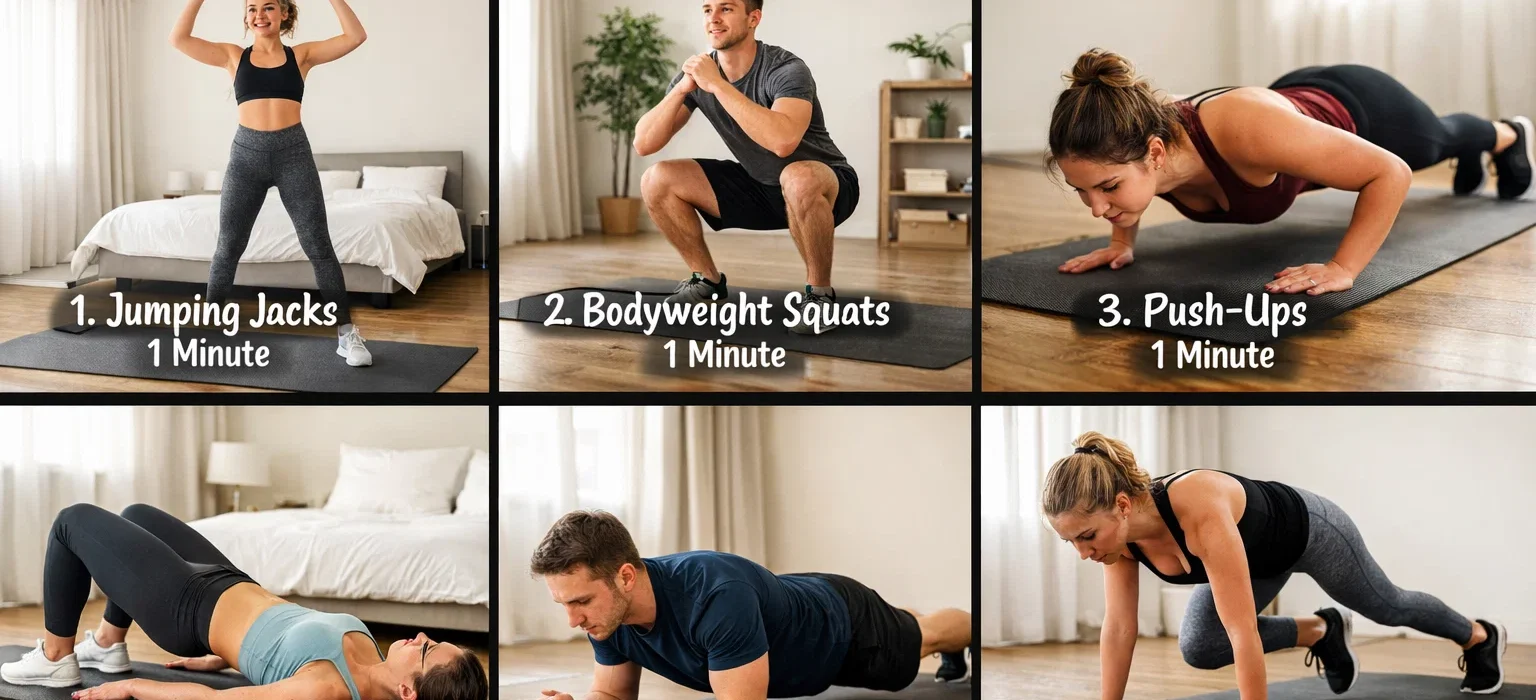

The best workout is the one you actually do. This beginner routine requires zero equipment, fits in 20–30 minutes, and is designed to build real fitness without burning you out. Let’s go.
📅 March 16, 2026 | ⏱ 10 min read | 🏃 Movement
Let’s be direct: the fitness industry has convinced most people that getting fit requires an expensive gym membership, complicated equipment, and hours of free time. None of that is true.
The reality is that a consistent, progressive bodyweight routine performed at home — ideally in the morning, before the day’s demands crowd out your intentions — can build genuine, lasting fitness. No commute, no membership fees, no waiting for machines. Just you, your body, and 25 minutes.
This routine is specifically designed for beginners. That means it starts manageable, builds progressively, and is structured to prevent the two most common beginner failures: doing too much too soon (leading to injury or burnout) and doing too little for too long (leading to no results). Follow this plan and you will feel meaningfully fitter within six weeks.

Why Morning Workouts Work (Especially for Beginners)
Morning exercise has several evidence-backed advantages over evening exercise — particularly for people who are building a new habit:
- It happens before decision fatigue sets in. Willpower and motivation are finite resources that deplete throughout the day. A workout scheduled for 7am has a far higher completion rate than one scheduled for 7pm, when you’ve already made hundreds of decisions and encountered whatever the day threw at you.
- It boosts metabolism. Exercise elevates your metabolic rate for several hours afterward (the EPOC effect — Excess Post-exercise Oxygen Consumption). Doing this in the morning means elevated metabolism throughout your most active hours.
- It improves focus and mental clarity. Morning exercise increases BDNF (brain-derived neurotrophic factor), dopamine, and serotonin — neurotransmitters that sharpen focus, elevate mood, and improve cognitive performance for hours afterward. Many people report that their best mental work happens on mornings after exercise.
- It creates a powerful psychological anchor. Completing a workout before 8am gives you a genuine sense of accomplishment that sets the tone for the rest of the day. You’ve already done something for yourself before the world has asked anything of you.
- Consistency is higher. Studies consistently show that people who exercise in the morning maintain their routines significantly longer than those who plan evening workouts.
💡 The Golden Rule: Lay out your workout clothes the night before. This single environmental nudge removes friction and increases morning workout completion rates significantly. Make the decision before you’re tired and unmotivated — not when you’re half-asleep at 6am.
Before You Start: What You Need to Know
A few important ground rules before you begin:
- Space: You need a floor area roughly the size of a yoga mat (1.8m x 0.6m). That’s it.
- Equipment: None required. A yoga mat is helpful for comfort but not essential.
- Shoes: Bare feet or socks are fine for home workouts. Supportive trainers if you prefer.
- Timing: This routine takes 25–30 minutes including warm-up and cool-down. Set your alarm 35 minutes early to allow time to change and have water.
- Hydration: Drink a large glass of water before you begin. You’ve been fasting and mildly dehydrating for 7–9 hours overnight.
- Modifications: Every exercise in this routine has a modification. If the standard version is too challenging, use the modification without hesitation. Form and consistency beat intensity every time.
Step 1: The Warm-Up (5 Minutes)
Never skip the warm-up. A proper warm-up increases blood flow to muscles, raises core temperature, lubricates joints, and reduces injury risk. It also signals to your nervous system that physical exertion is coming — improving exercise performance meaningfully.
| Exercise | Duration | Purpose |
|---|---|---|
| Arm circles (forward and back) | 30 seconds | Mobilises shoulder joints |
| Hip circles | 30 seconds | Mobilises hip joints and lower back |
| High-knee march in place | 60 seconds | Elevates heart rate, warms legs |
| Leg swings (front-to-back, each leg) | 30 seconds | Opens hip flexors and hamstrings |
| Slow bodyweight squats | 60 seconds | Warms quads, glutes, and knees |
| Cat-cow spinal mobilisation | 60 seconds | Wakes up the spine, reduces lower back stiffness |
Move through each exercise at a steady, deliberate pace. You should feel warmer and more mobile by the end — not tired.
Step 2: The Main Workout (15–20 Minutes)
Perform each exercise for 40 seconds of work, followed by 20 seconds of rest, then move immediately to the next exercise. This is a 1:2 work-to-rest ratio — appropriate for beginners and still highly effective for building strength and cardiovascular fitness.
Complete 2 rounds in weeks 1–2, then 3 rounds from week 3 onward.
Exercise 1: Bodyweight Squats

How to do it: Stand with feet shoulder-width apart, toes slightly turned out. Keep your chest tall and your weight in your heels. Lower until your thighs are parallel to the floor (or as low as comfortable). Drive through your heels to return to standing. Keep your knees tracking over your toes throughout.
- Muscles worked: Quadriceps, glutes, hamstrings, core
- Modification: Hold a chair back for balance, or only lower halfway until strength builds
- Common mistake: Letting knees cave inward — actively push them out over your toes
Exercise 2: Push-Ups
How to do it: Start in a high plank position with hands slightly wider than shoulder-width. Keep your body in a straight line from head to heels, core braced. Lower your chest toward the floor with control, keeping elbows at roughly 45 degrees from your body. Press back up to the start position.
- Muscles worked: Chest, shoulders, triceps, core
- Modification: Drop to your knees, keeping a straight line from knees to shoulders. This is not a beginner’s failure — it’s smart progressive training.
- Common mistake: Letting hips sag or rising — keep your entire body rigid throughout
Exercise 3: Reverse Lunges
How to do it: Stand tall, feet together. Step one foot directly back, lowering your back knee toward (but not touching) the floor. Your front knee should remain directly above your ankle. Press through your front heel to return to standing. Alternate legs with each rep.
- Muscles worked: Glutes, quadriceps, hamstrings, balance and stability
- Modification: Hold a wall or chair for balance support until confidence builds
- Common mistake: Leaning the torso forward — keep your chest upright throughout
Exercise 4: Plank Hold
How to do it: Lower to your forearms on the floor, elbows directly beneath your shoulders. Your body should form a straight line from head to heels. Brace your core as if bracing for impact. Breathe steadily. Don’t let your hips rise or sink.
- Muscles worked: Core (transverse abdominis, obliques), shoulders, back, glutes
- Modification: Drop to your knees while maintaining a straight line from knees to shoulders
- Progression tip: Start with a 20-second hold and add 5 seconds every few sessions
Exercise 5: Glute Bridges
How to do it: Lie on your back with knees bent, feet flat on the floor hip-width apart. Press your feet into the floor and drive your hips upward, squeezing your glutes hard at the top. Hold for one second, then lower slowly with control. Avoid arching your lower back.
- Muscles worked: Glutes, hamstrings, lower back, core
- Modification: This exercise is already very accessible — if any discomfort, reduce range of motion
- Progression: Try single-leg bridges once the two-legged version feels easy
Exercise 6: Mountain Climbers
How to do it: Start in a high push-up position with arms fully extended. Drive one knee toward your chest, then quickly switch legs in a running motion. Keep your hips level — resist the temptation to raise them. Keep your core braced throughout. You control the pace.
- Muscles worked: Core, hip flexors, shoulders, cardiovascular system
- Modification: Walk the knees in and out slowly rather than running them — same muscles, less intensity
- Common mistake: Letting the hips rise — keep them low and level at all times
Full Workout at a Glance
| Exercise | Work | Rest | Primary Muscles |
|---|---|---|---|
| Bodyweight Squats | 40 sec | 20 sec | Quads, glutes, hamstrings |
| Push-Ups | 40 sec | 20 sec | Chest, shoulders, triceps |
| Reverse Lunges | 40 sec | 20 sec | Glutes, quads, balance |
| Plank Hold | 40 sec | 20 sec | Core, shoulders, back |
| Glute Bridges | 40 sec | 20 sec | Glutes, hamstrings, lower back |
| Mountain Climbers | 40 sec | 20 sec | Core, cardio, hip flexors |
One full round takes approximately 6 minutes. Two rounds = 12 minutes. Three rounds = 18 minutes. With warm-up and cool-down, your total session is 25–30 minutes.
🔬 Why This Structure Works: This is a full-body circuit, which means every session works your entire body rather than isolating muscle groups. For beginners, full-body training three times per week produces faster strength and fitness gains than split routines, because each muscle group is stimulated more frequently.
Step 3: The Cool-Down (5 Minutes)
Never skip the cool-down. It helps your heart rate return to baseline gradually, begins the muscle recovery process, and significantly reduces next-day soreness. It also doubles as your daily flexibility and mobility work.
| Stretch | Duration | What It Targets |
|---|---|---|
| Child’s pose | 60 seconds | Lower back, hips, shoulders |
| Supine hamstring stretch (each leg) | 30 sec each | Hamstrings, lower back |
| Figure-four hip stretch (each side) | 30 sec each | Glutes, hip external rotators |
| Seated forward fold | 45 seconds | Hamstrings, spine, calves |
| Diaphragmatic breathing | 60 seconds | Nervous system recovery, heart rate reduction |
Your Weekly Schedule
As a beginner, start with 3 sessions per week with at least one rest day between each workout. This frequency is optimal for beginners — it provides enough stimulus to build fitness while allowing full recovery between sessions.
| Day | Activity | Duration |
|---|---|---|
| Monday | Full routine (2 rounds) | ~25 minutes |
| Tuesday | Rest or 20-minute walk | Optional |
| Wednesday | Full routine (2 rounds) | ~25 minutes |
| Thursday | Rest or gentle yoga / stretching | Optional |
| Friday | Full routine (2–3 rounds) | ~25–30 minutes |
| Saturday | Active recovery — walk, swim, or light stretching | 20–30 minutes |
| Sunday | Full rest day | — |

How to Progress Over Time
The most common beginner mistake is doing the same workout at the same intensity indefinitely. Your body adapts to training stimulus within two to four weeks — if you don’t increase the challenge, your progress stalls. This is called the progressive overload principle, and it’s the foundation of all effective training.
Here’s your 8-week progression plan:
| Weeks | Rounds | Work Interval | Focus |
|---|---|---|---|
| Weeks 1–2 | 2 rounds | 40 seconds on / 20 seconds rest | Learning form, building habit |
| Weeks 3–4 | 3 rounds | 40 seconds on / 20 seconds rest | Building volume, improving endurance |
| Weeks 5–6 | 3 rounds | 50 seconds on / 10 seconds rest | Increasing intensity, building strength |
| Weeks 7–8 | 4 rounds | 50 seconds on / 10 seconds rest | Peak beginner volume — ready to advance |
💪 After Week 8: By the end of this 8-week plan, you’ll have built a genuine fitness base. You can then explore adding resistance (light dumbbells, resistance bands) to the same exercises, incorporate more advanced movement patterns, or begin a more structured strength programme. The foundation you’ve built here makes everything else easier.
Common Beginner Mistakes to Avoid
- Skipping the warm-up and cool-down. These aren’t optional extras — they’re integral to the session. Skipping the warm-up dramatically increases injury risk. Skipping the cool-down slows recovery.
- Going too hard, too fast. Extreme muscle soreness after your first week is a sign you’ve overdone it. You should feel challenged and pleasantly tired — not barely able to walk the next day.
- Prioritising speed over form. Proper technique is everything. A slow, well-executed squat builds more strength and burns more calories than a fast, sloppy one — and it protects your joints.
- Skipping rest days. Muscles grow and repair during rest, not during the workout. Rest days are productive days.
- Comparing your progress to others. Your baseline is your own. Progress relative to where you started is the only comparison that matters.
- Giving up after one missed session. Missing a workout doesn’t break the habit. It’s completely normal. Just return to the routine the next scheduled day without guilt or self-judgement.
✦ Key Takeaways
- This 6-exercise, 25-minute routine requires no gym, no equipment, and no experience — just consistency.
- Warm up and cool down every session — they’re not optional.
- Start with 2 rounds for the first two weeks, then progress systematically every two weeks.
- Three sessions per week with rest days in between is optimal for beginner fitness gains.
- Lay your workout clothes out the night before — this single habit dramatically increases morning workout completion rates.
- Most people feel meaningfully fitter within 3–4 weeks and see visible changes by weeks 6–8.
Frequently Asked Questions
How long before I see results from this routine?
Most beginners notice improved energy, mood, and sleep quality within two to three weeks of consistent training. Cardiovascular fitness improves measurably within three to four weeks. Visible physical changes — improved muscle tone, reduced body fat — typically become noticeable around the six to eight week mark, provided nutrition is also supportive.
Should I eat before or after a morning workout?
For a 25–30 minute moderate-intensity session, most people perform well training fasted (no food before). If you feel faint or low-energy training fasted, a small snack 30–45 minutes before — like a banana or a small handful of nuts — is sufficient. Save larger meals for after the workout.
What if I’m too sore to work out?
Mild muscle soreness (DOMS — Delayed Onset Muscle Soreness) in the 24–48 hours following a workout is normal and actually indicates productive training. Light movement — walking, gentle stretching — on rest days helps resolve soreness faster than complete inactivity. If soreness is severe or sharp, rest and consider whether you’ve progressed too fast.
Can I do this routine every day?
Not recommended for beginners. Your muscles need 48 hours to repair after resistance training. Training daily without recovery leads to diminishing returns, fatigue, and increased injury risk. Three sessions per week as outlined is the sweet spot for beginners. Active recovery (walking, yoga, stretching) on other days is perfectly fine and beneficial.
What if I can’t do a full push-up?
Use the knee modification without hesitation — it’s a legitimate exercise, not a lesser version. Building strength through the knee push-up pattern first makes full push-ups easier and safer to achieve. Most beginners can progress to full push-ups within four to six weeks of consistent knee push-up training.
Is bodyweight training effective for building real muscle?
Absolutely — particularly for beginners. Bodyweight training produces significant strength and muscle gains in people new to exercise, because the body is easily challenged by its own weight initially. As you advance, progressively overloading bodyweight exercises (more reps, more rounds, harder variations) continues to drive adaptation. Many elite athletes include substantial bodyweight training in their programmes.
Evidence-based wellness content to help you feel your best — body and mind. | The Whole You Wellness


Leave a Comment