
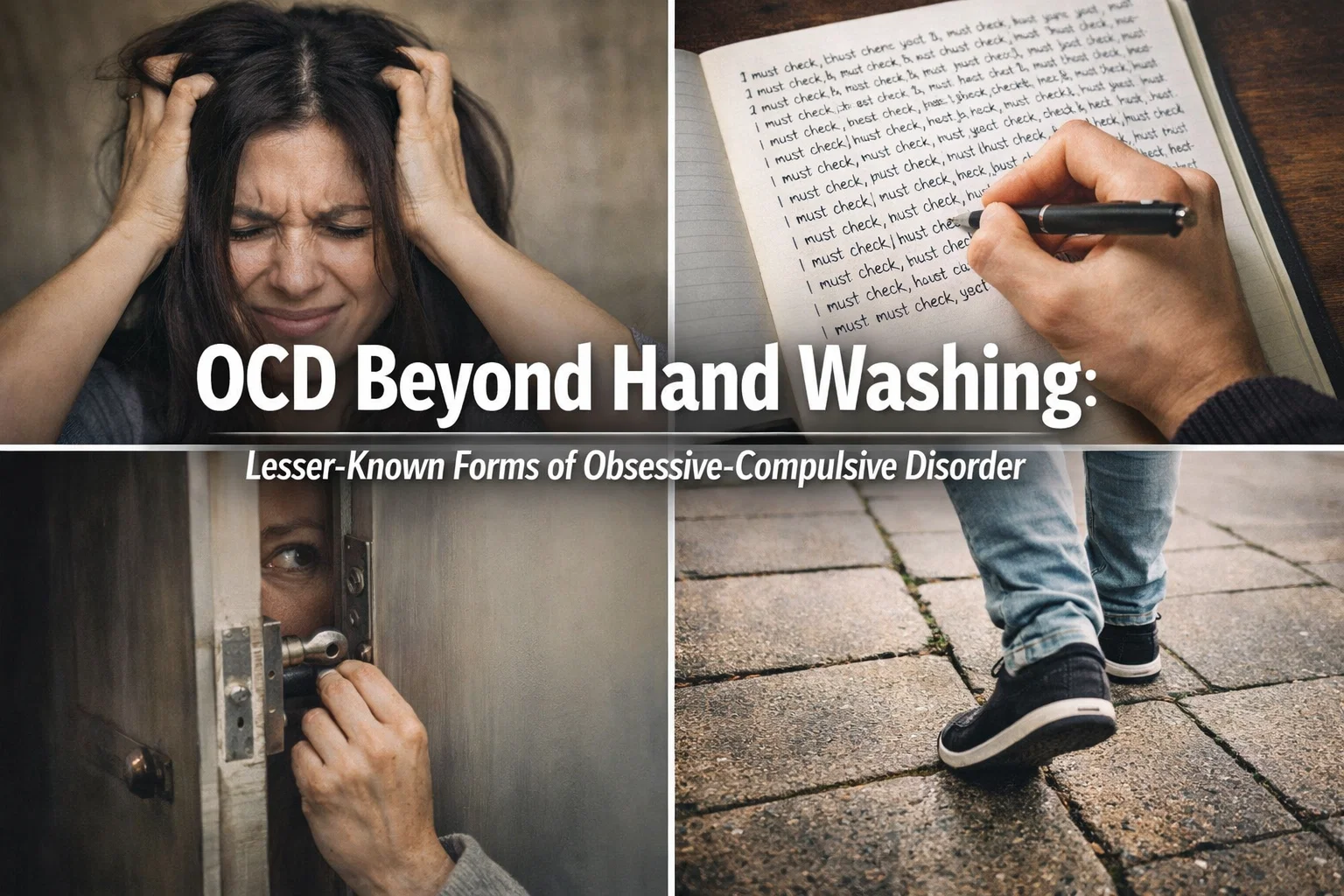

When most people think of Obsessive-Compulsive Disorder (OCD), they picture someone washing their hands repeatedly, checking locks multiple times, or arranging objects in perfect symmetry. While these are indeed common manifestations of OCD, they represent only a fraction of how this complex condition can present itself.
Many people suffer silently with forms of OCD that don’t involve visible compulsions, making their struggle invisible to others and often misunderstood even by themselves. You might spend hours each day tormented by disturbing intrusive thoughts, mentally reviewing conversations to check if you said something wrong, or seeking constant reassurance about your relationships—all forms of OCD that don’t fit the stereotypical image but are equally distressing and disabling.
Understanding the full spectrum of OCD, particularly its lesser-known presentations, is crucial for recognizing the condition in yourself or others and seeking appropriate treatment. This article explores the diverse ways OCD can manifest, with a particular focus on the forms that often go unrecognized and untreated.
Understanding OCD: The Basics
Obsessive-Compulsive Disorder is a mental health condition characterized by a cycle of obsessions and compulsions that significantly interfere with daily life.
Obsessions
Obsessions are intrusive, unwanted thoughts, images, urges, or doubts that repeatedly enter your mind. They’re not just everyday worries about real problems—they’re persistent, distressing mental intrusions that feel alien to your values and character.
Key characteristics of obsessions:
- They’re intrusive and unwanted, not something you choose to think about
- They cause significant anxiety or distress
- You recognize them as products of your own mind (not delusions)
- You typically recognize they’re excessive or unreasonable
- They’re difficult or impossible to ignore or suppress
- They often focus on specific themes (contamination, harm, sexuality, religion, etc.)
Compulsions
Compulsions are repetitive behaviors or mental acts that you feel driven to perform in response to an obsession or according to rigid rules. They’re aimed at reducing anxiety or preventing some dreaded outcome, even though they’re not realistically connected to the feared event or are clearly excessive.
Key characteristics of compulsions:
- They’re repetitive and often ritualized
- You feel you must perform them, even if you recognize they’re unreasonable
- They temporarily reduce anxiety but don’t provide lasting relief
- Not performing them causes intense anxiety or distress
- They take up significant time (at least one hour per day in clinical OCD)
- They can be behavioral (visible actions) or mental (invisible thoughts)
The OCD Cycle
OCD operates in a vicious cycle:
- Obsessive thought or trigger appears in your mind
- Anxiety or distress spikes in response to the thought
- Compulsion is performed to reduce the anxiety or prevent the feared outcome
- Temporary relief as anxiety decreases briefly
- Reinforcement of the belief that the compulsion was necessary, making the cycle more entrenched
This cycle strengthens over time, as the temporary relief from compulsions teaches your brain that they’re necessary and effective, even though they ultimately maintain the problem.
Why Lesser-Known Forms Go Unrecognized
Several factors contribute to many OCD presentations remaining undiagnosed or misdiagnosed:
Mental Compulsions Are Invisible
Many people with OCD primarily engage in mental compulsions—internal rituals like mental reviewing, counting, repeating phrases, or seeking mental reassurance. Because these compulsions aren’t visible to others, people may not recognize them as compulsions, and loved ones may not realize the person is struggling.
Shame and Secrecy
Many OCD obsessions involve taboo or disturbing content—violent thoughts, sexual thoughts about inappropriate people or situations, or blasphemous religious thoughts. The shame surrounding these thoughts often prevents people from disclosing them, even to mental health professionals.
Someone experiencing intrusive thoughts about harming loved ones might be terrified to tell anyone, fearing they’ll be seen as dangerous when in reality these thoughts are the opposite of their values and deeply distressing to them.
Misdiagnosis
OCD is often misdiagnosed as generalized anxiety disorder, depression, or other conditions. If you don’t fit the stereotype of visible cleaning or checking rituals, healthcare providers might not consider OCD as a diagnosis.
Cultural Factors
In South African communities where mental health stigma is significant, people may be even less likely to recognize or disclose OCD symptoms. Cultural beliefs about intrusive thoughts (seeing them as spiritual attacks, curses, or moral failings rather than symptoms of a treatable condition) can delay recognition and treatment.
Lack of Awareness
Many people simply don’t know that their experiences constitute OCD. They might think everyone has disturbing intrusive thoughts and mental rituals, not realizing that the intensity, frequency, and distress they experience are symptoms of a treatable condition.
Pure O: Purely Obsessional OCD
“Pure O” is a colloquial term for OCD presentations where the compulsions are primarily or entirely mental rather than behavioral. The name is somewhat misleading because compulsions are still present—they’re just not visible to observers.
Common Pure O Themes
Harm OCD: Intrusive thoughts about potentially harming yourself or others, despite having no desire or intention to do so. You might experience thoughts like “What if I lose control and hurt my child?” or images of pushing someone into traffic. These thoughts are ego-dystonic (completely contrary to your values) and deeply distressing.
Mental compulsions might include mentally reviewing whether you actually would harm someone, seeking mental reassurance that you’re not dangerous, avoiding situations where harm thoughts occur (like kitchens with knives or high places), or mentally checking how you feel about the intrusive thought.
Sexual Orientation OCD (SO-OCD): Intrusive doubts about your sexual orientation that cause significant distress. This isn’t about coming to terms with your actual orientation—it’s obsessive doubt and anxiety about potentially being different from what you know yourself to be.
You might constantly analyze your reactions to people, seek reassurance by mentally checking your attraction, avoid situations that trigger doubts, or ruminate endlessly about what your thoughts mean.
Pedophilia OCD (POCD): Deeply distressing intrusive thoughts about being sexually attracted to children. These thoughts are completely contrary to the person’s values and cause extreme anxiety and moral distress.
Compulsions include mentally checking whether you felt aroused, avoiding children, seeking reassurance that you’re not a pedophile, or mentally reviewing your history for “evidence” of your true nature.
Relationship OCD (ROCD): Obsessive doubts about romantic relationships. This can focus on your partner (“Are they attractive enough?” “Do they have the right qualities?” “What if they’re not ‘the one’?”) or on your own feelings (“Do I really love them?” “What if I’m with the wrong person?”).
Mental compulsions include constantly analyzing your feelings, comparing your relationship to others, seeking reassurance from your partner or others, or mentally reviewing the relationship for evidence of love or compatibility.
Existential OCD: Obsessive rumination about philosophical or existential questions like the nature of reality, the meaning of life, consciousness, or death. While everyone ponders these questions occasionally, in OCD they become relentless, distressing obsessions that interfere with functioning.
Religious/Scrupulosity OCD: Obsessive fear of having committed sins, blasphemed, or displeased God. This goes far beyond normal religious devotion into consuming fear and guilt. Intrusive blasphemous thoughts or images cause intense distress, and mental compulsions involve endless prayer, mental confession, or seeking reassurance about your spiritual state.
The Struggle of Pure O
People with Pure O often suffer intensely while appearing perfectly fine to others. You might spend hours each day trapped in mental rituals, tormented by disturbing thoughts, yet function reasonably well on the outside. This discrepancy can make it hard for others to understand the severity of your struggle.
The content of Pure O obsessions is often so shameful or frightening that many people go years without telling anyone, suffering in isolation and believing they’re uniquely disturbed or dangerous.
Hit-and-Run OCD
This form of OCD involves intrusive thoughts that you might have hit someone or something while driving without realizing it. After driving, you’re plagued by doubts: “Did I feel a bump? Was that person who stepped into the street okay? What if I hit someone and drove away?”
Obsessions
- Intrusive doubts about having hit pedestrians, cyclists, or animals
- Mental images of having caused an accident
- Hyperawareness to any bump or sound while driving
- Fears of being a hit-and-run criminal
Compulsions
- Repeatedly driving back to check the route for evidence of an accident
- Checking mirrors excessively while driving
- Mentally reviewing the drive for signs of having hit something
- Seeking reassurance from passengers
- Checking news reports for accidents in the area
- Avoiding driving altogether
This form of OCD can make driving extremely distressing and time-consuming, as you might spend hours driving back and forth checking for evidence of accidents that never occurred.
Just Right OCD
Just Right OCD (also called Incompleteness OCD) involves an overwhelming sense that things aren’t quite right and a drive to perform behaviors until they feel “just right” or complete. Unlike contamination OCD where the fear is specific (getting sick), Just Right OCD involves a more nebulous sense of discomfort or incompleteness.
Manifestations
Physical sensations: Needing to touch things in a certain way, step with equal pressure on both feet, or move your body until it feels balanced or complete.
Symmetry and ordering: Arranging objects until they feel perfectly balanced, aligned, or symmetrical, driven not by aesthetics but by a sense that asymmetry feels wrong or incomplete.
Repeating behaviors: Repeating actions (turning lights on and off, going through doorways, writing and rewriting) until they feel complete or right.
Perfectionism in actions: Needing to perform tasks in a specific way or order, and redoing them if they don’t feel right, even if objectively they’re fine.
The Feeling of “Not Right”
People with Just Right OCD describe the feeling as tension, discomfort, or incompleteness that builds until the compulsion is performed correctly. It’s not always about preventing a feared outcome—it’s about resolving an uncomfortable internal state.
Reassurance-Seeking OCD
While seeking reassurance can be a compulsion in any OCD subtype, for some people it becomes the primary manifestation of their OCD.
Forms of Reassurance-Seeking
Asking others repeatedly: “Did I lock the door?” “Do you think I offended them?” “Am I a good person?” “Is this symptom serious?” The same questions are asked over and over despite receiving answers.
Googling and researching: Spending hours searching for information that will definitively answer your obsessive questions. Each search provides temporary relief but ultimately fuels more doubt.
Confessing: Feeling compelled to confess even minor or imagined transgressions to relieve guilt or anxiety. You might repeatedly apologize or disclose thoughts to seek reassurance that you’re forgiven or that you’re not a bad person.
Self-reassurance: Mentally reviewing evidence that everything is okay, repeating reassuring phrases to yourself, or seeking internal certainty about obsessive doubts.
The Reassurance Trap
Reassurance provides temporary relief but ultimately maintains OCD. Each time you seek and receive reassurance, you’re reinforcing the belief that the obsessive doubt was legitimate and that you need external validation to feel safe. The relief is brief, and soon you’re seeking reassurance again, often about the same concern or a slightly modified version.
Over time, reassurance-seeking can strain relationships, as loved ones become exhausted by constant questioning or feel like nothing they say is ever enough.
Somatic OCD (Sensorimotor OCD)
Somatic OCD involves becoming hyperaware of and distressed by normally automatic bodily sensations or processes. Once you notice the sensation, you can’t stop noticing it, and the awareness becomes intrusive and distressing.
Common Focuses
Breathing: Becoming consciously aware of your breathing and unable to let it return to automatic. You might obsess about whether you’re breathing correctly or feel like you must manually control each breath.
Blinking: Hyperawareness of blinking, how often you blink, or the sensation of your eyelids moving.
Swallowing: Constant awareness of swallowing, which makes the normally automatic process feel effortful and uncomfortable.
Heartbeat: Constant monitoring of your heartbeat, how fast it’s beating, or whether it feels normal.
Floaters or visual sensations: Fixation on floaters in your vision or other visual phenomena, unable to stop noticing them.
Bodily sensations: Hyperawareness of tongue position, jaw tension, specific body parts, or other sensations that most people tune out.
The Paradox of Somatic OCD
The more you try not to notice the sensation, the more you notice it. Attempts to suppress awareness increase it. The anxiety about the awareness then makes it even harder to let go, creating a cycle where normal bodily processes become sources of constant distress.
Magical Thinking OCD
Magical thinking OCD involves believing that your thoughts, words, or actions can influence events in ways that don’t follow logical cause and effect. This goes beyond superstition into compulsive behaviors aimed at preventing harm through magical connections.
Examples
Thought-action fusion: Believing that thinking about something makes it more likely to happen or is morally equivalent to doing it. For instance, having an intrusive thought about a family member being in an accident and believing the thought itself increases the risk.
Numbers and counting: Believing certain numbers are good or bad and needing to perform actions a specific number of times to prevent harm.
Rituals to protect: Performing mental or behavioral rituals to “cancel out” bad thoughts or prevent feared outcomes. For example, if you have an intrusive negative thought about someone, you must immediately think a positive thought about them or something bad will happen.
Superstitious compulsions: Needing to perform elaborate rituals (touching wood, repeating phrases, specific movement patterns) to prevent catastrophe.
In the South African context, magical thinking OCD can sometimes be confused with or intertwined with cultural or traditional beliefs about thoughts, curses, or spiritual influences, making it more complex to identify and treat.
Responsibility OCD
Responsibility OCD involves an exaggerated sense of responsibility for preventing harm. You feel personally responsible for outcomes that are actually beyond your control or for which you bear minimal responsibility.
Manifestations
Checking: Excessive checking of locks, appliances, or safety measures because you feel solely responsible for preventing disasters like fires or break-ins.
Overprotection: Feeling excessively responsible for others’ safety or wellbeing, leading to overprotective behaviors or excessive worry about their welfare.
Moral responsibility: Feeling personally responsible for preventing any possible harm your actions might cause, no matter how indirect or unlikely.
In South Africa’s context where crime and safety are legitimate concerns, responsibility OCD can be particularly difficult to recognize. The line between appropriate caution and OCD-driven hyperresponsibility can be blurry when actual risks exist.
Contamination OCD Beyond Germs
While most people are aware of contamination OCD focused on germs and illness, contamination fears can extend to many other domains:
Chemical or environmental contamination: Fear of toxins, pesticides, asbestos, or other environmental contaminants leading to excessive avoidance and cleaning.
Emotional contamination: Fear of being “contaminated” by certain people, places, or objects that are associated with negative events or feelings. For example, avoiding items that belonged to someone who died or refusing to touch anything associated with a negative memory.
Metaphorical contamination: Feeling contaminated by immoral or “bad” things—words, concepts, or associations—even when there’s no physical substance involved.
Contamination by proxy: Believing that contamination can spread through chains of contact. If person A touched person B who touched the contaminant, then person A is contaminated and might contaminate you.
The South African Context
Several factors make OCD particularly complex in the South African context:
Cultural Beliefs and Interpretations
In some South African communities, intrusive thoughts or obsessive behaviors might be interpreted through cultural or spiritual frameworks—as spiritual attacks, ancestral communications, curses, or the influence of evil spirits. While these frameworks are valid within their cultural contexts, they can sometimes delay recognition of OCD as a treatable medical condition.
Traditional healing approaches may be sought first, and while these can provide support, they typically won’t address OCD’s specific cognitive-behavioral cycle. Integrating cultural understanding with evidence-based OCD treatment can provide the most comprehensive care.
Stigma and Shame
Mental health stigma in many South African communities is significant. OCD symptoms might be seen as weakness, attention-seeking, or moral failing. This stigma, combined with the already intense shame many OCD sufferers feel about their intrusive thoughts, can create powerful barriers to seeking help.
The taboo nature of many OCD themes (sexual thoughts, violent thoughts, religious doubts) is amplified in more conservative or religious communities, making disclosure feel impossible.
Access to Specialized Treatment
OCD responds best to a specific type of therapy called Exposure and Response Prevention (ERP), which is a form of Cognitive Behavioral Therapy. However, therapists trained in ERP are relatively scarce in South Africa, particularly outside major urban centers.
Many people might see therapists who use general counseling approaches that, while supportive, aren’t as effective for OCD as specialized ERP. This can lead to years of treatment without significant improvement.
Economic Stress and Real Dangers
South Africa’s economic challenges and high crime rates mean that some OCD themes overlap with realistic concerns. Responsibility for family members’ safety and wellbeing, financial worries, and checking behaviors related to security aren’t entirely unrealistic in this context.
This makes it more challenging to identify when concerns have crossed from appropriate caution into OCD territory. The key distinguishing factor is usually the excessiveness, the time consumed, and the distress caused relative to the actual risk.
The Impact of Unrecognized OCD
When OCD goes unrecognized, particularly in its less visible forms, the impact can be profound:
Isolation and Loneliness
Believing you’re uniquely disturbed or dangerous because of your intrusive thoughts leads to profound isolation. You might withdraw from relationships, afraid of being discovered or of harming others. The shame prevents you from sharing your struggles, leaving you feeling desperately alone.
Misdiagnosis and Ineffective Treatment
Being misdiagnosed with other conditions means receiving treatments that don’t address OCD’s specific mechanisms. Years might be spent in therapy that doesn’t include exposure work, or on medications that provide minimal relief.
Relationship Strain
Constant reassurance-seeking, avoidance behaviors, time consumed by rituals, or emotional withdrawal due to shame all strain relationships. Partners, family, and friends may feel frustrated, confused, or hurt by behaviors they don’t understand.
Functional Impairment
Time consumed by obsessions and compulsions can severely impair work performance, educational achievement, self-care, and participation in activities you once enjoyed. Life becomes increasingly restricted around OCD.
Depression and Despair
Living with unrecognized, untreated OCD often leads to depression. The hopelessness of struggling with something you don’t understand, believing you might be fundamentally broken or dangerous, and seeing no path to improvement creates profound despair.
Some people with severe, untreated OCD experience suicidal thoughts, not because they want to die but because they can’t imagine living indefinitely with such intense distress.
Treatment: Hope and Healing
The good news is that OCD, in all its forms, is highly treatable. The gold standard treatment is Exposure and Response Prevention (ERP), a specific type of Cognitive Behavioral Therapy.
Exposure and Response Prevention (ERP)
ERP works by breaking the OCD cycle. Rather than performing compulsions to reduce anxiety, you gradually face feared situations or thoughts (exposure) while resisting the urge to engage in compulsions (response prevention).
For harm obsessions: You might practice being around the person or situation related to harm thoughts without performing mental checking or reassurance-seeking.
For contamination fears: You gradually touch feared contaminants while resisting washing or cleaning rituals.
For Pure O: You practice allowing intrusive thoughts to be present without engaging in mental compulsions like rumination, mental checking, or seeking mental reassurance.
The key principle is that anxiety naturally decreases over time when you stay with the exposure without performing compulsions. This process is called habituation. By repeatedly experiencing that feared outcomes don’t occur and that you can tolerate anxiety without rituals, your brain learns that compulsions are unnecessary.
Cognitive Therapy Components
Alongside exposure work, cognitive therapy helps you:
Understand intrusive thoughts: Learn that intrusive thoughts are normal, random mental events that everyone experiences, not meaningful indicators of your character or intentions.
Challenge thought-action fusion: Recognize that thoughts don’t cause events and that thinking something doesn’t make you responsible for it or make it more likely to happen.
Reduce overestimation of threat: Develop more realistic assessments of actual risk versus OCD’s exaggerated fears.
Build tolerance for uncertainty: Accept that certainty is impossible and that you can function despite not knowing outcomes for certain.
Address perfectionism: Challenge rigid rules about how things “must” be and develop flexibility.
Medication
Selective Serotonin Reuptake Inhibitors (SSRIs) can be effective for OCD, often requiring higher doses than used for depression. Common medications include fluoxetine, sertraline, paroxetine, and fluvoxamine.
Some people also benefit from adding low-dose antipsychotic medications if SSRIs alone aren’t sufficient.
Medication can reduce the intensity of obsessions and the distress they cause, making it easier to engage in ERP. However, medication alone typically isn’t as effective as the combination of medication and ERP therapy.
Self-Help Strategies
While professional treatment is important, there are steps you can take on your own:
Name it: When you recognize OCD at work, label it: “This is an OCD thought, not a fact.” This creates distance from the obsession.
Resist compulsions: Start small by delaying compulsions (waiting 5 minutes before checking, for example) or reducing their frequency. Each small success builds confidence.
Practice uncertainty: When you notice yourself seeking certainty, practice responding to doubt with “Maybe, maybe not” or “I don’t know and that’s okay” rather than seeking reassurance or engaging in compulsions.
Understand ERP principles: Even before starting formal therapy, understanding that avoiding anxiety maintains OCD while facing it reduces it can help you make better choices.
Connect with others: Online OCD communities can reduce isolation and provide support. The International OCD Foundation has resources and forums where you can connect with others who understand.
When to Seek Professional Help
Seek professional help if:
- Obsessions and compulsions consume more than an hour per day
- OCD significantly interferes with work, relationships, or daily functioning
- You’re experiencing depression, hopelessness, or suicidal thoughts
- You’ve been struggling for months or years without improvement
- Relationships are strained by reassurance-seeking or avoidance
- You’ve tried self-help strategies without success
- The content of obsessions is causing severe distress or shame
When seeking help, specifically ask about therapists trained in ERP for OCD. Not all therapists have specialized OCD training, and general talk therapy, while supportive, typically isn’t sufficient for treating OCD.
In South Africa, organizations like SADAG (South African Depression and Anxiety Group) can provide referrals to OCD specialists. While specialized treatment may be more accessible in urban areas like Johannesburg, Cape Town, and Durban, teletherapy has made ERP more accessible to people in other regions.
Moving Forward: Life Beyond OCD
OCD can feel like a prison, particularly when your struggles are invisible to others and you believe you’re alone in your experiences. But recovery is possible. With appropriate treatment, most people with OCD experience significant improvement, and many achieve full remission of symptoms.
Recovery doesn’t necessarily mean obsessions disappear entirely. It means you develop a different relationship with them. You learn that intrusive thoughts are just thoughts, not directives or predictions. You build confidence that you can experience anxiety without performing compulsions. You reclaim time and energy previously consumed by OCD and redirect them toward what truly matters to you.
Many people who’ve recovered from OCD describe it as one of the most challenging things they’ve faced, but also as a journey that taught them resilience, self-compassion, and the ability to face fear. The skills learned in OCD treatment—tolerating uncertainty, facing discomfort, challenging unhelpful thoughts—serve them well in all areas of life.
You don’t have to suffer alone with disturbing thoughts or invisible rituals. OCD, in all its forms, is a recognized, understood, and treatable condition. Reaching out for help is not weakness—it’s the first brave step toward freedom.
If you’re struggling with OCD and need support, consider reaching out to a qualified mental health professional. In South Africa, contact:
- SADAG (South African Depression and Anxiety Group): 0800 567 567
- International OCD Foundation: www.iocdf.org (for information and resources)
Remember, intrusive thoughts don’t define you. They’re symptoms, not truths. Help is available, and recovery is possible.



Leave a Comment