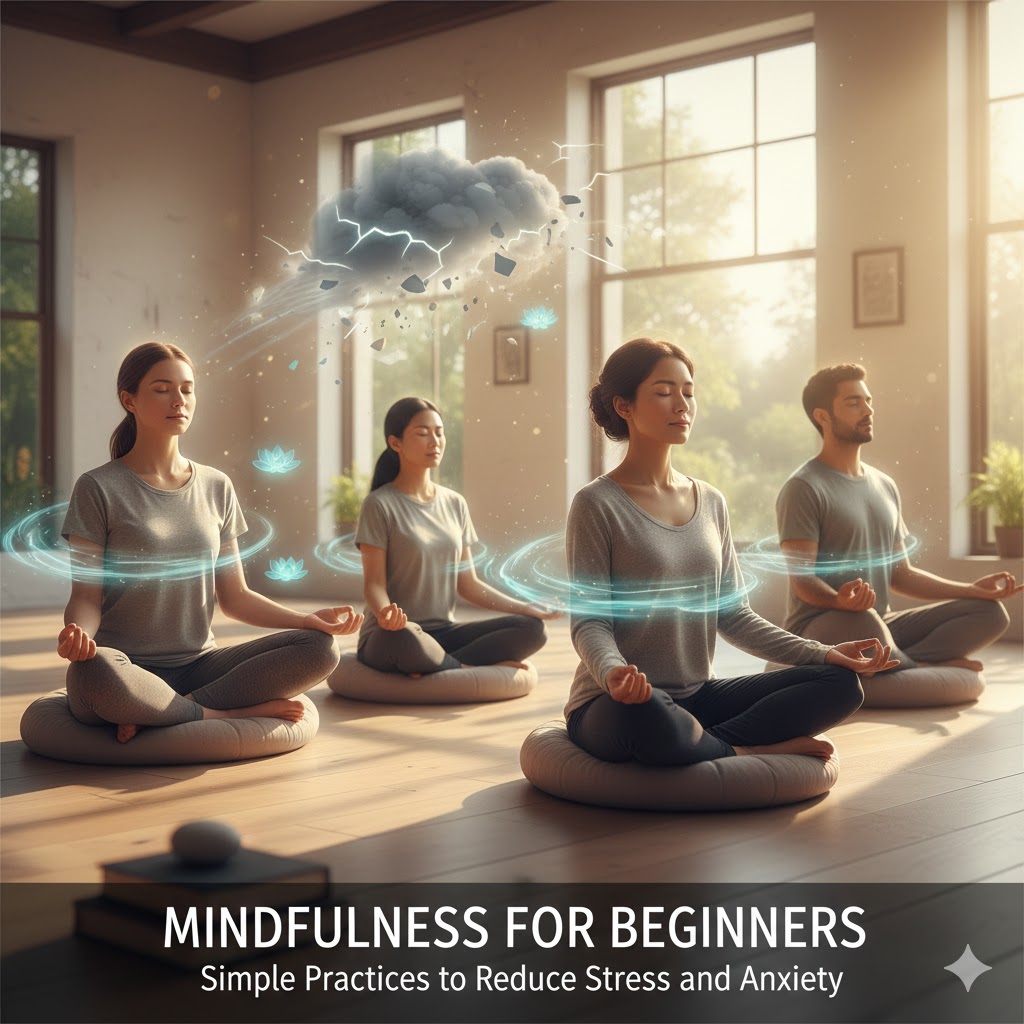

Your mind is rarely where you are. While eating breakfast, you’re mentally rehearsing today’s presentation. During a conversation with a friend, you’re thinking about your to-do list. Lying in bed, you’re replaying earlier conversations or worrying about tomorrow. You’re physically present but mentally elsewhere, missing moments of your actual life while consumed by thoughts about past and future.
This mental time travel is exhausting and fuels anxiety and stress. Mindfulness offers an alternative: learning to be fully present in this moment, right now, with acceptance and without judgment. While the concept is simple, the practice can profoundly transform your relationship with stress, anxiety, and life itself.
You don’t need to be spiritual, sit cross-legged for hours, or empty your mind completely to practice mindfulness. It’s accessible to anyone and can be integrated into daily life in small, practical ways. This guide introduces mindfulness for beginners, offering simple practices you can start today.
What Is Mindfulness?
Mindfulness is the practice of purposefully paying attention to the present moment with an attitude of openness, curiosity, and non-judgment. It’s about noticing what’s happening right now—in your body, mind, and surroundings—rather than being lost in thoughts about the past or future.
Key components:
Present-moment awareness: Focusing on what’s happening now rather than what happened or what might happen.
Non-judgmental observation: Noticing experiences without labeling them as good or bad, right or wrong.
Acceptance: Allowing experiences to be as they are rather than trying to change or resist them.
Beginner’s mind: Approaching each moment with fresh curiosity rather than assumptions based on past experience.
Mindfulness isn’t about achieving a particular state, forcing yourself to relax, or stopping all thoughts. It’s simply about paying attention differently.
The Science Behind Mindfulness
Research on mindfulness has expanded dramatically, showing measurable benefits:
Brain changes: Regular mindfulness practice is associated with increased gray matter in brain regions involved in learning, memory, emotional regulation, and perspective-taking. The amygdala (fear center) shows decreased activity.
Stress reduction: Mindfulness reduces levels of cortisol (stress hormone) and helps regulate the body’s stress response.
Anxiety and depression: Multiple studies show mindfulness-based interventions effectively reduce symptoms of anxiety and depression and prevent relapse.
Physical health: Benefits include lower blood pressure, improved immune function, better pain management, and improved sleep.
Attention and focus: Regular practice improves concentration, working memory, and ability to sustain attention.
Emotional regulation: Mindfulness helps people respond to emotions more skillfully rather than being overwhelmed or controlled by them.
Mindfulness vs. Meditation
Mindfulness is a quality of awareness—being present and attentive. You can be mindful while eating, walking, listening, or doing anything.
Meditation is a formal practice of training attention and awareness. Mindfulness meditation is one type of meditation (focused on present-moment awareness), but there are many others.
You can practice mindfulness without formal meditation, and you can meditate without necessarily being mindful. Ideally, formal meditation practice deepens your ability to be mindful throughout daily life.
Common Misconceptions
“I can’t meditate because my mind won’t stop thinking.”
Minds think—that’s what they do. Mindfulness isn’t about stopping thoughts but about changing your relationship with them. You learn to notice thoughts without getting caught up in them.
“Mindfulness is about relaxation.”
While mindfulness often reduces stress, relaxation isn’t the goal. The goal is awareness and acceptance of whatever is present, whether that’s calm or discomfort.
“I need to clear my mind completely.”
This is neither possible nor the point. Your mind will wander hundreds of times during practice. Each time you notice and gently return attention, you’re succeeding—not failing.
“Mindfulness is religious or spiritual.”
While mindfulness has roots in Buddhist meditation, modern mindfulness practices are secular and compatible with any belief system (or none).
“I don’t have time for mindfulness.”
Mindfulness can be practiced in moments throughout your day. Even 30 seconds of mindful breathing counts.
“Mindfulness means accepting everything and never taking action.”
Mindfulness doesn’t mean passive acceptance of harmful situations. It means seeing clearly what is, which actually enables more effective action.
Basic Mindfulness Practices
Mindful Breathing
The most fundamental practice. Your breath is always with you and anchors you to the present moment.
How to practice:
- Sit comfortably or lie down. You can also do this standing or walking.
- Close your eyes or soften your gaze downward.
- Bring attention to your breathing. Notice the sensation of air entering and leaving your nostrils, or your chest and belly rising and falling.
- You don’t need to change your breathing—just observe it as it is.
- When your mind wanders (and it will), gently notice where it went, then return attention to your breath.
- Continue for 1-10 minutes, or longer as you build practice.
Key point: Your mind will wander constantly. This is normal. The practice is noticing when it wanders and gently guiding it back. Each return is a success, not a failure.
Body Scan
Systematically bringing attention to different parts of your body, noticing sensations without trying to change them.
How to practice:
- Lie down or sit comfortably.
- Starting with your feet, bring attention to sensations there. Notice temperature, tingling, pressure, or tension. If you don’t feel anything, notice the absence of sensation.
- After 30 seconds to a minute, move attention up to your ankles, then calves, knees, thighs, progressively working up through your entire body.
- When your mind wanders, gently return to the body part you’re focusing on.
- Complete the practice with awareness of your whole body.
Duration: 10-30 minutes, though even 5 minutes is beneficial.
Benefits: Increases body awareness, releases tension, promotes relaxation, grounds you in present physical experience.
Mindful Walking
Bringing full attention to the experience of walking.
How to practice:
- Walk at a natural or slightly slower pace, somewhere you won’t be interrupted.
- Notice the sensations of walking: feet lifting and placing, weight shifting, movement through space, sounds, sights.
- You might focus particularly on the soles of your feet touching the ground with each step.
- When your mind wanders to thoughts, gently bring attention back to the physical sensations of walking.
Where: This can be practiced walking around your neighborhood, in a park, or even pacing in your home.
Benefits: Combines movement with mindfulness, accessible for people who find sitting meditation difficult.
Mindful Eating
Eating with full attention rather than while watching TV, reading, or thinking about other things.
How to practice (start with a single raisin, piece of chocolate, or small snack):
- Look at the food. Notice its colors, shapes, textures. Observe it as if you’ve never seen it before.
- Smell it. Notice the aroma.
- Place it in your mouth without chewing. Notice the sensation, taste, texture.
- Slowly chew, noticing how the taste and texture change.
- Swallow mindfully, noticing the sensation.
- Notice any urges to quickly move to the next bite.
Benefits: Enhances enjoyment of food, promotes healthier eating, breaks automatic eating patterns.
5-4-3-2-1 Grounding Technique
A quick mindfulness exercise particularly useful for anxiety or feeling overwhelmed.
How to practice:
Notice and name:
- 5 things you can see
- 4 things you can touch/feel
- 3 things you can hear
- 2 things you can smell
- 1 thing you can taste
This quickly brings you into the present moment and out of anxious thoughts.
Mindful Listening
Listening with full attention, without planning your response or judging what’s being said.
How to practice:
- When someone is speaking, give them your complete attention.
- Notice sounds—the tone, pace, volume—not just words.
- Notice when your mind wanders to forming your response, judging, or thinking about something else.
- Gently bring attention back to actively listening.
Benefits: Improves relationships, increases understanding, helps you feel more connected.
Integrating Mindfulness into Daily Life
You don’t need extra time for mindfulness—you can bring mindful awareness to activities you already do:
Morning routine: Brush teeth mindfully, noticing sensations, movements, tastes. Shower mindfully, feeling the water’s temperature and pressure.
Commuting: Whether in a car, taxi, or walking, notice your surroundings, sounds, physical sensations rather than being lost in thought.
Waiting: In queues, traffic, or waiting rooms, instead of scrolling your phone, take three mindful breaths or notice your surroundings.
Household tasks: Wash dishes, fold laundry, or clean mindfully, paying full attention to physical sensations and movements.
Transitions: Between activities, take one mindful breath to reset rather than rushing immediately to the next thing.
Before sleep: Instead of scrolling or worrying, practice a body scan or mindful breathing to transition into sleep.
Building a Regular Practice
Start Small
Begin with just 2-5 minutes daily. Consistency matters more than duration. You’re building a habit, and small sustainable practices grow over time.
Choose a Regular Time
Link mindfulness practice to an existing habit: after waking up, after breakfast, during lunch break, before bed. Consistent timing helps establish routine.
Create a Comfortable Space
While you can practice anywhere, having a designated comfortable spot helps, especially when beginning.
Use Guided Practices
Apps, YouTube videos, or audio recordings can guide you through practices when you’re learning.
Recommended apps (many have free versions):
- Headspace
- Calm
- Insight Timer
- Smiling Mind
Be Patient and Compassionate
You’ll have days when your mind is extremely busy or when practice feels difficult. This is normal. The practice is showing up, not achieving perfect calm.
Track Progress
Note briefly after practice how you’re feeling. Over weeks, patterns emerge showing the benefits.
Mindfulness for Specific Issues
Mindfulness for Anxiety
Notice anxious thoughts without engaging: When anxious thoughts arise, label them: “There’s an anxious thought.” Don’t argue with them or try to suppress them—just notice and return attention to your breath or present moment.
Anchor in the present: Anxiety pulls you into feared futures. Grounding practices bring you back to the present where you’re actually safe.
Observe physical anxiety: Notice where anxiety lives in your body—tight chest, racing heart, shallow breathing. Bring curious, accepting attention to these sensations rather than fighting them.
Mindfulness for Depression
Behavioral activation with awareness: Engage in activities mindfully rather than going through motions automatically.
Notice without believing: Depressive thoughts (“I’m worthless,” “Nothing will get better”) can be observed as mental events rather than truths.
Small moments of presence: Depression can make extensive practice overwhelming. Even 30 seconds of mindful breathing is valuable.
Mindfulness for Stress
Catch stress early: Regular body check-ins help you notice stress building before it becomes overwhelming.
Respond rather than react: Mindfulness creates space between stressful events and your response, allowing more skillful choices.
Acceptance reduces suffering: Resisting stress often intensifies it. Allowing it to be present paradoxically reduces suffering.
Mindfulness for Sleep
Bedtime body scan: Relaxes the body and quiets the mind before sleep.
Mindful breathing when awakening: If you wake during the night, use gentle breath focus rather than worrying about not sleeping.
Let go of sleep effort: Paradoxically, trying hard to sleep prevents it. Mindful acceptance reduces this pressure.
Mindfulness in the South African Context
Practical Applications
Commute stress: South Africa’s traffic and long commutes create significant stress. Mindful breathing in traffic (eyes open!) can transform this time from pure frustration to practice opportunity.
Safety awareness: Mindfulness enhances present-moment awareness, which can actually improve safety awareness while reducing excessive anxiety about potential threats.
Load shedding stress: When power cuts occur, mindfulness can help you respond skillfully rather than reacting with frustration or anxiety.
Economic stress: While mindfulness doesn’t solve financial problems, it helps you respond more effectively and reduces the additional suffering created by rumination and worry.
Cultural Integration
Ubuntu and mindfulness: The principle of interconnectedness in Ubuntu aligns well with mindfulness’s emphasis on awareness and compassion. Mindfulness can deepen your sense of connection with others.
Traditional practices: Many African cultures have contemplative traditions that share similarities with mindfulness. These can be honored and integrated.
Group practice: Collective mindfulness practice aligns with communal values. Consider practicing with family or community groups.
Accessibility
Free resources: Many mindfulness resources are freely available online—YouTube guided meditations, free apps, downloadable audio.
Nature practice: South Africa’s natural beauty provides wonderful settings for mindful walking or sitting practice.
Community spaces: Parks, botanical gardens, nature reserves offer places for mindfulness practice.
Common Challenges and Solutions
“My mind is too busy/I can’t concentrate.”
This is the most common challenge and actually proves you’re doing it right—you’re noticing your busy mind! The practice isn’t about having a quiet mind but about noticing when it’s busy and gently redirecting attention.
“I fall asleep during practice.”
Try practicing at different times of day, sitting rather than lying down, or opening your eyes slightly. Some sleepiness is normal—be gentle with yourself.
“I don’t have time.”
One mindful breath takes 5 seconds. Start incredibly small. Five minutes daily is more valuable than 30 minutes once weekly.
“Nothing is happening/I don’t feel different.”
Benefits accumulate gradually. Keep a brief journal noting how you feel. Changes become visible over weeks.
“I’m too stressed to be mindful.”
Mindfulness isn’t about being calm enough to practice—it’s about bringing attention to whatever’s present, including stress.
“This feels selfish with everything else I need to do.”
Taking care of your mental health enables you to better care for others. It’s like putting on your own oxygen mask first.
When Mindfulness Isn’t Enough
While powerful, mindfulness isn’t a cure-all:
- Professional help needed: For moderate to severe anxiety, depression, trauma, or other mental health conditions, mindfulness should complement—not replace—professional treatment.
- Medication may still be necessary: Mindfulness doesn’t replace needed medication.
- Difficult experiences: Sometimes mindfulness practice brings up difficult emotions or memories. Support from a therapist can be important.
- Structural problems: Mindfulness helps you respond skillfully to difficulties but doesn’t eliminate injustice, poverty, or systemic problems requiring action and change.
Moving Forward
Mindfulness is a skill developed through practice, like learning an instrument or language. You wouldn’t expect to play piano beautifully after one week—the same applies to mindfulness. Be patient with yourself.
The practice is simple but not always easy. Your mind will wander hundreds of times. You’ll forget to practice. You’ll have difficult sessions. This is all normal and part of the process.
Start today, right now. Take three mindful breaths. Notice the sensation of breathing in and out. When your mind wanders, gently bring it back. Those three breaths are your practice—and they count.
With consistency, you’ll gradually notice changes: more able to be present, less caught up in worry and rumination, more responsive and less reactive, more accepting of what is, and more appreciative of simple moments. These shifts transform your relationship with stress, anxiety, and life itself.
The present moment is the only one where life actually happens. Mindfulness helps you inhabit it more fully.
For more resources:
- Free guided meditations: YouTube, Insight Timer (free app)
- Mindfulness-Based Stress Reduction (MBSR) courses: Check local wellness centers, psychologists
- Books: “Wherever You Go, There You Are” by Jon Kabat-Zinn, “The Mindful Way Through Depression” by Williams, Teasdale, Segal, and Kabat-Zinn
Start small, be consistent, and be kind to yourself in the process.



Leave a Comment